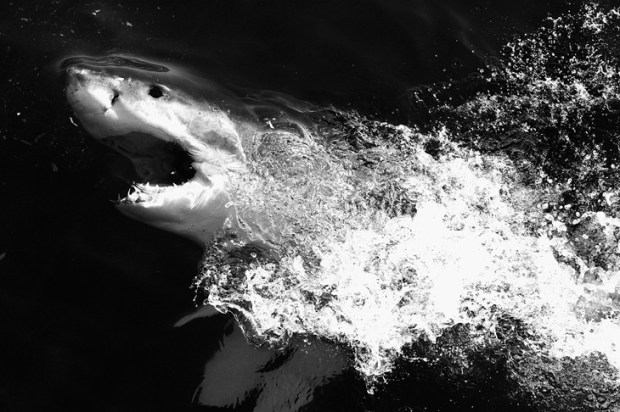
The debate surrounding the use of shark nets in New South Wales provides a real-world example of a Carnivalesque inversion of hierarchies.
The concept, developed by Mikhail Bakhtin, involves the suspension and reversal of established social, moral, and political hierarchies. In the context of shark attacks, the official hierarchy is the traditional view that human safety is paramount.
According to this tradition, the Shark Meshing Program (SMP) is justified by the sanctity of human life, the state’s responsibility for public safety, and the belief that dangerous sharks are expendable. This official hierarchy is inverted by shark conservationists, whose rhetoric can be likened to the antics of a carnival crowd.
Charged with emotion, activists insist that mankind is the real monster, and that sharks are the actual victims, along with other innocent sea creatures caught in shark nets.
This inversion of the official doctrine is reminiscent of the Carnivalistic crowning and de-crowning of a King; an age-old ritual that evokes a profound sense of liberation from authority figures.
Bakhtin explains that the crowning and de-crowning ritual expresses the joyful relativity of all authority, and the creative power of renewal.
However, shark attacks are not playacting.
The personal gratification gained through de-crowning mankind comes at enormous cost to shark attack victims and their families. These are real people, not actors performing a ritual. Carnivals allow people to let off steam from time to time. It is a joyous recalibration of the human spirit. The tragic deaths and permanent injuries caused by shark attacks completely undermine the Carnivalesque sentiment of renewal.
As Nietzsche warned, ‘Whoever fights monsters should see to it that in the process he does not become a monster.’
The Carnivalesque inversion of hierarchies has popular appeal. However, the arguments are not especially sound.
Recreation is not a frivolous activity. Surfing culture necessarily overlaps with the ‘shark’s domain’; a loaded expression that subordinates the surfing lifestyle to the political aspirations of the environmental movement. Shark nets do not threaten the population of sharks, or the stability of marine ecosystems. The number of sharks and the quantity of bycatch is insignificant compared to commercial fishing.
Of course, it is distressing to see innocent creatures caught in shark nets. However, shark attacks are deeply traumatic events that not only impact victims, but also their friends and loved ones, first responders, bystanders, and the broader community. It is just too high a price to pay for the vain satisfaction of siding with nature against mankind.
Unfortunately, non-lethal shark mitigation measures are inadequate, despite all the hype.
The government knows that the ‘dual objective’ of protecting people and sharks is fanciful. However, they are afraid of upsetting the mob, who are holding everyone to ransom, by shaming, ridiculing, and haranguing anyone who deviates from their emotion-driven agenda. Since sharks can get around the nets, the SMP is denounced as ineffective, and ridiculed for providing a false sense of security. However, this is a straw man argument, since the purpose of shark nets is to alter shark behaviour, so that they avoid the area. Although sharks can get around the nets, there are fewer sharks in the area, which means fewer shark attacks.
The misinformation campaign is relentless. In a public hearing of the New South Wales Legislative Council, it is my view that the conclusion of a study was misrepresented by erroneously claiming that shark nets do not work. Although the study found no difference between the rate of shark encounters at netted beaches compared to non-netted beaches, the authors did not therefore conclude that shark nets do not work.
The study by Huveneers et al (2024) ‘compared the number of interactions at 51 beaches with and 78 beaches without Shark Meshing Program nets in the Metro region’ and could not ‘detect statistical differences in the number of interactions over 22 years since 2000 at netted versus non-netted beaches’. Of course, this seems to imply that shark nets do not work. However, the study considers five alternative explanations for the finding:
‘This could be due to: (1) the purposeful deployment of mitigation measures at popular and frequently visited beaches, (2) sharks being naturally more abundant and spending more time at mitigated beaches, (3) the nets not reducing local shark populations sufficiently to decrease interactions beyond natural variation, (4) the nets reducing shark populations across the entire region such that the medium-to-long-term mitigation is similar across all beaches, rather than mitigated beaches only; and/or (5) the rise in patrolled beaches increasing protection for swimmers. Irrespective of whether shark nets mitigate shark bites, there are likely many components influencing the probability of an interaction at any beach.’
The study does question the suitability of shark nets; however, this is discussed without reference to their efficacy in shark-bite mitigation:
‘With a societal shift to support non-lethal over lethal measures … local councils requesting that non-lethal measures be used to replace nets … the increasing availability of non-lethal measures … and high bycatch rates of non-target and threatened species … reconsidering the purpose and effectiveness of the nets, and shark-bite mitigation in general, is warranted.’
Unfortunately, the Minister failed to respond with evidence supporting the efficacy of shark nets, despite the relevant source being mentioned in the same study:
‘Dudley (1997) analysed shark-bite rates up to 1995 in the three areas of the world where shark nets have been deployed (Queensland, New South Wales, South Africa). He concluded that the annual number of shark bites in New South Wales within the region of the beach-meshing program decreased by ~90 per cent after the nets were deployed (0.35 year 1 from 1900 to 1937 to 0.04 year 1 from 1937 to 1997).’
Curiously, the authors appear to doubt the validity of the massive decline in shark attacks after shark nets were deployed, adding:
‘However, since 2000, there have been periods of more interactions at netted beaches than non-netted ones.’
So, it is not surprising that an environmental activist would cite Huveneers et al (2024). However, item (4) above undermines the whole rationale for comparing beaches within the same region. The study ought to have compared regions, instead of beaches. Shark attacks are much more prevalent in the non-netted regions of the Northern Rivers and Mid-north Coast than in the neighbouring regions to the north and south where nets are deployed.
The abundance of sharks in each region is revealed in the following graph, which depicts the number of sharks caught on SMART drumlines across twenty locations, from Kingscliff in the north to Merimbula in the south. Since far fewer sharks are caught in the netted regions between Newcastle and Wollongong, there must be far fewer sharks in those regions.

The Carnivalesque inversion of hierarchies is supremely anti-human. Some environmentalists openly celebrate fatal shark attacks as nature fighting back against mankind.
A Facebook post decrying the decision to cull sharks in Western Australia elicited a storm of condemnation, including four comments suggesting that fatal shark attacks are; ‘nature’s way of culling too many humans on this planet’; ‘because it’s nature’s will’; that ‘nature will regulate both sharks and people’; and it’s just ‘nature getting its own back after all the destruction we have done to this world’.
The radical ecology movement, Earth First!, promotes this fanciful idea, which is ironic, since it imitates the vengeful God of the Old Testament. Apparently, environmentalists achieve salvation through sustainability, even when the cost is imposed on others!
Please sign the petition to extend shark nets north of Newcastle and south of Wollongong. If we reach 500 signatures, the minister is required to provide a formal response.