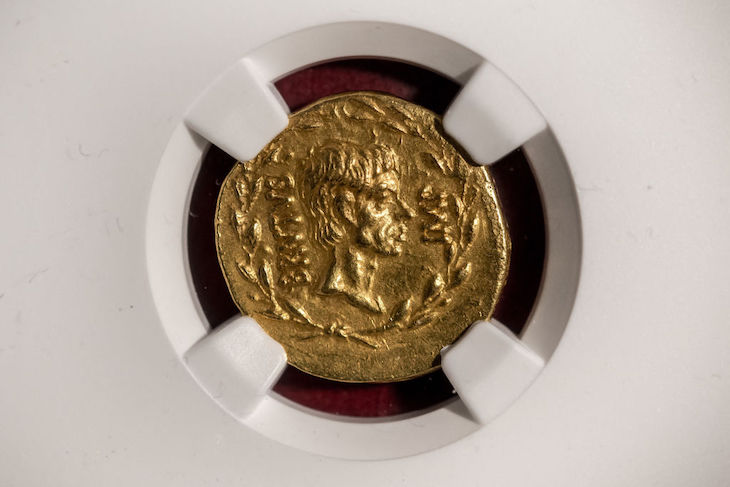
Today’s tech billionaires, property tycoons and hedge-fund titans have nothing on the ancient Romans. Julius Caesar, who plundered Gaul for both gold and slaves – at one point selling 53,000 captives from a single tribe – had a fortune valued at $5.4 trillion (£4.1 trillion). His wealth was on a scale that makes today’s billionaires look modest. Caesar’s riches were so great that he was worth more than Elon Musk, Jeff Bezos, Larry Page and Larry Ellison combined. His fortune was inherited by his great-nephew, Octavian, who, as Augustus, added to the family pot: by seizing Egypt he became, arguably, the richest man of all time.
Even the sternest Roman sermonisers never could have imagined our range of indulgences and luxuries
The Caesars weren’t alone among the Roman elite. The wealth of Marcus Crassus, who owned large chunks of Rome, has been estimated at the equivalent of more than $200 billion (£150 billion). He built his fortune by snapping up at knock-down prices the real estate of his murdered political opponents.
These Roman riches – and the decadence and debauchery that they enabled – are blamed by some historians for bringing about the decline and fall of the empire. So, in our world of riches and relentless capitalist consumption, are we failing to learn an important lesson from the ancient Romans?
Like us, the Romans held ambivalent attitudes towards wealth. A personal fortune was necessary to forge a successful political career. To qualify for and remain in office, senators needed to maintain a minimum wealth of one million sesterces – the equivalent of at least £2 million today. An aspiring politician was obliged to open his purse to fund temples and aqueducts as well as crowd-pleasing delights in the amphitheatre. Julius Caesar curried favour with voters by funding repairs to Via Appia, the crucial Roman road, and in 65 BC he sponsored battles between 320 pairs of gladiators. This public generosity was simply the price of staying in office in a city where bread and circuses counted for more than political pledges.
However necessary for a political career, money was, for many Roman moralists and historians, the root of all political evil, in particular because it enabled luxuria (excess and extravagance). The relentless competition for honour and status in Rome was played out, in part, through personal possessions. Conspicuous consumption involved sumptuous palaces and gardens, banquets featuring roast ostrich and sautéed flamingo tongues, and what became known as mensarum insania (table madness) – a craze for dining tables carved out of African citrus wood. Cicero paid a million sesterces for one. Julius Caesar, meanwhile, shelled out six million sesterces for a single pearl. He gave it to his mistress, the mother of – such was the irony of fate – Marcus Brutus.
For historians such as Sallust and Livy, the consumerist rot set in during the first half of the 2nd century BC, when the massive loot from successful conquests in Greece and Asia introduced Romans to such opulent wares as tapestries, silver salvers and bronze couches. These new consumer goods were blamed for undermining the mos maoirum (the ‘way of the ancestors’) – the unwritten code of social norms, values and traditional practices that governed Roman behaviour and were exemplified by the frugal and self-disciplined citizen-farmer of yore, content with his humble cottage and a draught of sour wine after a day behind the plough. For the historian Sallust, a ‘lust for money’ destroyed this honour and integrity, replacing it with insolence, cruelty and a desire ‘to set a price on everything’. Out went the homespun virtues of parsimonia and frugalitas. In came the ‘foreign’ vices of greed, debauchery and vulgar ostentation.
The Romans were not wrong to fear what wealth and consumerism could do to a society. If avaritia and luxuria explained for Livy and others how Rome lost its moral foundations, there are sharp lessons for us today. Just as themos maoirum fell victim to marble-lined fish ponds and ivory chamberpots, our own democracy needs to safeguard its modern equivalents: social trust, civic participation, shared norms, and the humdrum willingness to volunteer, vote and care about something beyond ourselves.
Modern social science has vindicated the Roman moralists. Hundreds of peer-reviewed studies quantify exactly how wealth and materialism corrode the social capital and community bonds that democracies require to survive. The philosopher Kate Soper argues that our hedonistic materialism means that life’s simple pleasures, such as hobbies and time with friends, have been downgraded or shunted aside. Instead we busy ourselves comparing sleep-tracker rings and agonising over which £300 ‘wellness’ water bottle best expresses our personal brand. The consequences for society of this self-absorbed consumerism are chastening. Robert Putnam has argued, in Bowling Alone, that consumer culture creates a lifestyle structurally incompatible with democratic citizenship – one in which virtually all measures of social engagement, including voter turnout and attendance at public meetings, has drastically declined.
When consumption becomes the closest thing we have to a shared religion, the public sphere shrivels. Trust collapses, the social contract expires, and politics becomes a blood sport in which outrage replaces argument. It is a pattern that the Romans – who watched their society trade common purpose for comfort and display – knew all too well. But even the sternest Roman sermonisers never could have imagined our range of indulgences. And if luxuries helped sink the greatest republic of antiquity, it’s worth contemplating how many self-warming smart mugs and diamond-encrusted dog prams a modern society can survive.