The path that links the Spice Girls to Jeffrey Dahmer – necrophile mass murderer of at least 17 men – is a circuitous and unusual one. It involves the establishment of Mothercare and Harold Wilson’s Chancellor of the Duchy of Lancaster and the New York underground of the early 1980s. The thread that joins the ends is a 76-year-old Ohioan called Chris Butler.
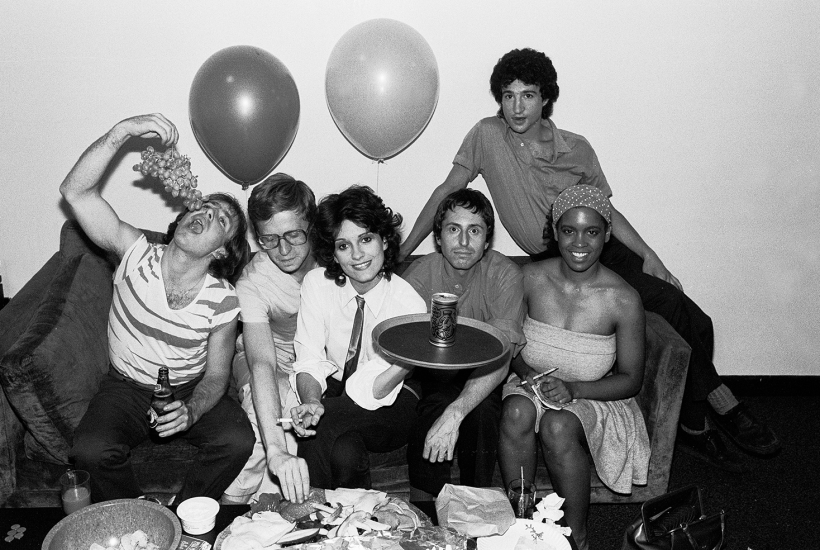
Butler was part of that art underground in 1981. He was – and is – a musician. Back home in Akron he’d started several bands – the wonderful art rock group 15-60-75 (aka the Numbers Band), and Tin Huey – and he’d brought the newest of them, the Waitresses, to New York. They were signed to ZE Records, an extraordinarily hip label run by a Frenchman, Michel Esteban, and an Englishman, Michael Zilkha. Zilkha had both money and ambition as a result of his upbringing (his father had established Mothercare, and when his mother remarried, it was to Harold Wilson’s consigliere, the future Lord Lever of Manchester).
Zilkha decamped to New York in his early twenties, where, in 1978, he cofounded ZE. But by 1981 the money had run out. He needed something to lift ZE’s status as a label and re-establish its identity.
In the stifling heat of summer in New York, Zilkha had an idea. ZE would mark Christmas 1981 with a compilation album made up of the label’s artists singing Christmas songs of their own choosing. It was a dandy idea, but for the fact that ZE’s roster was pretty much the opposite of festive: synth-confrontationalists Suicide, with their long, droning songs about murder; the skronky no-wavers James White and the Blacks, and Lydia Lunch. So when A Christmas Record came out later that year, the Waitresses’ contribution, ‘Christmas Wrapping’, rather stood out. It wasn’t just tuneful and festive, it was brilliant: catchy and danceable and witty.
‘Christmas Wrapping’ has become one of the constants of Christmas. But chances are that, unlike Slade, Mariah and Wham!, you will know next to nothing about its maker, because ‘Christmas Wrapping’ was really Butler’s only brush with immortality.
‘But I’m sitting in the house the Spice Girls bought. Thank you! Thank you! That saved my ass.’
Butler had been less than delighted when Zilkha had commanded him to write it. Butler didn’t like Christmas. ‘My upbringing in general was horrible, Dickensian,’ he told me when I spoke to him for a book I’m writing about Christmas songs. ‘Christmas was a disaster, usually. We were not a warm, loving family, so a kind of dread polluted my attitude to Christmas, which is why “Christmas Wrapping” is such a sour, sour song.’
‘Christmas Wrapping’ was indeed a sour song for much of its length. Though it popped musically, very much sounding like the New York of Talking Heads and Tom Tom Club – all lithe disco bassline and stabbing horns – it was like a hard-bitten old movie in its plot. Much of the song consists of the singer Patty Donahue lamenting her failures with the object of her affections, pausing only for the chorus: ‘Merry Christmas, but I think I’ll miss this one this year.’ Christmas Eve and she’s forgotten the cranberries for the ‘world’s smallest turkey’. She heads to the shops and bumps into… you guessed it.
‘Christmas Wrapping’ became a big hit on New York radio that December, though not in the actual charts (it was a minor UK hit the following year), and it became the better known of the two songs the Waitresses might be remembered for (‘I Know What Boys Like’ is the other one; stream it: you won’t forget it). Not that it made Butler rich. When the Waitresses didn’t break through, he returned to playing the bars and clubs of Akron, sleeping in rentals and generally not living the life of a rock star.
Then, around 1997, Butler started noticing the song popping up on TV shows and commercials. ‘We’re not talking millions of bucks, but that was useful.’ And then in 1998 the Spice Girls covered it for the B-side of ‘Goodbye’. That single – in the days of physical sales – was a top ten hit in 18 countries, and number 11 in America. It sold 380,000 copies in its first week. It was a lot of money, and as songwriter of its B-side, Butler was entitled to a good chunk of it.
‘It’s not a very good version,’ Butler admits. ‘But I’m sitting in the house the Spice Girls bought. Thank you! Thank you! That saved my ass. I flew to London, to the Virgin offices, and gave champagne and flowers to the A&R woman [who chose the song for the Spice Girls]. I don’t think she’d had an artist do that before. That song reprogrammed the Scrooge out of me; I got the Christmas miracle.’
And that’s where Jeffrey Dahmer comes in. In the early years of this century, driving around Akron, Butler came across a modest mid-century modern house that seemed very competitively priced – within his post-Spice Girls price range. He called the agent, and went for a tour. ‘They were sharp. They let me fall in love with it. And then the agent called and said, “In the interests of full disclosure, that’s the Dahmer childhood residency”’ – where he murdered his first victim – ‘“I hope that doesn’t affect the sale.” And I was stunned. But then I thought, I’ve got to do this. Jimmy Page had Aleister Crowley’s house, Trent Reznor had the Sharon Tate mansion, and I’ve got this.’
Every now and then, he hears ‘Christmas Wrapping’ when he’s out shopping. ‘It’s almost like I paid it forward to myself. A reminder to get into the Christmas spirit. And on FM radio in a car it sounds glorious, with all the EQ and the compression. It’s really something. It really is enough for you to go, “God, that’s good.”’
Got something to add? Join the discussion and comment below.
You might disagree with half of it, but you’ll enjoy reading all of it. Try your first month for free, then just $2 a week for the remainder of your first year.