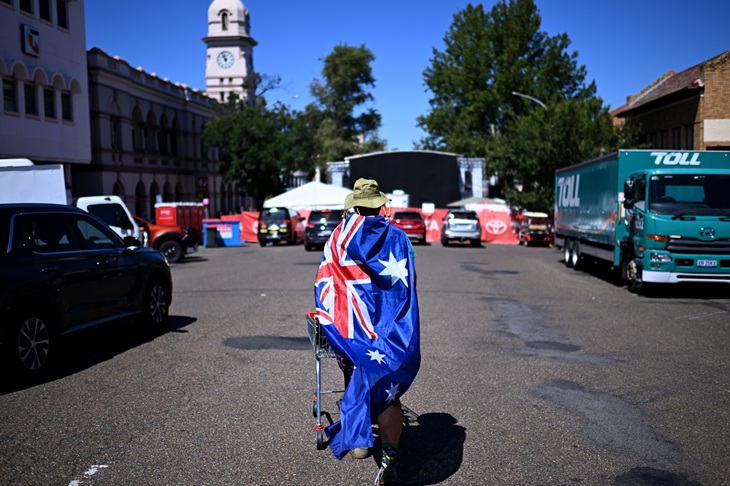
Walk into any supermarket in Australia and you’ll find the country’s mood on full display. Not in the specials bin or the bakery aisle, but in front of the cereal wall. A vast, shimmering landscape of muesli, protein puffs, low-GI loops, and sugar-coated virtue. If you earn a respectable income but still hover in front of a $7 box thinking, ‘Maybe not this week…’ then welcome: you are part of the middle class that no longer feels like the middle.
You’re not poor. You’re not secure. You’re suspended in a narrowing space between the two. A space that used to anchor stable democracies. Today, it’s becoming a pressure chamber.
For years, politicians obsessed over trickle-down economics – the idea that wealth at the top eventually spills to the rest. But that debate misses the real inversion happening now. The defining political force of our time isn’t wealth trickling down. It’s reassurance trickling down. Not money, but mood. Not opportunity, but sedation.
Call it what it is: trickle-down government.
It’s the quiet drift from helping citizens stand on their feet to managing their nerves. From empowering to pacifying. From ‘have a go’ to ‘don’t worry, we’ve got this … sort of.’
And nowhere is this dynamic sharper than in the modern middle class: the group every political party claims to champion yet increasingly treats like fragile stock whose confidence must be constantly propped up.
You can chart this shift across every Western democracy like a weather pattern.
In Australia, median earners hover nervously at the supermarket while house prices float at historic multiples of income. In the United States, 43 million young adults are trapped in student debt purgatory, waiting for the next presidential announcement to decide whether they can plan their lives. In the UK, frozen tax thresholds quietly push average workers into higher brackets without anyone voting for it.
A generation ago, these pressures would have produced unrest. Today, they produce something stranger: passivity.
That’s because governments have discovered that the middle class – anxious, aspirational, politically vital – can be managed more effectively with mood management than structural change.
So, instead of fixing housing, they offer grants that inflate prices further. Instead of reforming a tax system that punishes movement, they send offsets. Instead of tackling collapsing hospitals, they announce mental health ‘initiatives’ and colourful wellbeing campaigns.
It’s governance by Panadol. Pain relief instead of treatment. Press releases instead of reform.
None of this empowers the middle. It manages it.
The polite academic term for this is soft paternalism. Cass Sunstein and Richard Thaler call it ‘nudging’: designing the environment so that people make the ‘right’ choices, without technically removing their freedom.
But nudging has a dangerous side effect, especially when adopted by governments already inclined to centralise. It can slip from guidance into conditioning. A population that is constantly ‘nudged’ begins to internalise the idea that the state knows best. Expectations shift. Agency erodes.
You saw the acceleration of this during the pandemic. Programs designed for 12 weeks lasted for years. Freezes on debt repayments created entire cohorts who learned to wait for a government announcement before making a financial decision.
Welfare categories ballooned. Responsibility narrowed.
None of this was malicious. But it was consequential.
Whole societies developed the psychological equivalent of muscle memory: the instinct to wait, not act. To look upward, not outward. To see government intervention not as exceptional but expected.
Soft paternalism became soft dependency. And soft dependency, as Sir Niall Ferguson warns via Huxley, becomes a subtle form of control. Not coercive. Not Orwellian. More … therapeutic.
Governments discovered that if you soothe the middle class just enough, they won’t ask for serious reform. They’ll tolerate dysfunction as long as they receive the occasional rebate, top-up, subsidy or threshold freeze.
The great shift of the early 21st Century is this: the middle class no longer expects to advance; it hopes simply not to slip.
That psychological transition is political gold.
Everywhere you look, governments are increasingly in the business of managing vibes.
In place of real school reform, we get free zoo tickets. A policy gesture perfectly calibrated for social media, not student outcomes. In place of hospital beds and emergency capacity, we get state-sponsored swimming lessons. A summer giveaway sold as public health, because it’s easier to market than confronting systemic failure.
This is the pattern everywhere: not structural fixes, but mood management.
Taxation pain is managed not with reform but with frozen thresholds, letting inflation quietly do the heavy lifting while politicians pretend to be friends of the worker.
These are not solutions. They are distractions. They change the vibe, not the reality.
And they work – until they don’t.
The real damage isn’t economic. It’s cultural.
A society that is always cushioned becomes brittle. A middle class constantly protected from bumps and shocks begins to fear risk more than stagnation. It becomes fragile, or as Jonathan Haidt might say, anti-anti-fragile: unable to grow through adversity because it never encounters any.
Young people delay adulthood. Families become cautious. Citizens turn inward. Ambition shrinks. The desire to contribute is replaced by the fear of losing what little stability remains.
And governments respond not by reversing the trend, but by deepening it – more rebates, more offsets, more gestures. Sedation as stability. Comfort as control.
This is the emotional architecture of trickle-down government.
The antidote is not austerity. And it certainly isn’t cruelty. It’s something older and sturdier: responsibility.
A society thrives when citizens believe they can shape their own destinies. When families have room to raise strong children. When communities carry each other. When adults are treated as capable, not fragile.
The middle class does not need to be pacified. It needs to be trusted.
We don’t need smaller government. We need better boundaries – a state that solves real problems, not moods. A politics that builds capability, not complacency. A culture that values resilience over sedation.
The quiet battle of our time is not between left and right, or rich and poor. It’s between citizenship and sedation.
Between governing with people and governing at them.
Between a country that remembers what made it strong – and one that slowly forgets.
And if we want the middle class to stand tall again, we have to stop managing it and start liberating it.