If the Liberal party is truly going to unite around the values it was built upon, there is only one answer to the net zero question: it is il-Liberal and has to go.
A contest over the future of net zero has been going on inside the Liberal party in recent weeks. Representing one side, Andrew Hastie grabbed headlines when he quit the front bench so he could speak out against net zero, which he described as a ‘straitjacket for our economy’. Representing the other side, another Andrew (Bragg) said that, ‘We can make net zero work better for Australia than Labor has done.’
Fearing a split, some senior figures are trying to broker a peace by uniting the party around shared values. Angus Taylor said he thought the Liberal party ‘can get through this if we keep faith with our core values and traditions’. This followed Senator James Paterson stating that there ‘is nothing fundamentally defective with our values’.
But what are these values and traditions? Taylor says it is the blending of classical liberalism and conservatism that has served the party well in the past. ‘The answer,’ he said, ‘[is] to champion freedom and enterprise while defending family, community and national strength.’
The problem is that a policy of net zero is entirely incompatible with those values and that tradition. Net zero is an illiberal policy.
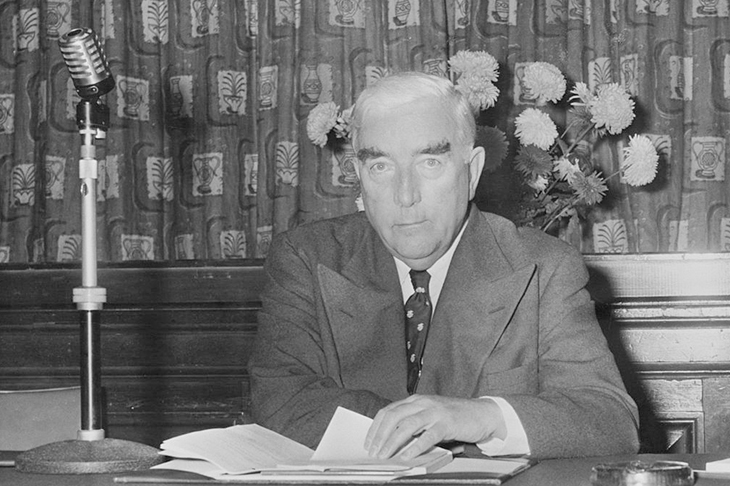
In his 1949 policy speech ahead of that year’s federal election, Robert Menzies warned: ‘You cannot have a controlled economy without controlling human beings, who are still the greatest of all economic factors.’ If ‘the party of Menzies’ means anything, it means putting faith in human agency and freedom above faith in centralised government and technocratic planners.
Australia’s political class has for too long failed to properly discuss the profound nature of the policy of net zero. It doesn’t just mean changing our electricity generation from coal-fired power to solar panels and windmills. It means changing every single component of our lives – from the food we eat to the cars we drive; from the homes we live in to how and where we can visit family members or take a holiday.
Opposing net zero is the only option open to those who believe in liberalism because it can only be achieved through a massive expansion of the state, ever-growing interference of bureaucrats in the economy and in our lives, and the deployment of legislation and regulation to control every aspect of production.
Returning to Menzies’ 1949 speech, he said that the election was a choice between ‘the Socialist State, with its subordination of the individual to the universal officialdom of government’ and ‘the ancient British faith that Governments are the servants of the people’. A future under a planned economy, like the planned economy required for net zero, would be bleak, and doomed to failure, ‘for unless people do what they are told, work where they are told to work, learn what they are drafted to learn; in a sentence, fit obediently into their appointed place, the Socialist “planned State” falls to pieces like the false and shoddy thing it is’. It may serve members of the Liberal party well to read this speech to understand the values and traditions their party was formed upon. Menzies won in 1949, and the Liberals won the next eight elections as well, governing for 23 years.
The only argument that pro-net zero Liberals have is that the policy is popular with the Australian people, and that they should follow their voters. To them, one might point out that the Voice to parliament referendum reportedly had over 70 per cent support until it was publicly debated. Then polled support levels tanked, and Australians ultimately delivered a 60-per-cent vote against it. The Voice was apparently incredibly popular, right up until it wasn’t.
The lesson should be applied to net zero. If support for net zero was, say, 70 per cent, then it is more likely to come down than to go up from there. As evidence of the costs of net zero mount, as we lose even more of our manufacturing capabilities, our mining investment, and the jobs that go with them, support will collapse. If there were a proper public debate, led by a confident political party which grounded its opposition in a commitment to values and a tradition that had served it so well in the past, then the moment when there is majority opposition to net zero would not be far away.
Besides, support for net zero is already incredibly soft, it’s just that Australian voters have never been given the opportunity to vote on the issue because it has been a bipartisan position for the past two elections (both of which the Liberal-National Coalition lost).
The highly respected Lowy Institute Poll 2025 Report found that while 38 per cent of Australians thought the economy would be better off under net zero, 36 per cent said it would be worse off. With a slight margin for error, this is profound: there are effectively two equally sized constituencies that have opposing views on whether net zero is a good policy to pursue. Those opposed are effectively politically homeless while the Liberal party retains its support for net zero.
There has emerged an element of the Liberal party that would like to retain net zero and Australia’s ‘obligations’ under international agreements, but apparently just not tell the Australian people about it. They are acting like a controlled opposition, rather than the opposition.
Napoleon Bonaparte is said to have told his generals that ‘when the enemy is making a false movement we must take good care not to interrupt him’. If the Liberal party dropping net zero would be so electorally poisonous as to make them unelectable, then why is it that their opponents are doing all they can to interrupt them?
Got something to add? Join the discussion and comment below.
Cian Hussey is a Research Fellow at the Institute of Public Affairs and writes No Permanent Solutions on Substack.
You might disagree with half of it, but you’ll enjoy reading all of it. Try your first month for free, then just $2 a week for the remainder of your first year.