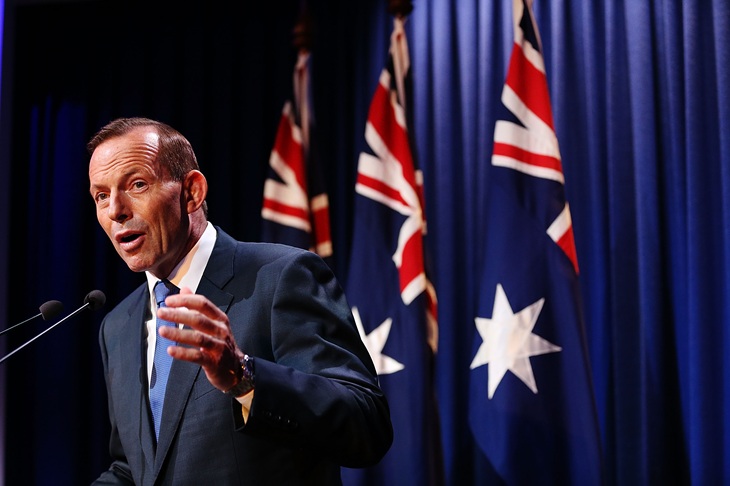
When Tony Abbott’s Australia: A History – How an ancient land became a great democracy, hit shelves on October 13, courtesy of HarperCollins, it sold out in most mainstream bookshops within a matter of hours.
Abbott’s book, which I have dutifully read within 24 hours of its release, has done far more than recount our past. It offers a roadmap – a political and moral compass – for a country that has lost confidence in its own story…
It's been a mammoth project telling the story of Australia but I'm excited this single-volume history will be available in bookstores in mid-October.
Link, for anyone wishing to pre-order: https://t.co/BwKkVMZMYg pic.twitter.com/J71oFd9dcg
— Tony Abbott (@HonTonyAbbott) September 3, 2025
As Australia wrestles with declining birth rates, hollowed-out institutions, and a culture obsessed with ‘apology’, Abbott’s latest work is not a lament, but a reclamation. It’s a reminder that ours is not a nation built on grievance but on grit, grace, and the capacity for renewal.
Historian Geoffrey Blainey captures it well on HarperCollins’ site: ‘Tony Abbott should be congratulated … this history of Australia is vivid, readable, provocative.’
Indeed, this is a book that refuses to pander to the academic revisionists who see only oppression in our past. Australia was a nation that has ebbed and flowed economically and has gone through enormous shifts within under two and half centuries.
Abbott – Rhodes Scholar, former Prime Minister, and lifelong conservative warrior – brings both intellectual weight and lived experience to the task. His conservative politics were forged early: from his education at St Ignatius’ Riverview, where the moral seriousness of faith met a sense of duty, to his days at the University of Sydney, where he studied economics and law while absorbing the Liberal tradition that built the West. Later, as a journalist, policy adviser, and politician, he learned that the soul of a nation can wither if its people forget who they are.
In Australia: A History, Abbott traces the unlikely rise of a penal colony into a prosperous democracy. But this isn’t mere nostalgia. His account insists that Australia’s foundations – rule of law, fair play, and respect for ordered liberty – remain the best defence against the ideological drift consuming Western democracies, and sending it backwards. Abbott explores milestones such as the invention of the secret ballot, the pioneering of women’s suffrage, and the emergence of egalitarian institutions that have become hallmarks of the Australian story. The book also explores Australia’s involvement in foreign conflicts, as well as recounts the Japanese bombing of Darwin. It also documents Australia’s harrowing loss of life when we were unprepared for conflict or were met with unexpected force.
Former Deputy Prime Minister John Anderson calls the book ‘a powerful antidote to the poison of little and bad history … we have much to be thankful for and to build on.’
That sense of gratitude, rather than grievance, is what Abbott seeks to restore in an otherwise declining national psyche. In a political age defined by cynicism, Abbott’s voice stands apart – not because he is naïve about our faults, but because he understands that the West’s survival depends on the preservation of truth, heritage, and faith in the democratic process. Australia was also built through plain hard work and resilience, particularly in troubling times – even women worked to support the economy and British officials purposefully sent in citizens with particular skills, to bolster the rapidly growing nation. It soon became populated with more valuable skills rather than ‘convict personalities’ alone.
The book is written for Abbott’s grandchildren, and the ‘new generation’, which indicates a forward-thinking approach to securing Australia’s future. For young Australians, this book will read as both education and exhortation – a call to greater civic involvement. At a time when many feel alienated from politics – caught between climate anxiety, identity politics, and cultural nihilism – Abbott offers a narrative that is both grounding and galvanising. He paints a refreshingly clear picture regarding the benefits of migration in Australia’s past, however cautions us in ‘overdoing it’ and inviting in illegal immigrants or those unsuitable.
Abbott presents history not as a museum artefact but as a living inheritance.
His message is clear: Australia’s best days are not behind us, but they will only return if we once again honour who we are. To enliven dampened spirits, the middle of the book contains a beautifully collated visual collage, invoking a sense of nostalgia, touching on Olympic icons, famous landmarks in the midst of construction, and other vestiges of the past – it shows young Australians what transpired precisely so we can forge ahead in troubled times…
The book also gestures toward the direction of the Liberal Party in the years ahead. Abbott’s historical lens is instructive and remarkably unbiased for an ‘ex-Liberal politician’ – he acknowledges some of the pitfalls under the Howard administration including the ban on civil nuclear power. He argues, implicitly, that the Liberal cause must rediscover its moral framework and act with common sense – a politics rooted not merely in managerial competence but in the defence of Western Civilisation itself. Either leaders must learn from the past or be subdued by ‘Kevin Rudd’ types. Mass migration, family decline, and cultural dislocation are treated not as tabloid talking points but as symptoms of a nation drifting from its Menzian ethos.
Abbott’s approach will resonate with those who identify as politically ‘right-wing’ but feel increasingly homeless in a culture that derides patriotism as parochialism. His prose is muscular and logical but hopeful, echoing the conviction that nations, like individuals, can recover their virtue through perseverance.
The endorsement of Senator Jacinta Nampijinpa Price adds a moral force to the book’s message. Price, who has consistently argued that Australia should celebrate its shared heritage rather than divide itself along racial lines, sees Abbott’s work as a call to unity through shared pride for our country.
Australia: A History thus serves as a manual for national recovery. It celebrates the institutions – Parliament, our industries, and especially our military and defence systems – that made Australia a beacon of ordered liberty. In doing so, Abbott has written not merely a history book, but a manifesto for resilience in an era of fragility. Its pages pulse with the conviction that gratitude, discipline, and faith are the antidotes to national amnesia.
At a time when universities rewrite history to fit the ideological trends of culture, Abbott insists on the earnest truth: that Australia’s story, though imperfect, is glorious and remarkably fast-paced. His challenge is as moral as it is political – to remember that the freedoms we enjoy were hard won through blood, sweat and tears, and that forgetting them in these times is the first step to losing them forever.