The battle against the control of speech and political expression continues in Australia with an acute, recent focus on climate policy.
The Australian Human Rights Commission (AHRC) has recently published submissions to Parliament titled, Combatting climate-related misinformation and disinformation.
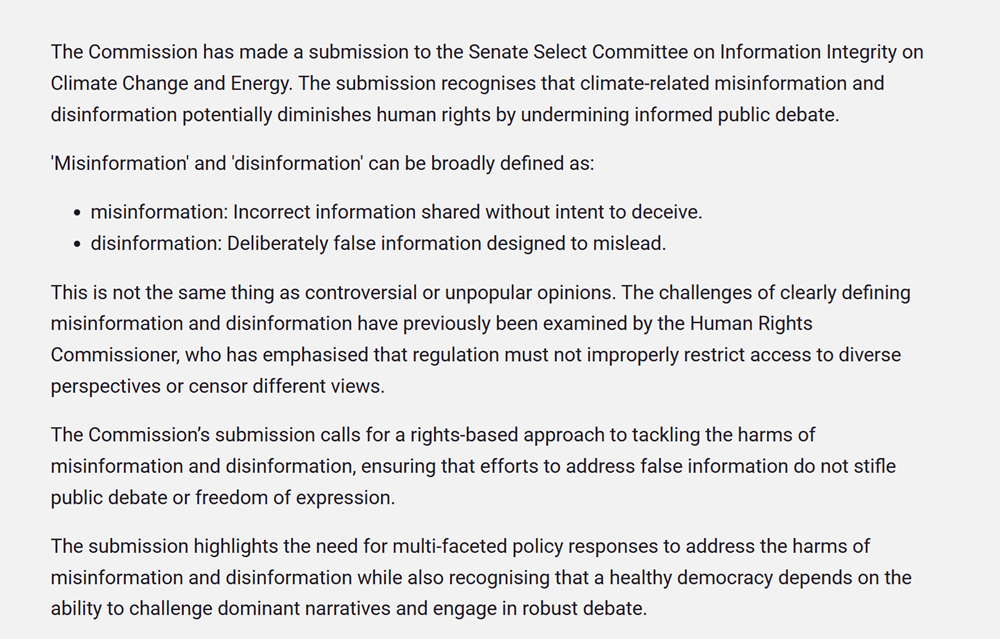
Screenshot from https://humanrights.gov.au/about/news/combatting-climate-related-misinformation-and-disinformation
We first witnessed the ambiguous terms of misinformation and disinformation within the proposed Communications Legislation Amendment (Combatting Misinformation and Disinformation) Bill 2024 (MAD Bill) that was thankfully defeated in 2024. If the Bill had passed, it would have provided the Australian Communications and Media Authority with powers to censor and control online discourse.
Thankfully, the MAD Bill was defeated before the Senate after a large public outcry.
However, an analysis of its key components reveals the underpinnings of the continued attacks on free speech and expression in Australia by our government that is now being given new lease under the guise of climate change.
The problem with misinformation and disinformation
Misinformation and disinformation are problematic within any context, as consensus is often impossible to reach amidst scientific debate. For example, there was an infamous study claiming that ‘97 per cent of all scientists agree on climate change’, which was proven to be objectively false and fell subject to its own misinformation campaign over the last decade.
In its submissions, the AHRC ‘broadly’ defined misinformation and disinformation as:
‘Misinformation: incorrect information shared without intent to deceive.
Disinformation: Deliberately false information designed to mislead.’
Although the AHRC states that these terms cannot be equated to represent ‘controversial or unpopular opinions’, it is hard to ignore the blatantly obvious problems that face the enforcement of such terms.
Would claims that support government and scientific consensus on climate policy be subject to such fact-checking, which could be similar to the 97 per cent consensus study discussed above, or would it only be those who go against the scientific and governmental consensus?
These concerns would rear their head in the surrounding discourse on who would be in charge of determining what is correct. For instance, if we take the Covid pandemic, the ‘fact-checkers’ were pressured to censor content that the US government claimed was ‘misinformation’. Applying the same logic to climate science, in a similar light to how the science changed toward Covid responses during the pandemic there is no ability to determine what is objectively right and wrong as scientific perspectives can change over time.
Notably, the Human Rights Commissioner points out that proposed climate ‘regulation must not improperly restrict access to diverse perspectives or censor different views’. But, that type of sentiment is baseless without adequate safeguards to ensure that we do not experience a similar academic and government consensus surrounding the ineffective handling of the Covid pandemic.
The importance of preserving freedom of speech and expression within public policy debate
Although freedom of speech is not constitutionally enshrined, and has recently been under attack with hate-speech legislation, Australia has a strong common-law history of protecting the implied right to freedom of political communication as a means of holding government accountable to its people.
In Attorney-General (SA) v Corporation of the City of Adelaide (2013), Chief Justice French stated:
‘Freedom of speech is a long-established common law freedom … linked to the proper functioning of representative democracies and on that basis has informed the application of public interest considerations to claimed restraints upon publication of information.’
Freedom of political communication is a fundamental component of a functioning democratic society.
With regard to climate policy, it is often at the forefront of government policy and implicitly forms key components of political debate with relation to the future of Australia. This has recently been evident with the Australian government announcing new outcomes for its 2035 renewables targets.
With the commentary from the AHRC and the inadequacies of recent scientific consensus on key climate and pandemic policy, it is hard to see how implementing restrictions on what information could be shared about climate policy will positively improve the way public discourse is carried out.
In addressing any form of public policy debate, we should counter any harmful information or opinions with more free speech and communication about prominent issues, not less.
The AHRC does make five key recommendations within its submissions. Amongst the advocacy for guidelines around misinformation and disinformation, it does argue for larger support for independent research into ‘the prevalence and impact of climate-related misinformation and disinformation, with a focus on human rights implications’.
Although the second half of the sentence is fundamentally flawed, as misinformation and disinformation are inadequate tools to address free speech and public discourse issues, the importance of independent research is a crucial point that can be elaborated on slightly. Instead of applying this research toward climate-related misinformation and disinformation, why don’t we instead apply funding to independent research on climate, and climate policy, that can benefit all Australians and not be subject to any consensus biases that may only inhibit positive discussion toward climate policy in Australia?
The only way to make informed decisions about topics, especially a topic so fundamentally important to the future of Australia like its climate, is to be able to sort through information and discern what is true or not via access to information. Limiting access to information under the guise of disinformation and misinformation, at the hands of unknown decision-makers, can eventually lead to an uprising of political or scientific dissent. This concept was evident as a result of the outcomes experienced throughout the Covid pandemic where government distrust in Australia surged during the implementation of mandatory Covid measures in mid-late 2021.