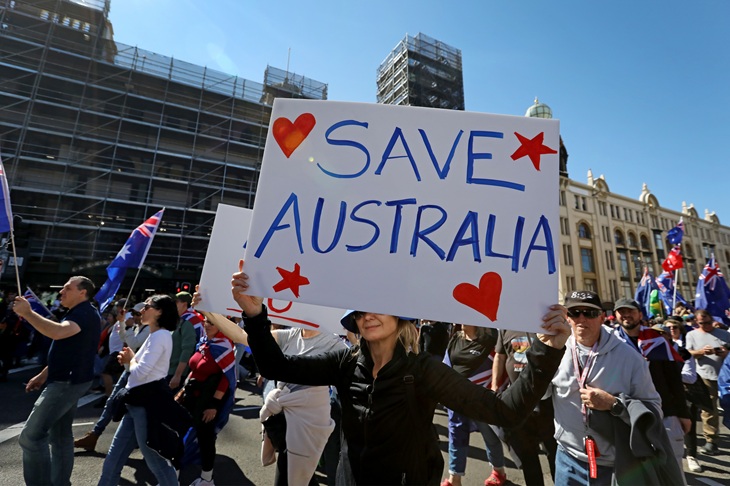
Despite the mainstream media labelling the recent anti mass migration rallies as ‘far right radical neo-Nazi protests’, thousands of Aussie-loving conservatives showed up in the ACT and around the country to demonstrate that they have had enough of the illogical and over-the-top immigration policies.
By and large, the ralliers were not ‘anti-migration’, they were anti mass migration.
Contrary to the legacy media, the rally drew a number of people from diverse backgrounds, including myself. Although Australian born, I am from a migrant family and was pleased to see a number of other ethnic or mixed people at the rally that proved this was not a ‘white supremacist’ demonstration but an event geared towards protecting Australia’s interests and ensuring our political and cultural longevity well into the future.
The rally was therefore in the interests of the entire population, and not just a select few.
The event kicked off at 12pm at the Captain James Cook Memorial. Ralliers gathered by the Molonglo River before marching down the bridge towards Parliament House.
Pauline Hanson, Malcolm Roberts, and Tyron Whitten from One Nation, were in attendance and spoke in preservation of Australia’s sovereignty. Other politicians such as Bob Katter were present at the Townsville rally. Organisers estimate about four to five thousand people showed up in ACT, which is impressive for Canberra, the only region in Australia that voted ‘yes’ to The Voice.
News about the march has been picked up by high-profile American commentators such as Jack Posobiec and Dinesh D-Souza. Internationally, it was reported ‘500,000 people took to the streets to demand a fix to the invasion of their country’.
One of the individuals who facilitated in the organisation of the ACT made the following statement:
‘March for Australia was the spark that lit the fire in many Australians’ hearts who have been feeling so disenfranchised, ignored, and invisible to the governing elite. Australians are really struggling under the policies being implemented by the government and mass immigration is something that is impacting people directly as evidenced with the availability and affordability of housing and the stresses placed on schools, hospitals, and the rapidly changing demographics of towns and suburbs these people have grown up in.’
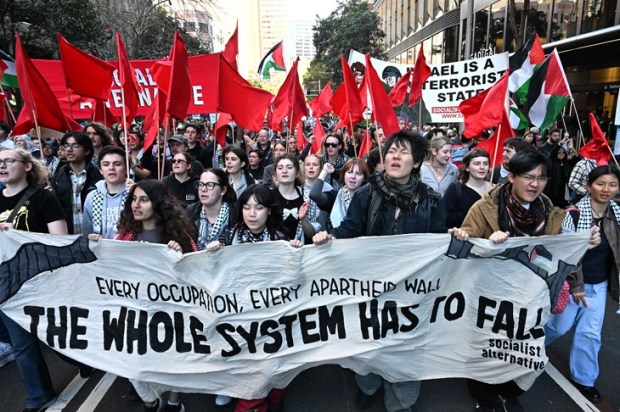
At the beginning of the event at the memorial, ralliers were met with about 300 counter-protesters, which were rowdy but were kept under control away from the ralliers, by two lines of police. In this crowd were citizens carrying banners reading ‘Revolutionary Communist Organisation’. On other placards, some stated that they were standing up against ‘Nazis’ and ‘patriots are parasites’.
This protest group was full of pro-Palestine figures. The irony of the situation is that historically, the German Nazis were allied with Muslims and collaborated with the Grand Mufti during the second world war. If anything, it could be argued that the antisemitic ‘neo-Nazi’ tribe were therefore the counter protesters.
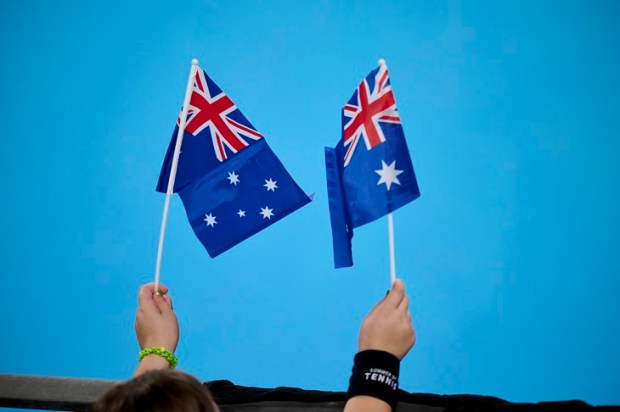
The mainstream media has done a poor job at highlighting the need for greater policing at rallies, such as the pro-Palestine one which recently occurred at the Sydney Harbour Bridge, and is instead indicating the threat to the country are those that wish to stop illogical mass migration as they wave the Australian flag which all politicians have a budget for and regularly hand out to citizens.
Further to this point, it is often the case that violence arises from the protest groups opposing the patriotic marches. Shouting, Globalise the intifada! is hardly peaceful.
According to the Australia Bureau of Statistics (ABS), in 2023-24 migrant intake was at 667,000. The year before, 739,000 migrants were recorded. Many are from the regions of China and India, and are foreign students, meaning the value they offer for Australia’s economy long-term is probably being overstated.
The common arguments for mass migration include the usual ‘it will boost the economy’ sentiments. Students, however, are likely to return to their countries of origin instead of benefitting Australia’s economy in the long run. Some commentators have suggested foreign student intake is occurring at these increased levels to keep universities afloat. In other words, foreign students are being granted visas to fund Australia’s dying tertiary academic system.
I spoke with an Indian migrant the other day who said he felt his quality of life was better in his homeland, given the lack of jobs and the inability to certify oneself in Australia’s institutions. Not only is there a lack of jobs, but there is a lack of infrastructure and housing to deal with the sudden influx of foreigners. In order to boost Australia’s economy long-term, it would be prudent to build the infrastructure needed to house high migrant intake, before opening wide the flood doors. Our backwards politicians mostly on the Labor side, however, are keen on throwing open the guestroom before having the garage set up.
Australians are left wondering about this sudden increase in temporary migrants. What economy is Australia aiming to boost? Should the universities not aim to boost student intake in other ways?
Although many who attended the pro-Australia rallies are being deemed ‘racist’ or ‘xenophobic’ it appears the real racism is taking place in institutions. Racism goes deeper than mere words people say – it is about how ethnic people are treated.
Pauline Hanson, one of Australia’s only political prisoners, has been accused of being xenophobic when in fact she is the opposite – she is concerned for average Australians who are already living in the country, and their ability to afford a house and find a job.
Interestingly, Australia is largely full of people who had migrant parents. According to the ABS, 31 per cent of Australia’s population were born overseas as of 2024. If they were not born overseas themselves, then many of them had parents who were, or married people from overseas. Australia is therefore one of the most diverse nations in the whole world. There is no doubt that Australia values its migrants – but migration policy itself has to be logically done in order to safeguard Australia’s economic future otherwise it will start having a net negative effect on the existing population’s quality of life.
It was not racist to indicate this at the March for Australia. Many people did, in their thousands, across the nation. The counter-protests were drowned out as a result. Some provocation and violence did erupt in regions such as Melbourne, while South Australia’s rally came to an abrupt halt when a speaker was reportedly pushed off stage and the sound was cut. However, the rally in Canberra was peaceful and finished with a Christian message.
Some white supremacists were reportedly spotted in various rallies across the country, but the vast majority of attendees were peaceful, Australia-loving conservatives with a commonsense migration stance.
It appears that when it comes to these nation-wide rallies, the mainstream media cannot be trusted to give an accurate account of the details. Allowing the media to indicate the rallies were not as effective as they were, would therefore be a mistake.
The rallies indicate that there is a strong and rapidly growing movement brewing, where citizens are determined to force our law makers to re-evaluate the nation’s current migration policies.
We have had enough – Australians want their country back.