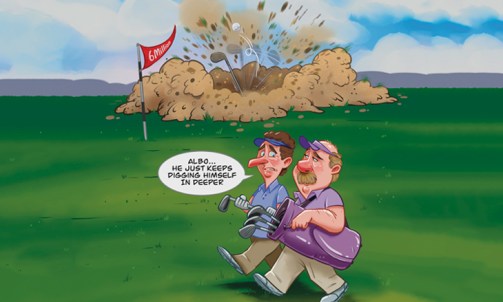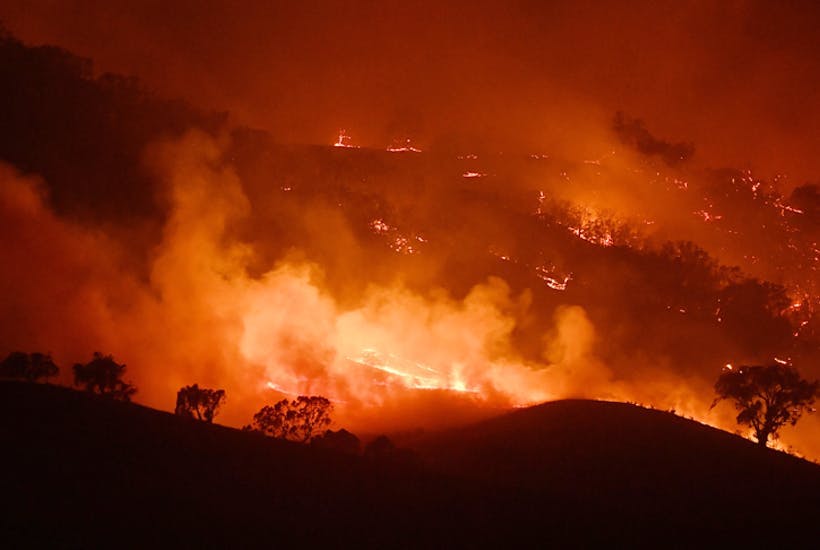
The season has commenced with a bushfire in Sydney’s Northern Beaches area reputedly started by a burn off. Another has popped in North Queensland and fire bans are now in place. No doubt these fires will ignite comments about climate change instead of posing probing questions about how they started.
The latest Northern Hemisphere bushfire outbreak is in Portugal where the government has declared a state of emergency. The fire has reached a massive scale with Portugal calling on help from outside countries. The government believes many fires have been started either by accident or intent. Reuters recently reported that 14 suspected arsonists had been arrested while 125,000 hectares of land had been burned so far.
Major bushfires in Greece last August threatened Athens and led to the inevitable cry of ‘global warming’. Some publications said there was ‘no doubt’ that the Mediterranean country was on the ‘frontline of human-caused climate change in Europe’.
The previous summer firestorm in Greece, 2023, led to 140 wildfire-related arrests, 79 of which were related to arson. Officials blamed negligence or arson for the majority of the blazes.
Estimates are that 60 per cent of the 2023 Italian summer fires were intentionally lit, with 22 arrests. Spain’s Asturias region was hit by 90 fires that year – most believed to be lit by arsonists who were labelled ‘fire terrorists’.
Canada’s record-breaking 2023 season saw 6,000 fires which some blamed on climate change. Half were believed to have been the result of human accidents while others were suspected arson events.
Interestingly, a man who claimed that some of the fires were deliberately started by government agencies was himself convicted of starting over a dozen fires the previous year.
The all-time record holder for arson in America is John Orr who is believed to have lit over 2,000 fires between 1984 and 1991.
It has been 15 years since one of Australia’s worst conflagrations, the Black Saturday bushfires in 2009, which followed a drought. Half a million hectares were burned in an area primarily confined to Victoria. The intensity of the blaze resulted in 173 deaths and the loss of 2,000 homes.
A range of things are believed to have contributed to the disaster, including fallen power lines, lightning strikes, and arson.
The Chief Fire Commissioner wanted all fire sites to be treated as crime scenes. A former Victorian Country Fire Authority volunteer was jailed over 10 counts of arson which caused death in relation to the Churchill fire.
Black Saturday reminded us what the 2023-24 summer period may have had in store for bush residents – until the rains came.
There were no lightning strikes in the area in September 2023 when a series of small fires in the east joined up to create a mega event. Arson was believed to play a role.
It’s a similar story across the country.
Around New Year, before the rains came, a fire outbreak in north Adelaide was listed as a suspicious event. Several fires near Geelong in January of 2024 were also treated as suspicious. Fires in March on the outskirts of Perth led to arrests. There were suspicions about the cause of fires on the Sunshine Coast and Whitsundays. In the Northern Territory, 2023, one man was charged with allegedly lighting 18 fires.
Despite this, the role of arson has been labelled by activists as ‘disinformation’.
Reporting on arson that runs contrary to climate change accepted rhetoric is something that may come under the government’s new anti-free speech bill that targets ‘disinformation and misinformation’.
Silencing the public does not change the reality that many bushfires have human, rather than natural, origins.
A review by the Australian Institute of Criminology (AIC) in 2002 found that over a 30-year period, the population had doubled and the incidence of arson had increased by 2,000 per cent. Their estimate was that cases were doubling every 10 years.
Examination of the last major fire season in 2019-20 by researcher, Colleen Bryant, revealed:
While Australia is particularly fire-prone, natural fires account for only six per cent of known causes of vegetation fires attended by fire services. Over 90 per cent are the result of people’s actions, and more often than not the result of deliberate ignitions; incendiary (maliciously lit fires) and suspicious fires account for one-half of known fire causes in Australia, and are the largest single cause of vegetation fires. However, if we consider in this analysis that accidental fires, which account for 35 per cent of all known vegetation fire causes, include those accidentally lit by children and smoking-related fires, the proportion of preventable vegetation fires is much higher. Forty per cent of all fires attended across Australia do not have a cause assigned by the responding fire agency.A 2016 Victorian Police report found that there were 4,500 cases of arson in that year with the incidence increasing by 30 per cent over five years. 60 per cent were unsolved. In 2014, the AIC estimated the total cost of arson to be somewhere around $2.4 billion. The Australian continent holds the record for being the most fire-prone zone on Earth. Fire services often record between 45-60,000 events annually. Whilst it is undoubtedly warmer than a century ago, (nearly as warm as 1,000 years ago), these weather patterns are nothing new. The continent continues its usual history with droughts, floods, and fires. This was all recorded 100 years ago by Jeannie Gunn in We of the Never Never.
And All of Us, and many of this company, shared each other’s lives for one bright, sunny year, away Behind the Back of Beyond, in the Land of the Never-Never; in that elusive land with an elusive name – a land of dangers and hardships and privations yet loved as few lands are loved – a land that bewitches her people with strange spells and mysteries, until they call sweet bitter, and bittersweet. Called the Never-Never, the Măluka loved to say, because they, who have lived in it and loved it Never-Never voluntarily leave it. Sadly enough, there are too many who Never-Never do leave it. Others – the unfitted – will tell you that it is so called because they who succeed in getting out of it swear they will Never-Never return to it. But we who have lived in it, and loved it, and left it, know that our hearts can Never-Never rest away from it.Environmental activism has limited the hazard-reduction of the La Niña associated vegetation growth. NSW fire services estimate only 40 per cent of the burns were carried out in the 2023-24 season. In Victoria, that figure was closer to 70 per cent. Although backburning is a traditional Aboriginal fire control practice, some experts now say it may increase fire risk. In reality, a lack of reduction burns leads to increases in the intensity of fires. The claim that Australia has ‘more intense fire seasons, brought about by climate change’ is not subjected to analysis. Statistics suggest a longer fire season, which it is argued has increased by 14 days over the last 40 years, but this does not support the claim of these fires getting worse in intensity or extent. Rather than statistical, it appears the change is occurring in how these incidents are reported on by the media. Upgrading fire risk classification – which originally ranged from low to high – to the new scale which goes to ‘catastrophic’ has resulted in much unnecessary sensationalism. If we are to judge a fire by the area it burned, the worse fire season in the last 100 years was 1974-75 when 117 million hectares was burned out. Other significant fire events occurred in 1969 (45 million hectares), and 2002 (38 million hectares). Earlier major historical events, such as Black Friday in 1938-39, or Black Thursday in 1851, do not have confirmed size. There is no pattern of increase, only a connection to previous heavy rains, followed by drought. Fires can start through natural events such as lightning strikes, human accidents or carelessness, arcing power lines and human intent. The variation in fire incidence, in different areas and at different times, can increase suspicion. In Australia, a higher incidence of fires occurs in outer suburbs, compared with the inner suburbs. Although accidental fires are also more likely at the weekend, so is the incidence of deliberate fire-setting; overall, they are 20-30 per cent more likely to start at that time. Deliberately lit fires are also more likely to start later in the day, peaking in the evening, some after sundown with an additional spike around midnight. It is impossible to control human failure or stupidity when in drought conditions. What we can do is predict and control who lights fires, where, and why do they do it. What can we do about it? The why has been extensively researched, with a number of causes revealed: one cohort lights fire to create excitement and relieve boredom; some want attention and an opportunity for recognition may be provided by fighting the self-lit fire. AIC has also revealed other motives, such as illegal land clearing, or revenge on a neighbour. Some perpetrators have psychiatric problems, many accidental fires can also result from carelessness or stupidity. Children light fires for a number of reasons. Juveniles are a problem group who are prone to attacks of vandalism, some with repeated episodes and may come from dysfunctional families and have a history of other anti-social behaviour. An AIC analysis, of over 1,200 arsonists from NSW, 2001-6, showed they were around 90 per cent male, one quarter under 18, around 20 per cent Indigenous, few had previous convictions for fire-setting but 40-50 per cent had other convictions, including drug offences. A larger country-wide study spanning over 25 years, reported in a psychiatric journal in 2015, gave the main motives as payback, crime, profit, and harming another. As we head to the new fire season, the BoM predicts another possible La Niña rain event, returning in summer 2024-25, we can but hope their predictions are more reliable than last time!