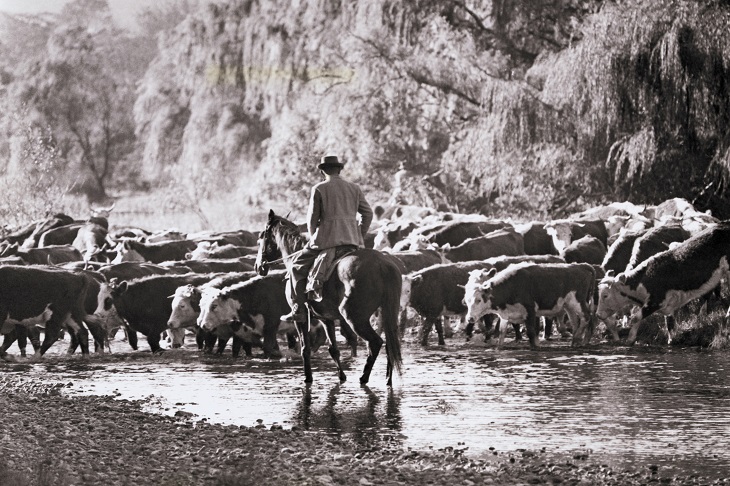
One of the more dominant themes intertwined in the great story of Australia is that of the bush. Embedded into our pioneering history are the experiences of settling farmers, explorers, stockmen, and workers who encountered the harshness of our environment, but also received with a profound admiration the beauty of this country’s unique landscape. Banjo Paterson encapsulates perfectly the plurality of Australian nature, from the ‘dusty and eaten out’ plains of a drought-stricken outback to the ‘breezes and rolling plains’ of the High Country that could develop even in the most resentful settler a deep-rooted affection for the country.
This poetic description of our natural environment conveys an integral aspect of the Australian character, that is, the daring determination and fortitude required to found an entirely new nation. The characteristic ‘grit’, as Henry Lawson puts it, of these settlers was inherited by generations far beyond their time and is illustrative of the significant impact that Australia’s natural features had in shaping what it means to be Australian. From the bush were so many distinguishing traits of traditional Australian identity drawn out or, at the very least, emphasised.
With this in mind, it is incumbent upon us to recognise the duty we have to continue to preserve the land that in many ways presented itself as a piece of the foundation for the genesis of Australian nationality. Part of this duty involves comprehending the dangers our environment faces at the hands of a bipartisan, media-backed, and elite-supported effort to import hundreds of thousands of people a year. The negative externalities of mass immigration have been largely ignored by all elected politicians – both state and federal – in the last six months, despite Westpac recently reporting the net migration figure for the last year reaching an astounding record of greater than 400,000.
Amidst what the New South Wales Tenants’ Union CEO says is the worst rental shortage since the Great Depression, the federal government, in unison with all state governments, has committed to record intakes of foreigners under the guise of a skills shortage heavily disputed by various esteemed economists across the country. With inflation continuing, and a negative growth in real wages affecting working families already feeling the pain of increasing interest rates, one must ask why the government thinks it is economically prudent to aggravate demand-side inflation through mass immigration. Of course, it is worth noting that businesses continue to profit from this policy because it is a means of delaying wage increases for Australian workers and rids parasitic corporations of a reliance on domestic labour.
Economic factors aside, we must return our focus to the environment and consider the implications of unsustainable population growth on the flora and fauna of our country. It is indisputable that flooding Australia with millions of people from all corners of the world will have significant and perhaps irreversible adverse effects on the environment. The artificial population growth caused by mass immigration results in more cars on our roads, and subsequently accelerates environmental degradation from the fume and particulate pollution inseparably linked with the use of vehicles. Obviously, a need for more housing arises from the hosting of so many non-citizens, which involves the clearing of land and the creeping encroachment of urbanity on the bush as cities expand like a malignant tumour.
It goes without saying, too, that the demand for an abundance of goods and services – think education, healthcare, public transport, energy, food, and just about every other type of good or service – is multiplied as immigration remains unhindered. The immigration-induced growth in demand should alarm the 21st century environmentalist, for it exacerbates many of their pre-existing concerns, namely the need for more international cargo shipping to import larger quantities of goods to Australia, the energy demands of ever-growing industry, and the consumption of fossil fuels in the day-to-day affairs of those living in Australia. The equation is simple: more demand = more pollution.
The ‘Australia to 2050: Future Challenges’ publication from the Treasury in 2010 spruiks migration as a key to maintaining economic growth and supporting an ageing population, but does subtly concede that it ‘will put pressure on our… environment’. Furthermore, Professor Chris Dickman from the University of Sydney more recently identified the contribution of land clearing, as well as ‘habitat degradation’, to Australia’s disproportionate rate of plant and animal extinction. The professor’s comments to the Sydney Morning Herald are not to be ignored, and are made with rightful concern. Many of the plants and animals of the land we have a responsibility to care for will fade into extinction if we do not pay serious attention to the maintenance of our biodiversity, and remaining indifferent to the excessive injection of people into Australia’s population undermines any effort to combat such extinctions.
The Victorian National Parks Association has attributed two of the main drivers of land clearing – which has contributed to a situation where eight out of every ten hectares of native plants on private land are gone – as ‘urban and peri-urban development’ and ‘new infrastructure’. In the absence of hordes of migrants entering the country, it is doubtful that even a fraction of the property development and infrastructure programs (like increasing the numbers of lanes on freeways, etc.) over the last decade would have been justified.
Even the Australian Museum acknowledges that ‘the greatest threat to biodiversity’ is ‘the size and rate of growth’ of the population. It beggars belief that anyone who genuinely identifies themselves as an advocate for sustainability and the environment could sit idly by whilst every element of environmental decline is intensified by mass immigration.
Immigration inevitably generates higher volumes of waste, both household and industrial. For example, when immigrants from India come to Australia, their level of plastic pollution will be tenfold compared to the plastic waste they would have generated as a consumer in India, as the comprehensive 2015 study from Australian Associate Professor Chris Wilcox and others shows. The federal Department of Climate Change, Energy, the Environment, and Water’s (DCCEEW) State of the Environment 2021 report highlights the fact that ‘much of Australia’s population growth has been driven by overseas immigration’ and the sad reality that ‘with population and economic growth, household waste has continuously increased across Australia’.
The exponential growth in industrial waste is enabled in part by the increase in foreign migrant workers available to companies which allow them to increase their production output. As opposed to being incentivised to focus on productivity improvements (multi-factor productivity growth is only at 0.18 per cent according to the ABS, which is below the 5-year average), companies have been able to get away with increased profits without productivity growth whilst strangling wages, largely because of ongoing mass immigration.
The concerning trend of growing waste levels in the context of a waste sector that is, as stated by the DCCEEW, already ‘facing various pressures’ and unable to keep up with the processing demand, underlines the blunt truth that our environment cannot afford the weight of a projected 3-4 million additional people through immigration over the next decade.
A healthy environment coincides with improved mental health across society, and the necessary urbanisation that complements immigration serves to simultaneously immerse more people in an urban lifestyle and degrade the very places of respite for those struggling in urban areas. The risk of psychosis in urbanised areas is 77 per cent higher than in the country and the risk of anxiety disorder 21 per cent higher, as respectively detailed in Kristina Sundquist’s 2018 study published in the British Journal of Psychiatry and Professor Robert Schoever’s 2010 peer-reviewed Scandinavian study. Consequently, as urbanisation continues and we destroy our environment, we are undoubtedly amplifying the vulnerability of the community to mental health issues. As we are reduced to consumers in an economic zone and contained in cities, we begin to lose our sense of common identity, and hurting our environment, which by all accounts has a positive effect on mental health, will only make matters worse.
To once again invoke the poet Banjo Paterson, it is worth reminding yourself of the imprint that the bush left on the minds of our nation’s settlers:
Here in my mountain home,
On rugged hills and steep,
I sit and watch you come,
Oh Riverina Sheep!
You come from fertile plains
Where saltbush (sometimes) grows,
And flats that (when it rains)
Will blossom like the rose.
But when the summer sun
Gleams down like burnished brass
You have to leave your run
And hustle off for grass.
Ultimately, immigration will continue to harm Australia’s environment if the community is not made aware of the serious problems that come with it. Our politicians, local and national media, the trade union movement, and the business community all ought to take responsibility for their actions. Eventually, if we fail to bring this to light, it will be too late.
Getty Images