Being a goth has its advantages, not least the opportunity to meet lots of witches. One is River Jordan, who wears Victorian corsets and tricorn hats and spends her nights taming foxes. ‘Death is just a part of life,’ she tells me. ‘I am grateful to be able to speak with the dead around Samhain/Halloween/Day of the Dead and have done since my childhood. I hope my body will one day be food nutrients.’
Samhain is the Celtic festival of the dead, pronounced ‘SAH-win’. Ariadne Rainbird, a psychologist from the Welsh valleys, tells me how she celebrates. She recommends a simple ritual: set up an altar with seasonal vegetation such as pinecones, ferns and apples, add a glass of water or fruit juice and an incense stick, then sit quietly and breathe deeply. Visualise a sphere of peace and protection around you in the form of a soft white light, before calling on the four elements.
It is a surprisingly wholesome prescription for a festival associated with the dead. But why do we celebrate it just before November? The Saxons called November Blodmonath, or Blood Month, because livestock were slaughtered for meat. The nights were growing longer, too, and the natural world was retreating into darkness.
I have always found it ironic that so many modern pagans are vegan environmentalists when historical pagan religions often involved animal sacrifice. Rainbird, a vegan, has got around this contradiction by joining the meat-free cult of Pythagoras, which began as a philosophical brotherhood founded around 530 bc in Croton, southern Italy.
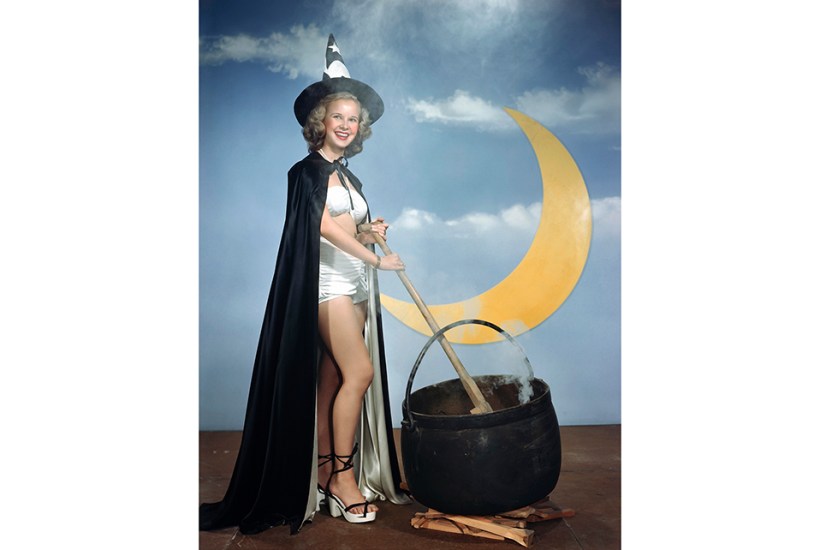
But where did our traditional image of the witch come from? One theory traces the pointed hat to alewives, who dominated brewing until men took over the industry around the 16th century. They supposedly wore hats to attract customers, left broomsticks outside to advertise their trade, brewed beer in cauldrons and kept cats to protect their barley from mice. Accusing them of witchcraft was a convenient way to undermine their business. The pointed nose, meanwhile, reflects the darker history of anti-Semitic caricatures.
Belief in witchcraft remains a matter of life and death in some parts of the world. In Tanzania, thousands have been killed in witchcraft-related violence. In Britain, witch-hunts are more likely to take place online.
Yet attitudes towards witches vary enormously, from terror to indifference. Professor Ronald Hutton’s lectures on witchcraft are insightful, as is Robert Eggers’s film The Witch, one of the most historically accurate depictions of witchcraft I have seen.
For a glimpse into the stranger corners of the occult, visit the Viktor Wynd Museum of Curiosities, Fine Art & Natural History in Hackney. Its entrance sign warns visitors away if they don’t worship ‘fairy tales, dead animals, dead people, broken children’s toys, erotica, the world’s largest crab, entomology, monsters, surrealism, the occult’. The list continues for another seven lines.
Down the spiral staircase, visitors encounter a two-headed baby skeleton and a Cyclops piglet in a jar. Among the magical artefacts is a jar of urine used for ‘skrying’, a form of divination, which Wynd bought from a West Country wizard for £500. The Voodoo section features a statue studded with nails, though these are charms, not the cursed dolls of horror-film mythology.
My favourite is an icon of Kinjinmbunduo, a bat goddess from Papua New Guinea, made from woven baskets. Yet none of these exhibits is quite as frightening as Russell Brand’s pubic hair.
Got something to add? Join the discussion and comment below.
You might disagree with half of it, but you’ll enjoy reading all of it. Try your first month for free, then just $2 a week for the remainder of your first year.