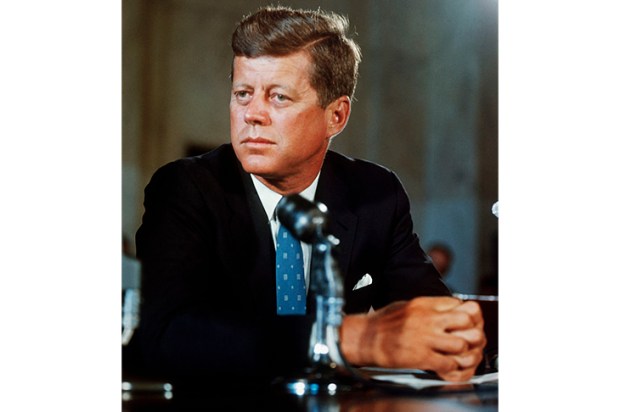
As Labour meet in Liverpool, from Sunday, Andy Burnham and his advisers are worrying about his lack of a mandate. You can see why. They have an almost unprecedentedly large majority with an unprecedentedly low vote-share, and when they won it, Mr Burnham was not even in Parliament. He gained his party’s leadership uncontested. Since there is a split right, he may feel he should boldly go to the country and offer it something or other. I suspect he won’t, because his majority would fall, and voters might curse him for troubling them. And I hope he won’t, because the mandate doctrine should not be pushed too hard. Our highly flexible system means legitimate government can usually be carried on by anyone who can command a majority in the Commons, limited only by the Parliament’s five-year term. Our two most important decisions ever made in the era of universal suffrage were completely innocent of a direct democratic mandate. They were the declaration of the second world war and the later choice of Winston Churchill to lead us through it.
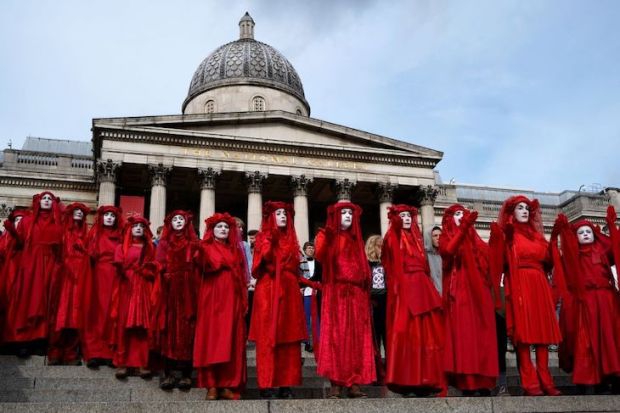
Just possibly, some readers will have allowed this week’s Liberal Democrat Assembly in Brighton to pass them by. Not I. For me, it is Proustian. It was a Liberal Assembly (the ‘Democrat’ was added much later) in Brighton which gave me my first taste of a national political gathering. I am shocked to realise this was exactly 60 years ago. My parents were both active Liberals, and I was nine. It was my first term at prep school, but I must somehow have got the day off. The vast, lifeless Brighton conference centre had not been built and the Assembly gathered in a grand old theatre with red plush walls and gilt boxes. In that era, the press and the BBC faithfully and fully reported even Liberal conferences. It was a day of drama because it marked the first mass appearance of the new, militant Young Liberals who, in very 1960s style and with very 1960s hair, were infiltrating leftish views and tactics into the mainstream. They were dubbed, in imitation of Chairman Mao’s Cultural Revolution goons, the Red Guards. The key motion was in favour of Britain’s continuing membership of Nato. The Red Guards were against it. My father, Richard Moore, moved the motion with a powerful speech which was possibly too fiercely eloquent for safety. Although only 35 at the time, he seemed of a completely different generation from the Red Guards – what Maoists called ‘a counter-revolutionary element’. The YLs started to fill the aisles and heckle. In that trusting time, there was no security at all and no check on whether those in the hall were accredited delegates. My memory – which could well be inaccurate – is that the Red Guards managed, by this cheating, to win a vote against the motion on the floor, a result which had to be overruled by the party’s executive. I may have been witnessing the first example of ‘revolting students’ in British party politics. Since then, it has never stopped. It took off in the Labour party in a big way in the 1970s and finds its most recent expression in Zack Polanski’s Greens. Even at that age, though thrilled by the drama, I detested the Red Guards, much preferring lunch at English’s Oyster Bar with Asquith’s formidable daughter, Lady Violet Bonham Carter. Nato somehow survived the onslaught. This week, the Lib Dems fervently supported Nato membership and increases in defence spending (though arguing, typically, that this could be achieved only by rejoining the single market). Nowadays, it is the Trumpian right, compromised by Russia, which wears the mantle of the Red Guards.
My sister was recently trying out various sentences by well-known authors to discuss examples of good ones with her online class. As an example of the longer sentence, she typed in the final words of Wuthering Heights: ‘I lingered round them, under that benign sky; watched the moths fluttering among the heath and harebells; listened to the soft wind breathing through the grass; and wondered how anyone could ever imagine unquiet slumbers, for the sleepers in that quiet earth.’ As she typed, Copilot intervened uninvited, offering to produce a clearer version of these words. Charlotte, out of curiosity, agreed. It came back with, ‘Beneath that benign sky, I lingered nearby, watching moths flutter among the heather and harebells and listening to the soft wind breathe through the grass. I wondered how anyone could imagine troubled sleep for those resting in that peaceful earth.’ Copilot’s translation is remarkable for its subtle skill in robbing the original of rhythm, distinction and interest, and in breaking the power of a single sentence by turning it into two, yet without doing obvious violence to its basic meaning. That flattening effect is AI’s characteristic verbal service, achieving the polar opposite of great literature.
Here in Sussex, we like to march, rather like anti-war protestors who shout ‘Not in my name!’ But our cry is ‘Not my Duke!’
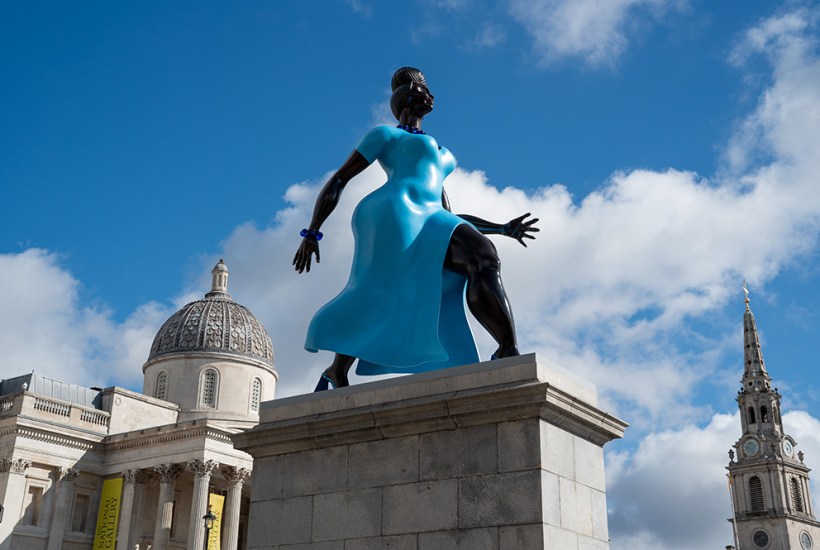
I know the choices for the fourth plinth in Trafalgar Square are deliberately baited for a horrified reaction, so I shall refrain from saying how hideous, gigantesque and ill-sorted with its surroundings is the latest artwork, Tschabalala Self’s ‘Lady in Blue’. But, as a concerned citizen, I feel it my duty to call out the fact that the statue is racist. Its depiction of a young black woman deliberately emphasises the traditional features of race-based caricatures of black women. She has huge breasts, huger buttocks, a fat thigh lubriciously exposed, and a figure-hugging dress. The sculpture’s publicity says the young woman is ‘confident’, but in fact she is shaped to look what used to be called ‘brazen’. I know the artist is black, but she has culturally appropriated the fevered imagination of the ‘white gaze’. Like Rhodes, the statue ‘must fall’.
Got something to add? Join the discussion and comment below.
You might disagree with half of it, but you’ll enjoy reading all of it. Try your first month for free, then just $2 a week for the remainder of your first year.