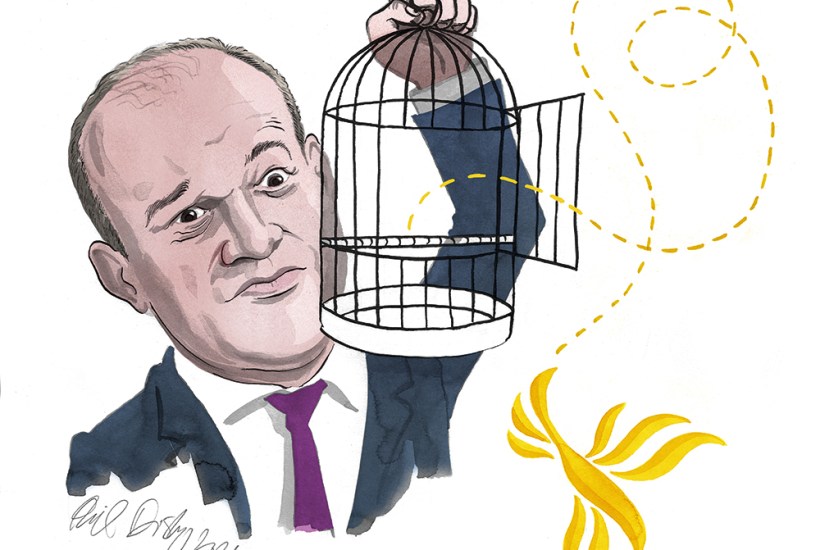
I’m sort of in awe of Ed Davey. How does he still manage to wake up every day and, despite all the other challengers for the title, somehow knock it out of the park as the nation’s most embarrassing political leader? His address to the Liberal Democrat conference this week was a masterpiece. There he was, the Postmaster’s Friend, wedged into a pair of dad-chinos and reminiscing about his radical days at the college JCR. Davey is in some ways the perfect Lib Dem leader – an id for embarrassing middle-class England. If you cut him, he bleeds organic muesli and opposition to planning applications.
He ticked every box in his speech. He evoked Liberal Britain’s prelapsarian Eden: the opening of the 2012 Olympics, complete with a prolonged panegyric to Mo Farah. He poured scorn on its Ragnarok – Brexit. And he called out the country’s real enemies: the shadowy crypto billionaires who apparently are the reason why no government can make any decisions anymore.
For the party of Gladstone, it simply isn’t good enough to be a political Werther’s Original
Tellingly, Davey’s speech was one which largely recalled the past – and an imagined one at that. If Labour’s plans for votes for 16-year-olds go ahead, part of the electorate at the next general election might not even have been conceived at the time of the 2012 opening ceremony. It’s now been a full decade since the Brexit vote. These are icons of a past Britain which Sir Ed and his supporters find easier to parse. Mo Farah, whom Davey spent a chunk of his speech wanging on about, has recently moved to Qatar to raise his children in a more explicitly Islamic culture. He might well be a figure who evokes some of the issues facing Britain, but not in the way Davey thinks. What was on offer here was pure nostalgia for a credulous faithful: exactly what Davey accuses Nigel Farage of peddling.
When it came to finger-pointing, Davey did plenty. But it’s revealing that he thinks Elon Musk is the biggest problem facing the country. He is not pitching his party’s priorities as the economy, or immigration, or housing, or infrastructure – but instead the repudiation of a foreign tech bro who lets people say nasty things online. Not liking Donald Trump is a widely held opinion in Britain, not a developed policy. This is the party for people who have nothing else to worry about, for whom the increasingly difficult reality of life is just a fantasy.
Or so it is for now. A tension underlies the Lib Dems which Davey’s moronic prattling will only worsen in the long term. Fundamentally, the party is trying to be too many things to too many people. Its conference is already descending into acrimony thanks to a vote on scrapping protections for women-only spaces, which Davey supported. For people who spend a lot of time talking about other parties’ financial setups, they are loath to have a line drawn between their gender woo-woo and the massive donations they’ve received from a pharma company which manufactures puberty-blockers.
Unfortunately for the Lib Dems, they have consistently underrated how much voters, especially women, do care about gender realism. What they characterise as a ‘culture-war’ triviality is, for far more people, a question of essential truth and female dignity. You detect here a desire to ride multiple horses at once, to entice disaffected centre-right voters while keeping progressives onside. There seems to be a hope that being ‘the nice guys’ will be enough. But actually in 2026 it’s no longer possible to coast on vibes, especially if those vibes are provided by Ed Davey.
There is confusion elsewhere. The party has consistently advocated a more liberal asylum policy. Oxfordshire’s Lib Dem-run county council pushed hard for its area to become a ‘Council of Sanctuary’. The potential housing of 1,250 male migrants near the village of Piddington has put these beliefs in direct conflict with reality. Having previously signed an open letter supporting ‘unity and compassion’ for asylum claimants, the local MP, Calum Miller, is now objecting to the migrant camp, but on exclusively ‘Nimby’ grounds. He cites the absence of infrastructure, rather than mentioning the risks and inherent unfairness of an influx of fighting-age men being imposed on a small community against its will. Saying other-wise would mean admitting earlier fault. A major reason for public dissatisfaction with Brexit is that the immigration control many voted for never came to pass. Rejoining the EU remains a key political objective of the Lib Dems, but rarely do they address this particular aspect of it. Far easier to dismiss their opponents as ‘far-right’.
Meanwhile, their cosiness to Labour will age spectacularly poorly if Andy Burnham makes good his threats to hammer the south and affluent rural areas with mansion taxes and jumbo council tax. Comfortable Britain may be in for a rude awakening.
Some will rub their hands at the thought of out-of-touch liberals getting their comeuppance, but it isn’t healthy for politics. I say this as someone who has voted Lib Dem in the past, who watches MPs for a living and knows that some of the most competent members of parliament sit on their benches. When they are good – on parliamentary committees, on local and neglected issues, on civil liberties – they can be very good. When they’re bad, they’re dire.
Nostalgia may be their greatest enemy. They often complain that their rivals are stuck in the past, but is being hermetically sealed in the early 2010s really any better than the 1950s? For the party of Gladstone, it simply isn’t good enough to be a political Werther’s Original. The most excruciating part of Davey’s speech came when he got the raisin-like heads of the audience to bob along and repeat a slogan back at him, ‘We care! We fight! We care! We fight!’ The avoidance of the obvious follow-up question of ‘What for?’ might well come back to haunt Davey as the realities of politics in 2026 – rather than the fantasies of 2012 – come home to roost in the Home Counties.
Got something to add? Join the discussion and comment below.
You might disagree with half of it, but you’ll enjoy reading all of it. Try your first month for free, then just $2 a week for the remainder of your first year.