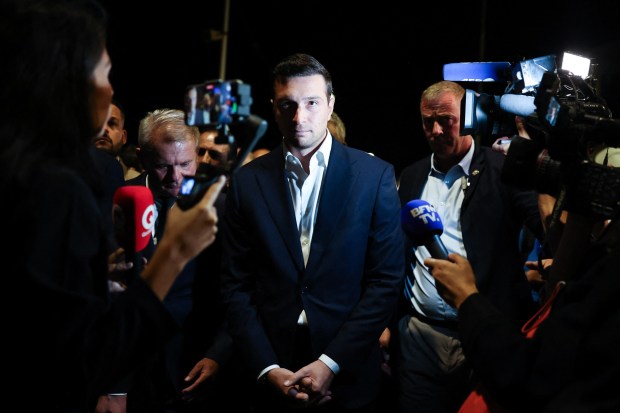
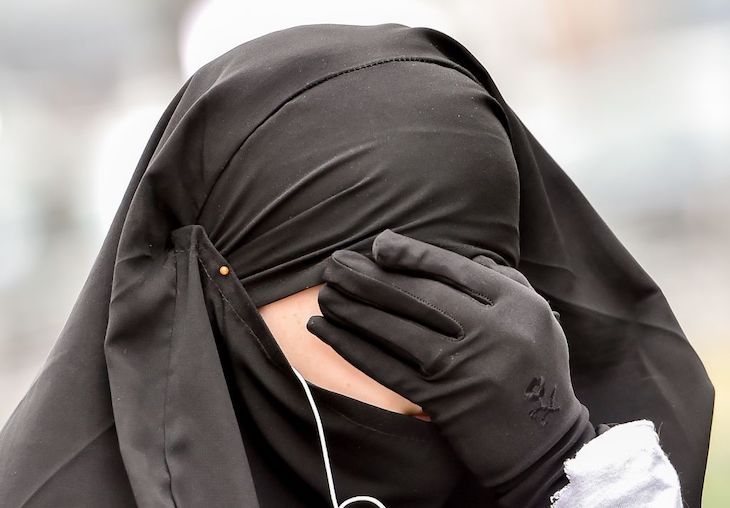
Marine Le Pen has promised to ban women wearing Muslim headscarves if she becomes president next year. The leader of the National Rally declared on X: ‘I will submit to the French people, by referendum, a bill to combat Islamist ideologies with numerous powerful measures, including the banning of the Islamist headscarf in public spaces’.
Le Pen may be out of step with the rest of the political class but she is speaking for a majority of the people
France has led the way among European countries on the issue of conservative Islamic dress. In 2004, for example, a law was passed prohibiting the wearing of conspicuous religious symbols in schools. It applied to Christians, Jews and Muslims, but France was accused of using the bill to persecute Islam. ‘Wearing a headscarf, for whatever reason, will not undermine the French nation,’ said the Guardian.
In 2010, France became the first European nation to ban the Islamic niqab – the full-face veil – with an overwhelming majority of MPs backing the bill. One of the most vociferous supporters of the ban was the prominent far-left politician, Jean-Luc Melenchon, who called the niqab ‘degrading’. He added: ‘We are not going to put up with phantoms wandering the streets and forbidding us from looking at them.’
Melenchon has since had a volte-face. He supports a woman’s right to wear Islamic dress and he has called Le Pen’s proposition to ban the headscarf ‘despicable’.
Why the change of heart? Melenchon’s La France Insoumise relies heavily on the Muslim vote – 62 per cent of French Muslims backed the party in the 2024 European elections – and the cynic might wonder if he’s not pandering to this demographic.
Melenchon isn’t the only politician to denounce Le Pen’s plan. The two leading centrist candidates for the presidency: Gabriel Attal and Edouard Philippe (both former PMs under Macron) have voiced their opposition. Philippe described it as ‘dangerous’ and ‘unconstitutional’.
Even the conservative candidate, Bruno Retailleau, leader of the centre-right Republicans, attacked Le Pen for wishing to ban the headscarf. Nothing but cheap ‘populism’ in his view.
Le Pen may be out of step with the rest of the political class but she is speaking for a majority of the people. An opinion poll conducted at the start of the week found that 60 per cent of respondents supported the ban.
This is just a small drop on the 70 per cent who said they were pleased to see the niqab outlawed in 2010. In response to the decision, the Financial Times canvassed the view of Germans, Italians, Spaniards, Britons and Americans.
The Spanish were most supportive of banning the niqab (65 per cent) and the Americans (33 per cent) were most opposed. In Britain, 57 per cent of respondents supported a ban.
As the BBC reported in 2010, France’s decision to proscribe the wearing of face veils was ‘being closely watched in other countries’. Belgium was the first to follow suit, introducing a ban in 2011, and Austria, Bulgaria, Denmark, Luxembourg, Switzerland and Portugal have done likewise in the years since.
Holland forbids full-face coverings in hospitals, educational and public institutions and on public transport. In Italy, Giorgia Meloni’s government has tabled a draft bill to prohibit full-face Islamic coverings in public spaces, but it has not yet been passed into law.
Portugal introduced its ban last month with fines for those who flout the law. ‘The face must be considered a central element of human identity and communication,’ said Portugal’s president António Jose Seguro.
There is no ban in Britain, and there won’t be as long as Labour are in power. Keir Starmer dismissed the idea last year when it was put to him in PMQs by Reform MP Sarah Pochin.
The Conservatives have expressed tentative support for a ban, and last year Kemi Badenoch said she refuses to engage with a constituent if they enter her surgery wearing ‘a burka or a balaclava’. She said that she won’t talk to people ‘who are not going to show me their faces’.
Nevertheless, Badenoch said there were more pressing issues in the fight against Islamism than policing what people wear. ‘France has a ban, and they have worse problems than we do in this country on integration,’ she said. ‘Sharia courts, sectarianism, things like first-cousin marriage. There’s a whole heap of stuff that is far more insidious, and that breeds more problems.’
The French disagree. In an interview last year the former French (Socialist) prime minister, Manuel Valls, said the headscarf was being worn as ‘a political banner’ against the Republic. ’We must take a firm stance on this issue,’ continued Valls. ‘Islamism is waging a cultural war against us, so we must respond with the weapons of the rule of law.’
That’s Le Pen’s intention with her proposed ban. She believes it is not a ‘populist’ measure but a popular one.