Lessons in education
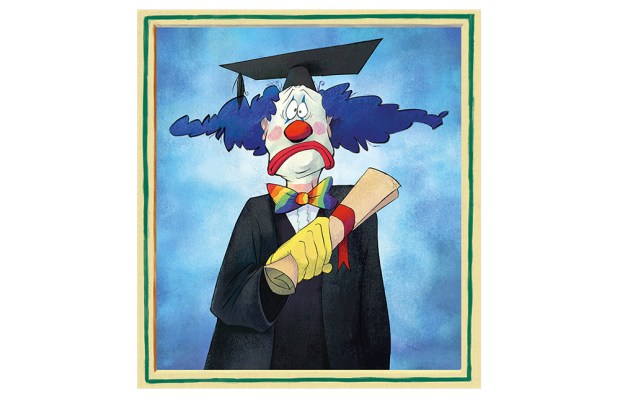
Sir: I read Michael Gove’s thought-provoking piece (‘Revenge of the Blob’, 29 August) with great interest. It prompted me to reflect on my 26 years’ experience in various teaching and leadership roles in the English education system. This has convinced me that, despite changes of government, political persuasion, and evolving theories of pedagogy and school improvement, two fundamental truths remain constant.
First, the quality of teaching makes the single greatest difference to young people’s achievements and, ultimately, their life chances. This is particularly true for disadvantaged pupils and those with additional needs. Second, the quality of school leadership is fundamental to the ethos, culture and expectations of a school.
Great teaching and strong leadership are two sure ingredients for educational excellence, irrespective of the political or theoretical perspectives of the day.
David Hatchett
London E1
My Trotskyist sympathies
Sir: I do realise that I am a headline-writer’s nightmare and regret it. So please forgive me if I object slightly to the heading on my article last week (29 August) which suggested my visit to Prague in 1978 ‘cured me of my communist sympathies’. I was never a communist. Trotskyists, such as I was, were to varying extents hostile to the Soviet Union and its subservient western communist parties. The fallacy in this view was the belief that we, by following the ideas of Leon Trotsky, would avoid the horrors of the Stalinist state.
After my 1978 visit to the Czech capital I was increasingly amazed at how indifferent many in the West were to the miseries and cruelties of left-wing despotisms. Most still do not realise what it was that collapsed in 1989 or what that meant for us in the free part of the continent.
Peter Hitchens
London W8
A faithless crime
Sir: Madeline Grant notes that bishops of the Church of England ‘are fond of pointing opponents’ of Project Spire to my work (9 August). However, she avoids responding to that work.
The Church’s role in the transatlantic slave trade is not ‘historically contested’. These are the facts: it knowingly held shares in the South Sea Company as it trafficked 19,758 people from Africa to the Americas. Slave traders and ‘owners’ donated around a third of its original endowment fund.
The Church justified Atlantic slavery on religious grounds. Its missionary wing owned plantations and purchased more than 400 captives for them, branding them with the word ‘Society’. The Archbishop of Canterbury Thomas Secker wrote: ‘I have long wondered and lamented that the negroes in our plantations decrease, and new supplies become necessary, continuously.’
Unlike the Quakers, the Church never banned its members from owning people. Although many Anglicans backed the anti-slavery campaign, 96 Anglican clergy were compensated £46 million in today’s terms for the loss of their human ‘property’. Their captives got nothing.
The plantations pioneered a dehumanising variant of slavery, turning black people into items of capital stock. As the historian David Eltis puts it, ‘by contrast’ with other forms of slavery, ‘the enslavement of Africans in the Atlantic continues to feed into deep modern social inequities’. The contestation over Project Spire is about questions of institutional responsibility and morality rather than historical complicity. While Madeline Grant may be annoyed at the £100 million Spire is committing over ten years, reparations campaigners are disappointed that the Church is allocating so little, and for an investment scheme that will yield profit, rather than reparations. It seems paltry given the institution’s key role in the most economically transformative and longest-lasting crime against humanity.
Professor Alan Lester
Uckfield, East Sussex
Crippling hypocrisy
Sir: Good on Julie Burchill for reappropriating a word beginning with ‘c’ and rhyming with ‘ripple’ (‘I’ve reclaimed the word “cripple”’, 29 August). I suffer from a neuro-developmental disorder severe enough for it to affect how I interact with others, and I’ve decided to reappropriate the word ‘retard’. That word is currently straddling the divide between being an acceptable insult in some circles and an Official Slur in others. At least one person who called me a retard when we were teenagers sanctimoniously ‘calls out’ my using it in casual conversation. Apparently enough tokenistic pearl-clutching can absolve any hypocrisy. Well, if people want to call me a retard, then I suppose I am a retard, whether the world likes it or not.
C.P. Johnston
Manningham, Bradford
Poetic licence
Sir: I much enjoyed Dear Mary on the Yeats ‘expert’ who pronounced the poet’s name ‘Yeets’ (29 August). Your sublime columnist the late Auberon Waugh once recalled a sergeant major during his national service shouting at the squaddies: ‘Tonight, there will be a lecture on Keats. I bet none of you know what a fucking Keat is!’
Harry Mount
London N1
Relish the memory
Sir: I presume that your stock of Gentleman’s Relish, received as a gift, has now run out. I am terribly sad because, over the past few weeks, instead of delving first into the late lamented Rod Liddle, I went to the Letters page to see if I could judge the winner of the Relish, before looking to see who it was. Without Rod and the Relish, what am I to do?
Professor Robin Jacoby
Bicester, Oxfordshire
Got something to add? Join the discussion and comment below.
You might disagree with half of it, but you’ll enjoy reading all of it. Try your first month for free, then just $2 a week for the remainder of your first year.