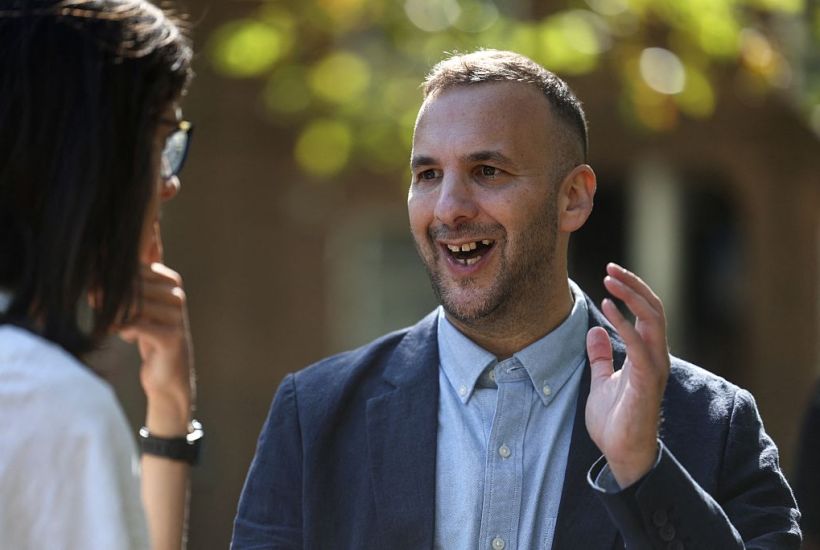
Why is Zack Polanski campaigning in Urdu? Even by the standards of the hypnotic hooter-helper, a man who once sang ‘Lib Dem fightback’ on national television, his latest social media video reaches new levels of cringe. With the shameless gusto of a man who has spent ten minutes on Duolingo, he addresses his prospective constituents in Holborn and St Pancras in Urdu, the national language of Pakistan.
A staggering 43.3 per cent of households are social renters
The obvious explanation for this bizarre spectacle is the Green party’s growing indulgence of sectarian politics. During the recent Gorton and Denton by-election, Hannah Spencer’s successful campaign published leaflets in Urdu and released videos implying Labour was in the pocket of Narendra Modi and Benjamin Netanyahu. And at the local elections in May, many Green candidates seemed more fixated on Palestine than potholes. Such tactics have become as predictable as they are depressing.
And yet what’s striking about Polanski’s choice to pander to the Pakistani vote, is how relatively small it is in Holborn and St Pancras. At the 2021 census, there were just 816 Pakistanis in the seat. And according to Camden Council, the most commonly spoken languages in the area (other than English) are French, Bengali and Spanish. In fact, ‘other South Asian languages’, the category covering Urdu, are spoken by just 0.3 per cent of locals. That means Italian, Arabic, Portuguese, Somali, Greek, Albanian, Russian, Farsi, Japanese, German, Filipino, Polish and Turkish are all more commonly spoken. I can only assume Polanski’s team will soon be desperately using Google Translate to craft a video in Tagalog.
But such linguistic diversity speaks to something bigger: the somewhat bizarre demographic make-up of Holborn and St Pancras. It seems fitting that the seat covers the British Museum, because even the antiquities of Great Russell Street would struggle to compete with the constituency’s own curiosities.
Despite being in the heart of a global city, almost half of all households are economically inactive. Just 55 per cent of constituents were born in the UK, low even by London standards, and just 54.8 per cent are white. Both child poverty rates and the number of Universal Credit claimants are higher than both the London and national average, as is the total number of people out of work altogether.
But perhaps the most egregious example of the seat’s demographic discrepancy is housing. Unsurprisingly, Holborn and St Pancras is home to sky-high prices, with the median being £680,000. But tellingly, almost half of all constituents are far removed from the private market. A staggering 43.3 per cent of households are social renters, almost double the London average and higher still than the rest of the country.
A further 32.3 per cent are private renters, leaving less than one in four locals as home owners, which you might have thought would give Polanski pause for thought when he promises to ‘abolish landlords’. Side note – this being the Greens – it’s now been revealed that both their deputy leaders, Mothin Ali and Rachel Millward, are in fact private landlords themselves. Which seems fitting for a party that never lets an opportunity for rank hypocrisy go to waste.
But back to the numbers. Despite average private rents of around £2,700 a month, the average council tenant pays around 80 per cent less. That means while relatively high-earning young professionals are paying through the nose to live in zone one, even larger numbers of low-earning or unemployed council tenants are enjoying heavily subsidised accommodation within striking distance of the West End. It underlines why Kemi Badenoch was onto something when she advocated last week for capping the local housing allowance. After all, why should a taxpayer living outside London, who commutes in every day, be expected to fund someone on benefits to live in Bloomsbury?
In many ways, Holborn and St Pancras has become the perfect microcosm of the capital’s increasingly polarised reality. It has fewer British-born and white constituents than even the London average. And yet those who do fall under those categories are more likely to be paying eye-watering rents or mortgage costs, while simultaneously forking out for the subsidised housing arrangements of their neighbours who were born overseas. It is a pretty indefensible status quo. No wonder Zack Polanski likes it.