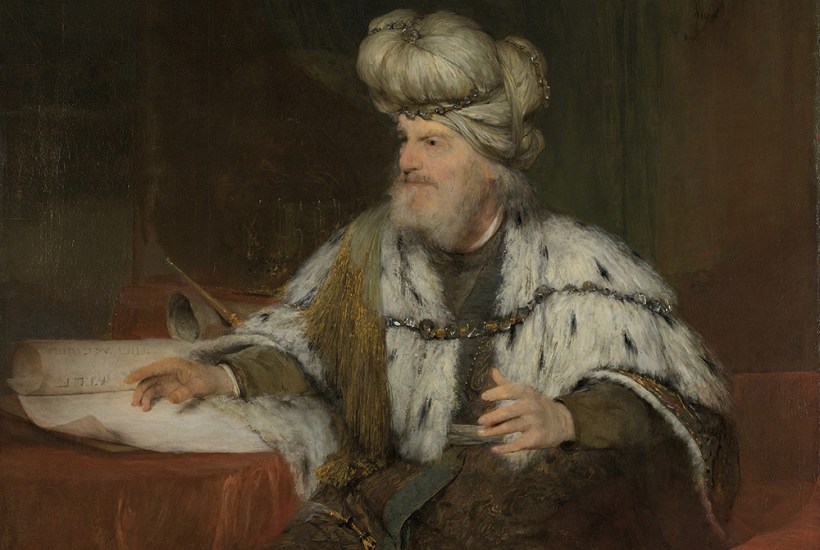
According to conventional wisdom, David was a proper hero. He slew Goliath; he wrote beautiful psalms; he built Jerusalem. His celebrity prompted a jealous King Saul to try to kill him. The legend of David is just one of the myths debunked by Amotz Asa-El in this book.
David was actually ‘a shrewd and violent usurper’, who behaved like ‘a Sicilian mafioso’ at the head of a Judean militia that consisted of ‘everyone who was in straits and everyone who was in debt and everyone who was desperate’ (1 Samuel xxii 2). Moreover, his proclamation of Judah’s secession from Israel accelerated a tradition of political folly that would blight the Jews’ entire future.
The Israelite leaders’ gravest mistake was to outsource their people’s fate to God
The Israelites had long been plagued by factionalism. For all that Moses prefigured Thomas Hobbes in conditioning his leadership on popular consent, and Montesquieu in establishing a separation of powers, his ban on intermarriage between tribes enforced a sectarian mindset. The internecine disputes that followed the crossing of the River Jordan resulted, on Joshua’s death, in a rigid separation of tribes. From then on, the Israelites were beset by civil wars, disastrous conflicts with foreign powers and lengthy periods of exile.
A nadir was reached shortly after King Herod’s death in 4 BC when a delegation of 50 Jewish notables travelled to Rome to ask Augustus to rule over Judea, a forfeiture of sovereignty that was ‘historically absurd and nationally suicidal’. It was also typical of a people so divided that they were unable to rule themselves. (‘Two Jews, three opinions’ goes the saying.) The battles fought between Johanan Hyrcanus, who was a high priest, and his brother Judah Aristobulus, between monarchist Sadducees and God-fearing Pharisees, between libertarian Zealots and moderates who acquiesced to Roman rule, all showed only that ideology had replaced tribalism as a cause of internal conflict.
The Israelite leaders’ gravest mistake was to outsource their people’s fate to God. From the earliest days, they assumed that ‘history, at its every level, is managed by God’. The writers of the Books of Judges, Samuel, Kings and Chronicles shared an intention to ‘serve morality by belittling government in all its forms’, because human rule was an affront to divine will. Asa-El calls Samuel’s oration to an assembly of tribal leaders (1 Samuel viii:11-18) ‘an anarchistic manifesto’. This loaded terminology is not as outlandish as it seems. In his Introduction to Josephus’s The Jewish War, Martin Goodman recalls Judean society’s belief in ‘an anarchist philosophy which forbade submission to any mortal master’.
Asa-El also challenges the ‘disjointed reporting, ideological partiality and descriptive poverty’ that characterise Old Testament narratives. Rather than taking the text at face value, we should regard Biblical stories ‘as suspiciously as a news editor treats a press release’. Ancient spin can be seen in the allocation of just a few sporadic verses to David’s vast military campaigns, in contrast to the extensive coverage of the Bathsheba affair and its lessons in morality. Similarly, the Book of Kings’s treatment of a summit between Judah’s King Jehoshaphat and Israel’s King Ahab is inexplicably terse. Given that it ended six decades of civil war, the meeting should have been covered as a momentous event, yet in what amounts to ‘a literary scandal’, it is reduced to a minor detail.
There are, of course, many ways to interpret the Old Testament. One chapter frames it as ‘the Hebrew tragedy’, which differs from its Greek, Roman and Shakespearean counterparts in being ‘designed not to entertain but to preach, moralise and admonish’. The other difference is that between pulpit and stage.
After the Romans destroyed the second Jewish commonwealth, rabbis now living in exile continued their foolish preaching from the pulpit. Where they should have analysed the past rationally and attributed their misfortunes to the failures of weak political leaders, they saw only God’s punishment for the sins of ordinary Jews. And on they marched, to the 20th century (and beyond), when rabbis on both sides of the Orthodox-Reform schism opposed Zionism, the movement that was to redeem the Jewish nation. One side claimed that only the messiah could revoke their exile; the other said they were quite happy to stay in the diaspora, thank you very much.
The book’s title, inspired by Barbara Tuchman’s The March of Folly: From Troy to Vietnam, might well ruffle feathers. I can already hear Jewish friends complaining: ‘What, we don’t have enough enemies bringing charges against us?’ But in Israel, polemical truth runs deeper than self-serving propaganda. The original Hebrew-language version was in the bestseller lists for several months; and in 2022, Prime Minister Naftali Bennett gave each of his 26 cabinet members a copy inscribed with his words: ‘Together we will protect our third commonwealth.’