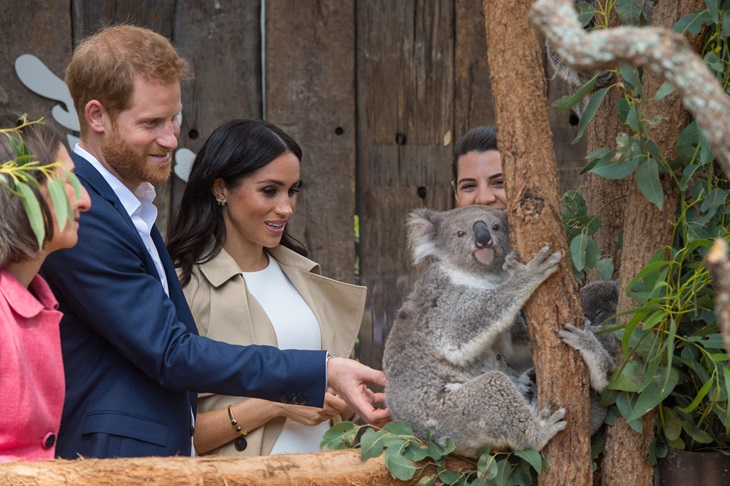
Royal Watchers will be aware of the unexpected news that Prince Harry and Meghan Markle are evacuating California after a series of lacklustre streaming gigs and a bewilderingly cruel book.
According to reports, they have enrolled their young children in school and will shortly head to the UK where they will remain for an extended period.
The pair are not expected to return to their roles as ‘working Royals’. Instead, they will remain private citizens.
Speculation abounds that Meghan might return to acting and who knows … perhaps the BBC can play at being the poor cousin of Netflix and Spotify and pump out a few ‘Sussex’ shows.
For the casual observer, there is something a little cynical about seeking the warm embrace of a nation that was rejected and smeared with petty remarks about racism. Especially considering the bankable attributes of ‘The Sussexes’ flow from the distinctly British Crown – its history, nostalgia, and lore. Without the shadow of the monarchy, the Californian sun burned away Prince Harry’s mystique and charm.
It is not the British way to harass or cause a fuss. We can assume the Sussexes will slip back into the Empire, largely unnoticed.
If, at any point, they wish to make hay from their titles, the Sussexes will have to spend time repairing their relationship with the British people or, in this context, their future customers.
The real damage is not to the Sussexes, but to what the six-year saga revealed about the power of the Crown.
Her late Majesty, Queen Elizabeth II, was always careful not to over-expose herself or the monarchy, understanding that its closed doors, whispers, and mystery played a large role in the public interest.
The same is true of most celebrities, who revealed the full spectrum of their nature on social media resulting in the magic of Hollywood evaporating. Fortunes along with it.
Actors, directors, writers … turns out they are either uninteresting, insane, or repulsive with, more often than not, outrageous political views.
Hollywood has been damaged by the exposé, and so too, some may argue, has the Crown by the Netflixification of the Royals.
The Sussexes may be the more nauseating example, but there have been others.
It could be said the process began to tap on the Royal window with The Queen (2006) starring Helen Mirren.
This was a reasonable movie and groundbreaking as it represented a deeply controversial time in the life of a (then) living monarch. There were criticisms, particularly before the film’s release, about inaccurate or callous portrayals of a sensitive historical event.
Princess Diana was painted by culture at large as an angel impervious to criticism. Opposing her was the narrative of the Royal Family which came very close to being hated. The wound between the people and their Queen was healed the day Her Majesty stepped outside to lay flowers only for a young girl to hand a small bouquet to her. The Queen tip-toed over a cultural crack.
Panic about the film faded away as it was a nuanced production and handled exceptionally well by Helen Mirren (who received an invitation to Buckingham Palace).
The Crown (2013), created by Peter Morgan (who wrote The Queen) was a mixed bag. The first two seasons, starring Claire Foy as the Queen and Matt Smith as Prince Philip, arrived with the same care and dramatisation. The series covered, in more detail, the personal lives behind the Crown and events within living memory of the audience. It was not leaving much to the imagination and, beyond Foy’s era, started to dim some of the mystery in the same way as leaked Royal gossip columns cheapen the image.
While making theatre of long-dead monarchs, such as Henry VIII, has never been an issue for British history – even Shakespeare toyed with the Royals – humanising living Royals to the point of tedium raises questions about the nature of the human beings behind the Crown.
People stop seeing monarchs as critical cultural, ceremonial, and political pieces of the democratic puzzle, and instead romanticise them as villains and heroes, heartthrobs and scoundrels. They become characters in a story and while a streaming channel can terminate a contract, if the people tire of their Crown, they might stage a revolution.
The Press, as a collective piece of performance art, have always played a role in this process. However, they have a vested interest in keeping the Crown alive. The Royals are some of the best click-generators on the books. Diana made them a fortune. The Queen, upon her death, generated thousands of hours of bankable content. While we were crying, the cameras were rolling. Their role is largely useful.
As far as ‘damaging’ press stories go, Andrew Mountbatten-Windsor can give himself the prize for poor decisions. The Royal Family evidently realise this, and pushed him as far out of the circle as physically possible to quarantine the damage.
Really, when it comes to diminishing the brand, it could be argued that the Sussexes have excelled. They tried to bring stardom. Instead, they delivered tedium.
There has been a realisation that Prince Harry’s monetisable qualification seems to be his Royal persona. As he drifted away from the Crown, his press power rapidly faded. Even his laudable founding of the Invictus Games is something made possible because of his Royal connections.
The commercial world was quick and brutal.
Neither Prince Harry nor Meghan Markle brought the numbers streaming services were looking for. The duo also released books and other commercial items, including those related to cooking. Mostly they have been trading on the ever-softening Royal brand in a nation made famous for its rejection of the British monarchy.
This cash-grab popularity pales when compared to the crowds of mourners lining the streets, throwing flowers on the Queen’s hearse.
The Queen wasn’t loved because she was famous and the Crown isn’t valuable because of its commercial price tag.
It is perfectly understandable that the Sussexes may wish to move back to the UK to be nearer the King, especially considering the serious illness he has been fighting. Not to mention bringing their children closer to the rest of their family.
And yet we can’t help but wonder if perhaps reality has set in, and the Sussexes have realised the value of the Crown…
Alexandra Marshall is an independent writer. If you would like to support her work, shout her a coffee over at donor-box.