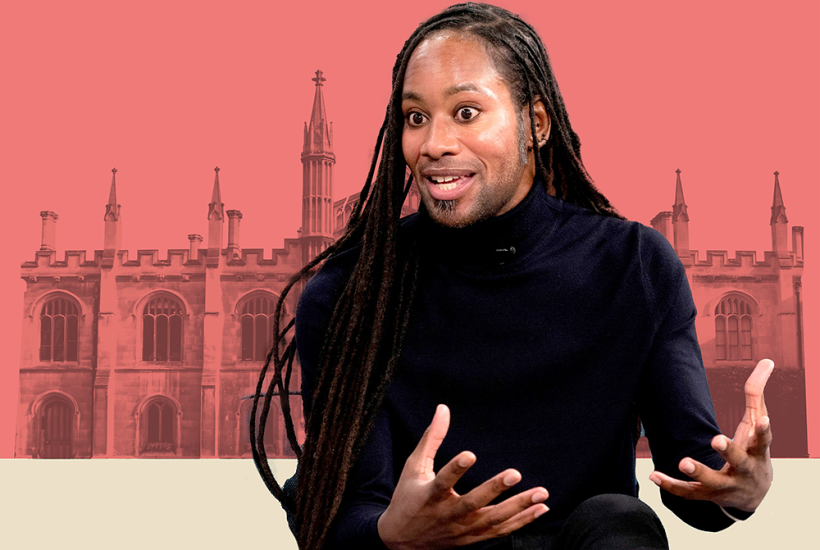
The story of Jason Arday is so brilliantly illuminating of the rottenness of our Establishment that it seems – literally – fabulous. He seems to be almost too fantastic a figure for conventional fiction; rather, he is a character from fables of old – an archetype exposing the sins and hypocrisy of our times, a modern Till Eulenspiegel or Robin Goodfellow. In Arday’s frictionless ascent to academic eminence from a background of apparent disadvantage we see apparently elite institutions eagerly suspending their critical faculties in order to virtue-signal on race, disability and hardship.
By studying Arday’s biography we can begin to understand just how in hock to progressive guilt our top universities are – and how damaging this is for real scholarship.
The story Arday has told about his life seems perfectly attuned to appeal to scholars pursuing research in two of the most fashionable areas of current university activity: neurodiversity and institutional racism. Arday purportedly could not speak until he was 11 and could not read until he was 18. Yet he overcame those disabilities and, of course, ubiquitous racial prejudice, to leverage an educational studies and physical education degree from the former teacher training college in Twickenham which calls itself St Mary’s University, into a professorial chair at Cambridge by the age of 37.
Arday’s ascent is a stunning indictment not just of the incuriosity of Cambridge but its corruption
His stunning academic achievements were accompanied by claims of marathon running successes that would test the greatest ultra runners and charity fundraising that would make Bob Geldof feel inadequate, all achieved in the face of vicious racial persecution which would not have been out of place in 19th-century Alabama.
Each of his claims – the 30 marathons, the millions raised for good causes, the violent persecution – has been comprehensively debunked. But still he pushes back against his critics. His defence seems to be that in academia, no one looks that closely. ‘Could I have ever guessed that somebody would literally comb through every single word I’ve ever said?’ he asked the Times. When a Guardian journalist tried to verify his claims – that he’d been threatened by knife-wielding lunatics, had bananas, bullets and a severed pig’s head sent to his home address – and found no evidence, he told the journalist: ‘I thought you’d just believe me.’
That’s because Arday’s entire career has been an exercise in being believed, even though the whole point of academia is to question, test and criticise. Arday’s ascent is a stunning indictment not just of the incuriosity of Cambridge but its corruption. It seems that no one has ever checked his academic CV, the papers he’s put out for publication (and their corrections) or the data he has used. Sociology rewards what it calls ‘reflexive accounts’. Put simply, this is the act of evaluating one’s own experiences or biases. In other words, just believing someone about the world, without any further investigation.
Grifters have been plying their trade since Alexander of Abonoteichus affixed a false human head to a snake and declared it a God. There have always been Jason Ardays. The question is why this charlatan made his mark in Cambridge. How is it that one of our most respected institutions proved so permeable and undiscerning? Why is a university, that has now been offered incontrovertible evidence that it has been duped standing by him?
Arday was appointed to his professorship following a unanimous vote by the Board of Electors, chaired by Labour’s Baroness Sally Morgan. The announcement was made with considerable fanfare. Before Arday even started the job, the BBC made a video about his extraordinary story. In it, Arday quizzed his new boss, Hilary Cremin, on her work to make the education faculty inclusive. She promised that ‘we’ve listened to the voices of our black scholars and our black students’, and that Cambridge would be ‘facing up to the structural issues that people face’. Most outlandishly, she told Arday: ‘We are so lucky to have you. You are the best in the world in terms of the research that you do.’
It is almost impossible to believe that Cremin really thought this was true. At this point, Arday had just a handful of publications to his name and an exceptionally low citation count. The title of his PhD contained a grammatical error and his papers misspelt basic words like micro-aggression. He had done very little in the way of actual research, preferring to deploy ‘a Critical Race Theory (CRT) a [sic] storytelling method, which operates as a counter-narrative in attempting to conceptualise my own professional experiences of negotiating normative Whiteness’.
Even in the world of racial grievance peddling, Arday was mediocre. One academic source told me that education was a ‘high publication, low-quality field’. It is not like maths or economics, in which one may write a small number of high-quality papers before securing academic posts. Much of Arday’s work was about his own experiences. It is possible to churn out this sort of content at an unusually high rate. A number of staff members junior to Arday at Cambridge’s faculty of education have managed to amass much longer lists of publications. I wonder how they felt when Arday was brought in above them and declared ‘the best in the world’.
Then there is his academic CV. An undergraduate degree and MA from St Mary’s University; a PhD from Liverpool John Moores University, then brief stints at the University of Roehampton and Durham (Arday also claims to have worked at Glasgow but a spokesman denies this). Arday may also have completed an MA in education studies at Liverpool John Moores but this has recently disappeared from his biography on the Jesus College website, where he is a fellow.
Without wishing to descend into snobbery, it would be impressive to secure a PhD at Cambridge from Liverpool John Moores. It is almost unheard of to secure a full chair at Cambridge with those qualifications – I have been unable to find a single other Cambridge professor from Arday’s alma mater. It is, frankly, quite unusual for anyone with a doctorate from a post-1992 university to ascend to such lofty heights.
So what bodies of work did Arday rely on to overcome his credentials? When electors sat down to review Arday’s application to a professorship, they presumably read his breakout paper, ‘Understanding mental health: what are the issues for black and ethnic minority students at university?’. Assuming they did so, they would have seen the long list of corrections, added after he ‘inadvertently omitted overlap between the two publications [his and a 2016 paper on perceived access to mental health services among black and minority ethnic (BME) communities by Professor Anjum Memon et al]’.
If the electors were familiar with the field in which they believed Arday was ‘best in the world’, did they not find it odd that the 32 BME university students he allegedly recruited gave quotes that can be found in an almost identical form elsewhere? One undergraduate student quoted by Arday seems to parrot the words of Professor Memon almost word for word. Other quotes are attributed to different people (of different races) across Arday’s work. You might expect this to be the sort of discrepancy a panel which had actually read Arday’s research before appointing him would pick up on. Worse still, this is not just plagiarism. If these quotes aren’t real, then Arday may be guilty of data fraud, a much more severe offence for which, one academic says, people are regularly sacked.
Arday’s lack of interest in good research should come as no surprise. He announced it during his ‘disrupting racism’ training sessions at other universities. One whistleblower has shown me a lecture he gave in which he told attendees that an ‘obsession with data is unhelpful’ when discussing racism, while asserting that ‘white culture is exclusionary’.
Again, one might expect Cambridge to be quite embarrassed by its inability to identify these issues. Apparently not. The university has issued a statement claiming that: ‘Professor Arday has been the victim of a vile campaign to undermine his credibility, which must stop. Allegations of plagiarism regarding his thesis and journal publications have been thoroughly investigated by the relevant institutions and the journals in question. Professor Arday has been cleared by those investigations of any wrongdoing.’
Notably, despite appointing Arday, at the time of going to press Cambridge seems to believe that it is not its job to investigate allegations itself and is happy to take as read an investigation by Liverpool John Moores as proof of his innocence. During an interview with Times Radio, the writer Nels Abbey read out a letter Arday had received from Liverpool John Moores, which said ‘the allegations were not proven’. He told the station that everyone makes ‘errors along the way’, that’s ‘just how these things tend to work’. Abbey did not address even one of the allegations substantively. You’d think Cambridge might be tempted to do its own review.
Academics are falling over themselves to assert that casual plagiarism is part of normal research. Alan Lester, a Cambridge-educated professor of historical geography at the University of Sussex specialising in colonialism, has had to apologise for suggesting that the extent of Arday’s uncited duplication of other scholars’ work is widespread among peers or ‘appropriate’. It isn’t. Presumably his colleagues advised him that this isn’t the sort of industry secret you want to let on.
Three Cambridge Heads of House signed an open letter defending Arday, instigated by the Good Law Project, a political non-profit founded by Jolyon Maugham. Interestingly, Professor Dame Ijeoma Uchegbu, president of Wolfson College, removed her name and Lord Woolley removed his title as principal of Homerton. Sonita Alleyne, master of Jesus College, has kept her name on the letter despite mounting evidence. No surprise, given her previous work attempting to remove a memorial to the college’s benefactor Tobias Rustat from the chapel.
Even in the world of racial grievance peddling, Arday was mediocre
Cambridge has made it very clear that it does not believe lifting more than 100 passages from another source to be bad academic practice. Several academics have signalled that they do not care about evidence that one of their peers may be manipulating or inventing data. It would seem from the evidence that no one responsible for professorships actually reads the candidate’s work – otherwise we might imagine that some of these issues would have been identified.
These problems are not unique to Cambridge’s Faculty of Education. Analysis by The Spectator found that Cambridge has the highest rates of error in results and/or conclusions in withdrawn papers of any British institution tracked by academic watchdog Retraction Watch. The lack of academic scrutiny to which Arday was subjected appears to be rife across the whole institution.
This is the same institution which set up an inquiry into ‘legacies of enslavement’ at Cambridge, found ‘no evidence has been seen that suggests Cambridge institutions directly owned any plantations that exploited enslaved people’ and then committed £1.5 million of seed funding to resolve wrongs they couldn’t prove.
The truth is almost certainly that Cambridge University hired Arday so that he could be sent on an endless, self-flagellating media round in which he berated Cambridge for being systematically racist but then praised it for trying to do better.
Maybe, perversely, we should be quite grateful to Professor Arday. He has exposed that journalists are better peer reviewers than Cambridge academics. He’s drawn attention to the vacuous nature of an entire field of research. He’s also granted us a wonderful sanity test. Moving forward, we can safely assume that anyone who has defended Arday’s academic practice has themselves never produced anything of value in the field. Which provokes the question: why are they still in their jobs? At least Jason Arday is creative. What excuse do they have?