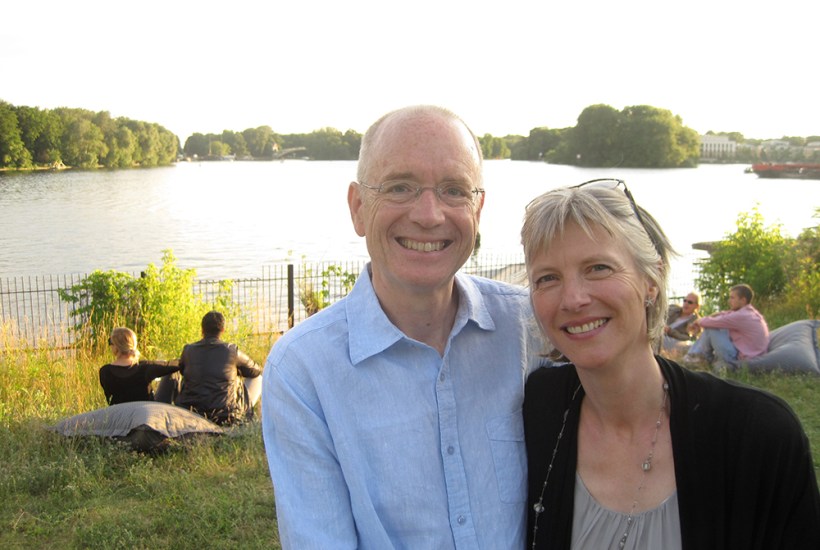
One September, Rory MacLean’s wife, Katrin, was diagnosed with terminal cancer. Seven months later she was dead. The couple had been married for 32 years. In the wake of his wife’s death, MacLean decided to write a book about the afterlife. He had already written books about Russia and Myanmar, Berlin and Crete, but it was not clear where this journey should begin. ‘Unfortunately, few who entered heaven alive returned with a guidebook.’
Over the next five years, he travelled the globe, learning how different faiths understood the afterlife and exploring various sacred sites and religious rites. At the same time he read a wide range of mystical writers and collected insights into death from science, philosophy and the history of religion. This was no scholarly exercise but an attempt to find some meaning in his grief, or even discover some lasting trace of his lost wife. His book, Geography of Heaven, is a moving account of that search.
To begin with, MacLean travels to Beit El, an Israeli settlement near Jacob’s Rock on the West Bank. Here, the patriarch dreamed of a ladder leading to heaven; now, IDF drones fill the night with flashes of light like descending angels. The author also visits the homeland of the Snaw-naw-as First Nation in British Columbia and the Rosebud Sioux Reservation in South Dakota; and he attends meditation retreats in an attic in Glastonbury, an ashram in Tamil Nadu and a monastery in Bhutan.
Throughout this journey, MacLean balances openness to spiritual experience with scepticism about wishful thinking. At the same time, he is frank about the longing caused by bereavement: ‘In the wasteland after death, I couldn’t be sure if I was sensing or only imagining that love must endure, somewhere, somehow.’ In addition, there are thoughtful discussions of the dreams, hauntings and uncanny coincidences that often follow the loss of a loved partner. At one point he even considers creating an AI avatar of his departed wife, before deciding, no doubt correctly, that ‘AI’s disruptive technology hindered the ability to heal’.
He dips his toe into almost a dozen different religions. Some of these experiences are so fleeting that they add little to the book: brief encounters with a Shinto shrine in north London and a Zoroastrian temple in New York. He also writes about faith from a perennialist perspective – the idea that superficial differences between religions distract from their fundamental sameness – that several practitioners he meets seem to doubt. Describing ineffable experience is always difficult, and at times the book resorts to New Age clichés of the ‘primordial transcendence’ or ‘timeless tradition’ variety. However, these moments are outweighed by MacLean’s tender descriptions of his departed wife and his crystalline writing about grief.
‘Since forever, man has known that he will die,’ he argues. ‘Yet in a way we’ve never believed it.’ Certainly, western society – whether Christian or secular – makes little space for departed ancestors and lost loved ones. In some cases, this explains the draw of esoteric religions, with their precise accounts of how the soul navigates from this world to the next. Whether or not MacLean believes these accounts, he agrees with Octavia Paz that, when speaking of death, most Americans and Europeans ‘burn their lips’. However, on visiting Croagh Patrick in the latter chapters of the book, he admires the way that elements of Celtic paganism endured alongside Ireland’s devout Christianity. Despite the official account of heaven and hell, for many Irish people, ‘the dead don’t go anywhere. They remain among us, spoken of as if still alive, a vibrant part of every living family.’
MacLean makes clear at the start of Geography of Heaven that he is no churchgoer: ‘Not agnostic, not ungodly, not indifferent – not anything really.’ During a Vipassana retreat in the Himalayas, he confronts the cold reality of his wife’s death: ‘All that we love will be lost.’ Later, having taken ayahuasca in the Peruvian Amazon, he has a vision of hell that is filled not with infernal tortures but with absolute nothingness. ‘No soul, no heaven, no Katrin. I despaired of it, and of the lack of response to my call.’
However, this is not the end of the journey. Throughout the book, MacLean meets various guides, gurus and fellow seekers. One of them describes the author’s grief as ‘the beginning of the sacred’ in him. Another reminds him of Dante and the old Christian concept that the love of a human being can be a stepping stone towards love of the divine. MacLean insists that he was not searching for God but simply trying to find out what happened to his departed wife. Nonetheless, reaching the end of this inspiring journey through love and loss, he concludes that ‘she awoke in me a vision to share life beyond life’.
Got something to add? Join the discussion and comment below.
You might disagree with half of it, but you’ll enjoy reading all of it. Try your first month for free, then just $2 a week for the remainder of your first year.