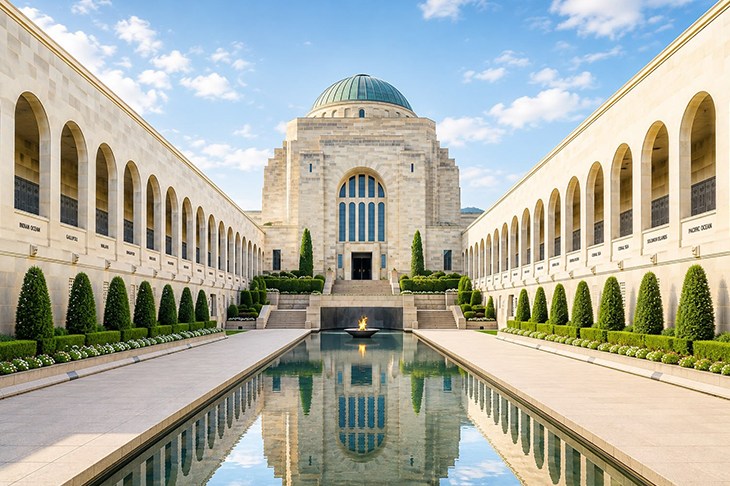
The Australian War Memorial Council, under Chairman Kim Beazley, is proposing to include extensive coverage, in its new Pre-1914 Gallery, of frontier conflict in what were then crown colonies on the Australian continent. This is a dangerous and divisive proposal which is vehemently opposed by the Defend Sacred Ground campaign, of which I am a representative.
There are two questions at the heart of our campaign. Can the Council legally do what it is proposing under its governing Act? And secondly, should they do it?
Let me deal first with the legal question. From my reading, what is proposed is in breach of the Act.
Here is the relevant section of the Act:
- Functions of Memorial
(1) The functions of the Memorial are:
(a) to maintain and develop the national memorial referred to in subsection 6(1) of the Australian War Memorial Act 1962 as a national memorial of Australians who have died:
(i) on or as a result of active service; or
(ii) as a result of any war or warlike operations in which Australians have been on active service;
(b) to develop and maintain, as an integral part of the national memorial referred to in paragraph (a), a national collection of historical material;
(c) to exhibit, or to make available for exhibition by others, historical material from the memorial collection or historical material that is otherwise in the possession of the Memorial;
(d) to conduct, arrange for and assist in research into matters pertaining to Australian military history; and
(e) to disseminate information relating to:
(i) Australian military history;
(ii) the national memorial referred to in paragraph (a);
(iii) the memorial collection; and
(iv) the Memorial and its functions.
Just to be clear, according to the Act, Australian military history means the history of:
wars and warlike operations in which Australians have been on active service, including the events leading up to, and the aftermath of, such wars and warlike operations; and the Defence Force.
And: Defence Force includes any naval or military force of the Crown raised in Australia before the establishment of the Commonwealth.
And: active service means active service in war or in warlike operations by members of the Defence Force.
The term ‘active service’ is the key. It drives everything else. To be included in the Memorial, a person must have been on active service (Subsection (1) (a)). And to be on active service for the purposes of the Act, that person must have been a member of the Defence force, i.e., a unit raised in Australia. Not a member of a British regiment.
And that also drives the history/museum functions as well. The collection of historical material is linked to the memorial function. The historical material must be ‘an integral part of the national memorial’ i.e., it must relate to active service as defined in the Act. And the museum function flows from that.
Therefore, for frontier conflict to be included in the AWM it must have involved military units raised in Australia.
My cursory AI search has not revealed any colonial military force involved in action against Aborigines in incidents listed in the University of Newcastle Massacre Map, which is the most comprehensive study of frontier conflict. It is possible that, on a few occasions, such a unit might have been deployed in an ‘aid to the civil power’ role. That is not active service.
Defend Sacred Ground has received legal advice that the Council is acting in contravention of the Act. Legal recourse would involve an application for a constitutional writ, but we should all hope it doesn’t come to that. We are relying on public sentiment to convince the Council to abandon this divisive initiative, or failing that, to convince the Minister for Veterans Affairs to do his job and intervene.
Now to the second aspect. Regardless of the Act, should they do it? Should the Act be amended to allow it?
There are those who believe we owe it to Aboriginal people to recognise what they went through. They see inclusion of this early strife as a healing gesture, a benign concession. They see it as a legitimate expression of our history – something that we must, not just acknowledge, but also memorialise. I don’t agree with that, for reasons I shall elaborate below, but on the face of it, it is an uncontroversial position.
But ‘frontier conflict’, in the hands of activists, is not just a simple account of what happened in the now distant past. It is also a tool to undermine the legitimacy of Australia. That may not be the intent of well-meaning researchers and councillors at the AWM, but if you hand your enemy a weapon, do not be surprised if he uses it.
The long-accepted version of Australia’s history is that it was a settlement. The narrative pushed by Aboriginal activists and their useful idiots in the tertiary sector, is that it was an invasion. That this country ‘always was, always will be Aboriginal land’. That ‘sovereignty and land were never ceded’. That non-Aboriginal citizens must ‘pay the rent’. That the nation must be ‘decolonised’, whatever that means. All this rhetoric is divisive and corrosive. And it attaches itself to the history of frontier conflict like a parasite. And like a parasite, it strangles its host, turning an unfortunate – and yes sometimes bloody – series of cultural clashes into a continent-wide, century-long resistance movement called the ‘frontier wars’ that involved the deaths of up to 100,000 unknown Aborigines. This claim is patently absurd. There is no empirical evidence to back it up. And it trivialises the sacrifice of 103,000 known heroes.
In hindsight, the name Australian War Memorial might have been ill-judged. It is not a memorial or museum to war, as Chairman Kim Beazley would have it. It is, in its essence, a shrine to the fallen. It should have been called The National Shrine of Remembrance. And as such it should be inviolate. It is sacred ground and must be shielded from political and ideological contamination. It should be a unifying symbol, honouring those who died in the service of the nation.
You can help to prevent this desecration of sacred ground by signing our petition, donating if you are able and promoting this campaign as widely as you can.
Got something to add? Join the discussion and comment below.
You can find our petition at the website www.defendsacredground.com
You might disagree with half of it, but you’ll enjoy reading all of it. Try your first month for free, then just $2 a week for the remainder of your first year.