Next week, we will celebrate a decade since the Brexit vote. The decade that followed was one of political turmoil: five prime ministers in just twice as many years, and maybe a sixth to join them in just a few weeks. David Cameron hoped that a referendum might stop his party obsessing over Europe. Instead, the stalemate in parliament and acrimony that followed Brexit saw his party dealt a semi-fatal blow at the ballot box.
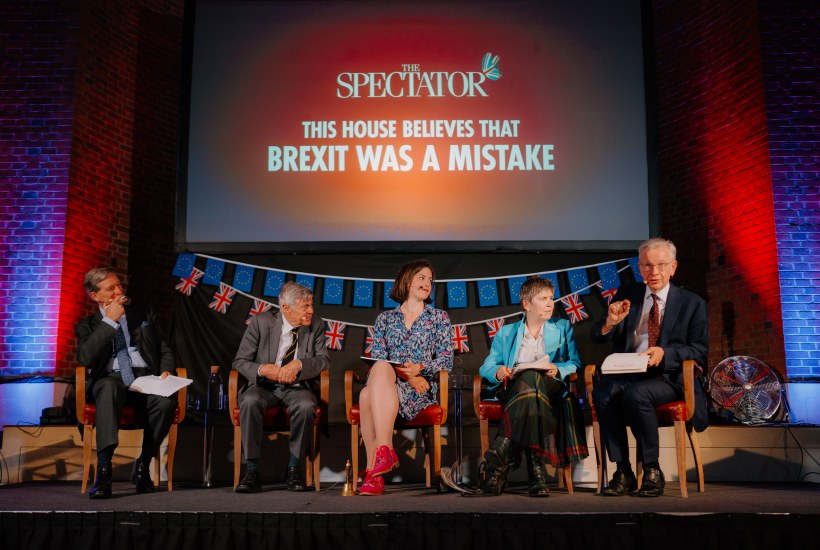
To mark this anniversary, on Wednesday The Spectator asked those who played a key role in the events leading up to the vote: was Brexit a mistake? Batting for Remain were barrister and former Conservative MP Dominic Grieve KC and Spectator columnist Matthew Parris, while former Brexit Party MEP Baroness Claire Fox and The Spectator editor Michael Gove defended Leave. The Spectator’s assistant editor Isabel Hardman refereed.
Dominic Grieve spoke first and provided the only passionate defence of the European Union. ‘The opportunities [the single market] gave us to increase our national security, prosperity and wellbeing were immense.’ Post Britain’s departure, he claimed that ‘the superior growth rate which we enjoyed in 2016 is gone’, replaced by ‘a 4 per cent reduction in growth, a 15 per cent reduction in trade, our GDP is down 5 per cent and our goods exports are down 18 per cent in real terms’.
Is the economy really suffering thanks to the electorate’s decision that we are better off out? It was a claim repeated throughout the night. Both speakers on the Leave side contested Grieve’s assertion that Brexit ‘was never going to work. It didn’t work and won’t in the future.’ Michael Gove offered the Remainers a bet, to prove they really did believe in the economic trauma triggered by Leave: ‘Even if Andy Burnham becomes Prime Minister, I will bet that we will grow faster than Germany in the next five, or even ten, years.’ No one on the Remain side, nor even a single audience member, took him up on it.
‘Running away to join the circus was quite simply silly.’
Matthew Parris struggled to make quite such a positive case for the EU. He opened with a quote from his late friend Tristan Garel-Jones, one of the Conservative party’s most Europeanist politicians. Garel-Jones loved Europe and believed in the European ideal, but once warned Matthew to ‘never forget that the European Union is a f*ckpig organisation’.
For Parris, it was the Leavers who were too idealistic. They were searching for ‘sunny uplands’. But we are ‘doomed in politics to a world of least worse’. ‘Running away to join the circus was quite simply silly.’ Brexit was ‘a populist revolt … an insistence by those who had been overlooked that their voice should be heard. Their voice was heard and they made a mistake.’
Claire Fox, a former member of the British Revolutionary Communist Party and a former Brexit Party MEP, offered a defence of those who voted out. ‘It remains one of the greatest democratic accomplishments of the modern era.’ In 2016, Leave voters ‘who felt their opinions, lifestyles and values were derided … took a gamble and forced themselves on to the stage of history’.
She recalled a meeting of thinktankers shortly after the referendum was called, in which senior politicians ‘fretted that a low turnout would make the taken-for-granted Remain victory seem illegitimate’. ‘Let’s tell everyone,’ they concluded, ‘that this will be a once-in-a-lifetime vote.’ But that tactic worked against them. People concluded that ‘what we think really matters this time. We’re being trusted to make a constitutional decision’.
Fox remembers the referendum as a ‘David and Goliath’ battle: the elites versus the people. The ‘start of the fake-news moral panic’ in which the Labour party ‘branded their own supporters neo-Nazi types’. She believes it was always ‘about more than pounds and pennies and trade deals … it was about tearing up the excuses’.
Michael Gove concurred that Brexit was about democracy. ‘When I was a politician, I was accountable to you,’ he opened. ‘When I got things wrong, and boy did I get things wrong, you had the right to yank the chain.’ Right or left, ‘the thing about Brexit is that politicians can make choices and then you can be the judge’.
Gove regretted that team Leave lacked one speaker, whom he knew ‘would prove that this side is with us tonight’: ‘Schrödinger’s Prime Minister: Keir Starmer.’ Starmer built his career wrapping himself in the gold stars and calling for a second vote on the EU. But what are his revealed preferences? He has cut tariffs, protected the steel industry, allowed AI to grow and even imposed VAT on private schools (a policy booed by the audience). All decisions which Labour could not have made in the EU.
Gove was unconvinced by Grieve’s and Parris’s economic doom-mongering. ‘Dominic said before we voted Leave there would be a recession – the worst recession that we would ever have faced in living memory. The truth is, the British economy has grown just as fast as other European economies. Indeed, we’ve grown faster than Germany.’ In fact, when we were in the single market after 1992, we grew more slowly than before. ‘More Europe meant less growth.’
Our audience, on the whole, did not regret Brexit. At the top of the debate, only 37.9 per cent voted that Brexit was a mistake. Some 62.1 per cent thought that it was not. But that margin did tighten. Once all of our speakers had their say, 39.9 per cent of the audience came to the conclusion that Brexit was indeed an error, with 60.1 per cent against. So the Remainers won the swing.
You can listen to a full recording of The Brexit Debate here. Join our events newsletter here for updates on upcoming events and special offers