In 1911 Duncan Grant’s ‘Bathing’ went on display as part of a design scheme for the dining room of the Borough Polytechnic in Southwark. This large painting depicts a group of strongly muscled male bathers diving, swimming and hauling themselves into a boat. Only one of them is wearing a bathing slip, and while this kind of spectacle might have been familiar to anyone educated at a public school at this period, the art critic of the Times complained that it could well have ‘a degenerative influence on the children of the working class’.
The picture now hangs in Tate Britain, and is used on the gallery’s website to direct people to an account of ‘Queer Life and Art’. This seems fair enough – Grant was after all largely homosexual and ‘Bathing’ clearly carries a homoerotic charge – but what precisely is ‘queer art’? This was a question addressed in 2017 when the gallery mounted its Queer British Art exhibition to mark the 50th anniversary of the partial decriminalisation of homosexuality in England and Wales. It was not simply a matter of artist and subject, for the exhibition’s curator also described ‘the possibilities of queer interpretations’ of art, ‘readings… that foreground connections with same-sex or gender-variant desires, lives, cultures, identities or perspectives’. Such interpretations, she added, ‘have often been excluded from the history of art or squeezed to its margins’.
In the scramble for ‘inclusivity’ many museums and galleries now actively promote their queer holdings
This is certainly no longer the case, and in the scramble for ‘inclusivity’ many museums and galleries now actively promote their queer holdings. The Metropolitan Museum in New York, which in 2006 was attacked by a gay newspaper for avoiding all mention of Robert Rauschenberg’s sexuality in the retrospective it held two years after the artist’s death, now has an article on its website titled ‘Queering the Catalogue’. The Tate’s website is rather more radical, providing a video in which ‘three iconic LGBTQ+ advocates… interpret and make sense of artworks on the basis of their own identities and experiences’. It starts with them standing before Marcus Gheeraerts II’s 1594 ‘Portrait of Captain Thomas Lee’. ‘She’s got her legs out, hasn’t she?’ says one. ‘And she’s got her wrist like that, but she’s holding a helmet just, like, to feel her fantasy,’ observes another, reducing his fellows to helpless laughter. ‘And look at the positioning of the gun!’ ‘Ooooh!’ they all chorus. While this kind of thing might be quite entertaining in a drag pub on a particularly quiet night, one wonders quite what it adds to anyone’s understanding of this portrait of a ruthless
twice-married professional soldier.
If the queer ‘interpretation’ of art has become something of a free-for-all, it has its roots in the rather more rigorous academic discipline of queer theory, in which an LGBTQ+ lens was used to view texts anew.There is nevertheless a distinction between ‘queering’ works of art and usefully drawing attention to homosexual or lesbian painters who might otherwise be overlooked. Artists who were well known during their lifetimes but had subsequently faded from view a little – Keith Vaughan, John Minton, the Roberts Colquhoun and MacBryde, for example – have undoubtedly seen their reputations revive partly because they are now designated as ‘queer’.
The career of Vaughan in particular is instructive. At a time when homosexuality was still illegal his male nudes, painted with varying degrees of abstraction, were notably collected by gay men. His 1946 gouache ‘Two Male Nudes’, for example, was bought by Christopher Isherwood and given to E.M. Forster (along with a bottle of claret) for his 72nd birthday, and then later given by Forster to his last great love, Mattei Radev. Even without so illustrious a provenance, Vaughan’s paintings have increasingly attracted attention and high prices, his ‘queer vision’ now attracting buyers rather than putting them off. In 2008, for instance, a 1951 painting of a seated male figure sold at Christie’s for £79,250, a little under the top estimate of £80,000; in 2022, however, his ‘St Sebastian’, painted in 1961 and with a top estimate of £80,000, went for well over double that at £189,000.
In 2012 Henry Miller founded a fine-art company called ‘Focusing on the Male Form’ with no idea whether it would succeed, but the business has flourished and he now appears at major art fairs and holds regular exhibitions of paintings, drawings, photography and sculpture. It took the big auction houses rather longer to tap into this increasingly lucrative market, and Bonhams’s 2021 sale similarly devoted to ‘The Male Form’ marked a belated recognition that what may once have been regarded as somewhat niche and sub rosa was becoming mainstream. The sale even included an untitled 1974 drawing by Tom of Finland (Touko Laaksonen, 1920-91), whose fantasy images of hyper-masculine sailors and bikers, often depicted quite literally bursting out of their trousers, are seen by some as more akin to pornography than fine art. This particular drawing of a muscular man with outsize genitals being clasped around the waist and thigh by another one (to which Bonham’s gave the wittily descriptive title of ‘Happy Couple’) was nevertheless trumpeted as one of the highlights of the sale, fetching £29,000. It might not suit every living-room wall, but Miller says that younger collectors are now much more relaxed than their elders about buying and displaying erotica. Indeed, Bonhams’s later ‘Male Form’ sales have included a Robert Mapplethorpe photograph of a man hanging out of his jockstrap, a Pierre et Gilles pigment print of three naked footballers cheerfully displaying their wares, and a drawing by Jean Cocteau of a sailor drooling over an erect penis.
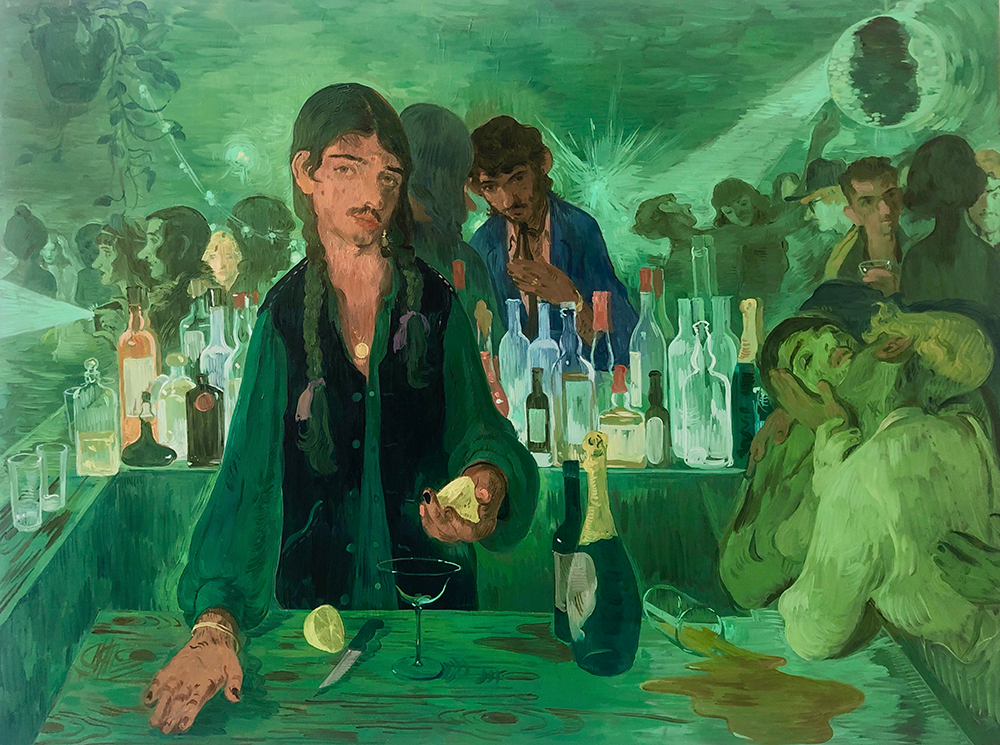 ‘The Bar on East 13th’, 2019, by Salman Toor. Image: © Salman Toor; Courtesy of the artist, Luhring Augustine, New York, and Thomas Dane Gallery.
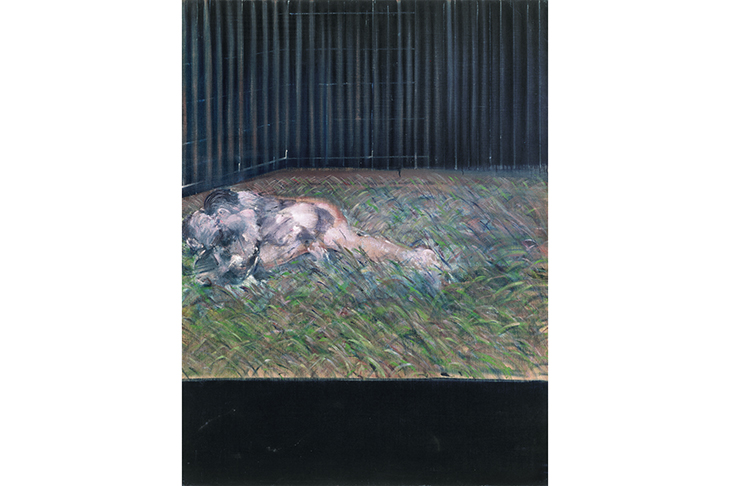
Queer art was a tricky proposition while homosexuality remained illegal, but if some gay artists allowed their sexuality to be inferred from their work rather than making it explicit, both Francis Bacon and David Hockney were more confrontational, even when to do so was risky. The illegal homosexual acts depicted in Bacon’s ‘Two Figures’ (1953) and ‘Two Figures in the Grass’ (1954) led to the earlier painting being dubbed ‘The Two Buggers’ and the latter one provoking a police investigation when it was exhibited in a 1955 retrospective at the ICA. Hockney’s early work also includes images of homosexual activity: ‘Adhesiveness’ (1960), for example (its title referring to a term used for homosexuality by the queer poet Walt Whitman), clearly depicts two males indulging in mutual fellatio. Other paintings of this period, such as ‘Doll Boy’ and ‘Going to be a Queen for Tonight’, incorporate the words ‘queen’ and ‘queer’ as if they were lavatory-wall graffiti. The paintings of both artists embody the kind of defiance that would become a marker of later queer art, notably in the work of Derek Jarman.
To view Hockney’s work solely through a queer lens risks overlooking his technical mastery
While Jarman embraced queerness, giving paintings done in the 1990s such titles as ‘Poofs’, ‘KY’ and indeed ‘Queer’, not everyone feels as comfortable with being categorised in this way. Henry Miller does not think that any of the artists he represents would call themselves ‘queer’, but when he posts their work on Instagram he is canny enough to add the hashtag #queerart. Some 2.7 million other images, many of them owing more to Tom of Finland than to Michelangelo, also attract this hashtag, though some would argue that labels such as this, or #queerartist, can be limiting. Calling someone a ‘queer artist’ may at first glance seem progressive, but few people now would describe Tracey Emin as a ‘woman artist’ or Jean-Michel Basquiat as a ‘black artist’. While Hockney, who was rightly praised in some of last week’s obituaries for the work he produced celebrating homosexual life and desire, could with some justification be designated a ‘queer artist’, this label tells only part of the story. Indeed, one of the most remarkable things about Hockney was his range and versatility, and to view his work solely through a queer lens risks overlooking his technical mastery. If in the past some queer artists have been undervalued because their subject matter was outside the sexual mainstream, there is now perhaps a danger of prioritising subject matter and sensibility over aesthetic merit.
That said, many fine contemporary artists are happy to be labelled queer. The highly successful US-based Pakistani painter Salman Toor, who has an exhibition coming up at the Courtauld in October, says: ‘I paint figures to enhance my context as a queer man living between cultures. It is powerful to be connected with other queer people, through a queer network, across cities and state lines.’ Louis Fratino’s sumptuous artworks depicting ‘the intimacy and tenderness of everyday queer life’, including such sexually graphic paintings as ‘I Keep My Treasure in My Ass’, were selected for the Venice Biennale in 2024 and attract very high prices for an artist still in his early thirties.
While many major galleries have embraced queer art, not everyone is as relaxed. When Jonathan D. Katz was making selections for The First Homosexuals, a scholarly exhibition that investigates ‘how new images of sexuality, gender and identity arose’ after the coining of the word ‘homosexuality’ in 1869, some 80 to 90 per cent of the museums and collectors he approached refused to lend artworks. Agreeing to loan works for a specifically queer exhibition perhaps risked shining an unwelcome spotlight on pictures that otherwise nestled unobtrusively (and un-queered) among other paintings as part of more general and conservative collections. One might see a parallel here with gay men in the past who had to some extent been tolerated as long as they did not draw attention to themselves. The eventual success of the exhibition, last year in Chicago and now in Basel, nevertheless suggests that, whatever qualms such collectors may have felt, queer art has now come roaring out of the closet to become a major attraction for all kinds of audiences, regardless of their own sexuality.<//>
Got something to add? Join the discussion and comment below.
You might disagree with half of it, but you’ll enjoy reading all of it. Try your first month for free, then just $2 a week for the remainder of your first year.