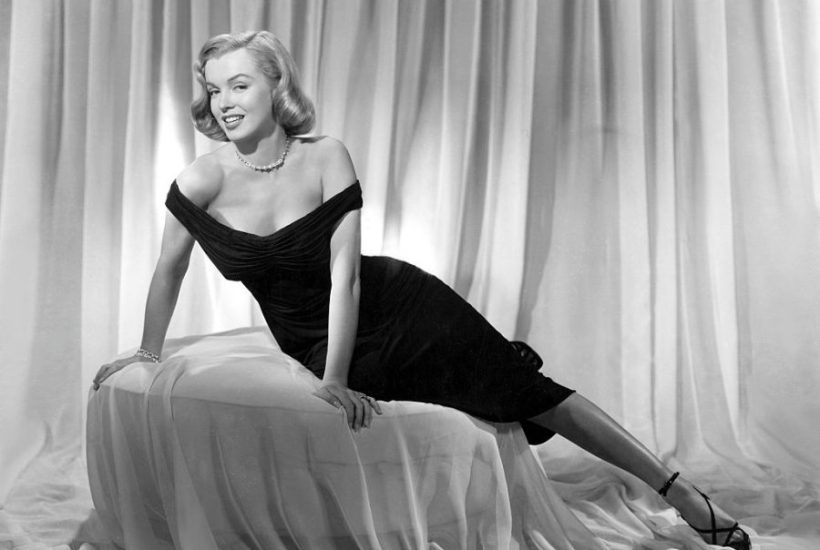
Marilyn Monroe was born a hundred years ago today. She was famous enough in her lifetime to be one of those rare figures referred to by their first name alone. Such fame seldom lasts. Even Frank now needs to be called ‘Sinatra’. She is still ‘Marilyn’ partly because the name fell out of use; her fame survives partly because she died young – of a barbiturate overdose, presumed to be suicide – at the age of thirty-six.
My favourite Monroe story is one told by Billy Wilder, who directed and co-wrote the film Some Like It Hot. Newly engaged to Arthur Miller, the actress was taken to meet Miller’s parents in a small New York apartment with thin walls. Nervous of being overheard while she was using the bathroom, Monroe turned on the taps to cover the noise. Miller phoned the next day to ask what impression his bride-to-be had made. ‘Sweet girl,’ his mother replied. ‘Wonderful girl. Pisses like a horse.’
Monroe’s afterlife has oscillated between those states: goddess and mammal
The joke works because the whole scene ceases to be about fame and becomes about being human. Monroe’s afterlife has oscillated between those states: goddess and mammal, icon and woman caught short. Other stories do the same, but few make you immediately like everyone involved that little bit more. A transcript – supposedly of tapes Marilyn made for her psychiatrist, though the originals were never produced – has her saying that her greatest acting came in bed. ‘I would win overwhelmingly if the Academy gave an Oscar for faking orgasms,’ she reportedly said. Human, certainly, but with an undercurrent of sadness, and even in its kindest interpretation a statement about manners triumphing over sincerity.
That famous photo from The Seven Year Itch gives an even less appetising account of the gap between humanity and fame. As Monroe stood over the subway grating, above a wind machine blowing her skirt upwards, a crowd yelled for it to go higher and higher. Her baseball star husband Joe DiMaggio – a man so famous that it was said she had been the only girl in America not to know who he was – looked on appalled as his wife was ogled by thousands of onlookers. Billy Wilder, directing, recalled DiMaggio’s ‘look of death’. The next day the on-set make-up artists needed to cover up the bruises he gave her, and the incident brought their marriage to a close. If you look at that photo today without hearing the crowd or knowing what happened, it looks as light-hearted as it was meant to.
When Monroe and Joe DiMaggio divorced, Oscar Levant quipped that it proved a man couldn’t triumph at two national pastimes. In his childish combination of brutality and sentimentality, DiMaggio certainly demonstrated a failure to treat her as fully human. His violence was an ugly episode in her life, but the inability behind it seems to have blighted the rest of his own. He never remarried. He had roses sent to her grave thrice weekly for twenty years before stopping because what he’d meant as a private act had become a public spectacle. He was said to have died saying that at least he’d get to be with Marilyn again, a prospect it apparently didn’t occur to him she might have had different views on.
It is impossible, still, to watch Some Like It Hot without feeling richer and more joyful for the experience. If anything the sense of delight is only accentuated by reading about the film’s problems. Monroe was catastrophically unreliable, taking fifty takes to get a line right even when it had only three words. Because her lines sometimes came at the end of scenes, Curtis and Lemmon had to perform their own more demanding parts perfectly, every time. Wilder said his doctor instructed him never to attempt another film with Monroe; Curtis said kissing her was like kissing Hitler – a line he later blamed on irritation at a dumb question. But the bitterness was real; so is the film’s lasting joy.
Intimacy is for those closest to us; what the rest of us have of movie stars is celebrity, which belongs to gossip: a grand source of pleasure, and a foolish place to look for anything more. Strip away the phoney tinsel of Hollywood, said Oscar Levant, and you’ll find the real tinsel underneath.
Monroe was beautiful, gifted in front of a camera, and no less inwardly complicated than the rest of us. What happens on the screen is for us to enjoy; what goes on in private is often best left that way; it’s a mistake to try and read the mysteries of our own hearts in those we know only through fame. Gossip, though, is part of life, and we relish what comes our way, much of it from the world of film. Gossip is at its best not when it pretends to expose the soul, but when it catches everyone being human. Wilder remembered seeing the director Ernst Lubitsch burst into laughter over a comment card from a test screening of Ninotchka. ‘This movie was hilarious,’ it read. ‘I laughed so hard I almost peed into my girlfriend’s hand.’