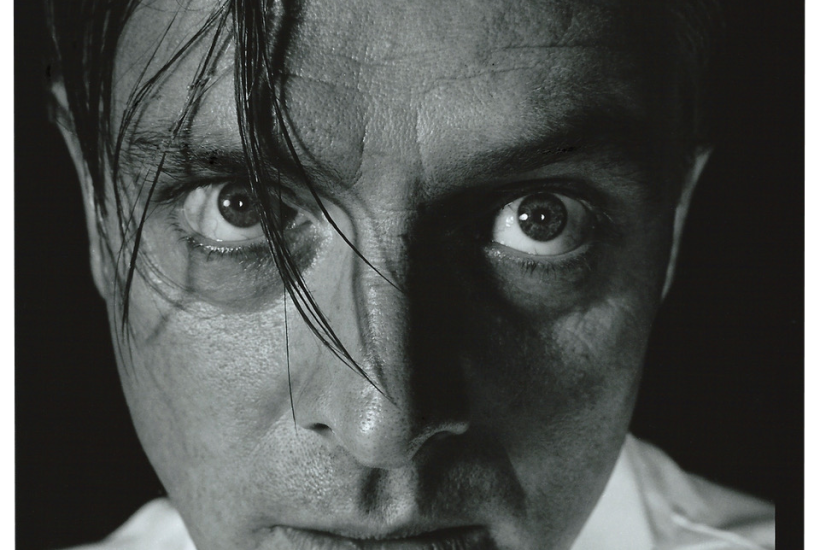
If you’ve tended to think Rik Mayall was both very funny and quite annoying, it turns out you’re not alone – because, with varying degrees of tact, that’s what most of the people who knew him suggested in Rik Mayall: Magnificent B’stard. At a time when far too many documentaries about celebrities are celebratory to the point of cloying, this one was, of course, all the better for it.
By his own account, Mayall first discovered the joys of showing off in primary school. Instructed to mime in the choir, since his voice was ‘so horrible’, he did so with the wild exaggeration that would remain his speciality. The laughs he got duly turned his boyhood head.
By the time he was a drama student in Manchester, he’d already developed the schtick that he was ‘the funniest man in the history of the universe’. Schtick, or perhaps conviction, given that the gap between him as a performer and as a man was, according to every contributor here, impossible to distinguish, even by him. Instead, much of his personal life, as well as his professional one, seems to have comprised a note-perfect impersonation of ‘Rik Mayall’.
Along the way, the documentary provided an unusually close analysis of his work, beginning with his early incarnations as Rick the poet and Rick in The Young Ones (still toweringly great, as the clips demonstrated). Oddly, the underrated showbiz satire Filthy, Rich and Catflap also appears to be underrated by its writer, Ben Elton. But Ade Edmondson, another friend since Manchester, was rightly proud of their joint project Bottom, describing it as Waiting for Godot with added Wile E. Coyote – which would be hideously pretentious if it weren’t so bang-on. There was a lot of (mostly) good-natured eye-rolling about Mayall’s extravagant turn as Flashheart in Blackadder, after which he boasted – again maybe ironically, but probably not – that he’d ‘won the show’.
But by then, he was boozing heavily, heading to the pub straight afterwards to line up three pints of lager and two whiskies, before getting down to some serious drinking. Mayall’s boozing also put paid to the touching and ultimately tragic love story at the heart of the documentary: the one between him and Edmondson. ‘We used to enjoy alcohol so much together,’ Edmondson mistily recalled. But during the lucrative Bottom theatre tours, he began to find being in Mayall’s relentless company for weeks increasingly trying.
The drinking worsened after Mayall’s co-star Stephen Fry did that famous runner from Cell Mates in 1995 – which, said Elton, was ‘catastrophic for Rik’. When Fry’s disappearance became front-page news, ‘he found himself an also-ran, which he really couldn’t take. He was not attuned to being ignored.’ Mayall’s daughter Rosie remembered her and her father travelling by train to their Devon farm, when he spent the journey necking miniatures, with the injunction ‘Just don’t tell your mum’. On arrival, he went on the quad-bike ride that ended with him in a coma, and never the same again.
Mayall had already developed the conviction that he was ‘the funniest man in the history of the universe’
Even so, the Bottom tours resumed – with Edmondson having less and less fun, until he finally told his old pal that it was over. The announcement left Mayall tearfully shattered; and Edmondson ‘grieving’ to this day that his partner’s sudden death in 2014, aged 56, meant ‘we never repaired what our relationship was’.
Compared with the fully acknowledged knottiness of Magnificent B’stard, the three-part drama Goolagong is a straightforward, old-school biopic of Evonne Goolagong, who, in the traditional way, rose from humble beginnings to conquer the world – or at least to be very good at tennis.
To prove it, the opening scenes interspersed her first match at Wimbledon in 1970 with her early life as part of a loving Aborigine family in rural New South Wales where she started her career knocking a ball against the wall with a small plank. Luckily, a tennis club then opened nearby and she soon shone enough for the local coach to call in a big-name professional: Vic Edwards from Sydney, who took her back to live with his family and be turned into a champion.
But – again, not unexpectedly – Edwards’s motives became ever more mixed. While it might even have been true that he wanted ‘only the best’ for Evonne, the best in question by 1970 included him controlling her money and, ideally, her responding to his sexual advances. To have more money to control, he also arranged for her to play in South Africa – which inevitably appalled Aborigine activists.
In this week’s two episodes, the programme traced all this with a determined lack of sensationalism, but with an impressively beady eye nonetheless. The result is a programme that feels content to avoid frills, confident that the story itself is strong enough to keep us watching. Happily, this confidence is entirely justified.
Got something to add? Join the discussion and comment below.
You might disagree with half of it, but you’ll enjoy reading all of it. Try your first month for free, then just $2 a week for the remainder of your first year.