I finished reading The Book of Birds by Robert Macfarlane and Jackie Morris, and leaned out of my attic window to smoke and think about it, when there among the tumbling spires of the apple trees was a spasm of fluttering and a flurry of notes: two spotted flycatchers! One held the air for a moment, hovering and looking me in the eye, and then darted back to its perch while the other called.
It has been years since we have seen them, and straight to my bird books I went. The Book of Birds was no help because it does not include the spotted flycatcher and is not designed as a recognition guide. Instead, Macfarlane writes: ‘Ours is a field guide with a difference… It asks not “What is that bird?” but “Who is that bird?”. The aim is to help readers identify with them.’
The prodigiously creative and productive Macfarlane has toured Britain with musicians, staging shows of words and music; and the influence is clear in the writing, which reads like performance poetry. Each bird is addressed personally, Macfarlane summoning them to be personally introduced:
Where to start with you, Cuckoo? Your one-two call, perhaps, from high on oak or yew, which heralds spring anew then beats out summer’s hot tattoo. The curious beauty of your feathers; their smalty blue, their smoky, petrol hue. And we must not forget, or course, the chilling trick you pull on other birds – your devious, monstrous switcheroo.
Rhymes and complementary rhythms come effortlessly. It is like listening to the Ajax of the rap-battle, as if Eminem had taken up ornithology. Read in one go it is too rich: this is not necessarily a book to be swallowed in a sitting. But dipped into and savoured, it is a delight. Macfarlane’s love of language and different cultural traditions make it a trove of avian lore and history: ‘In Newfoundland, razorbills were known as “thinkers”. The name was given for their habit, while courting, of holding their bills upwards, apparently in contemplation of the heavens.’ Avocets survived because their pumped-dry feeding grounds on the east coast were reflooded as a defence against German invasion. In 1949, so many starlings landed on the hands of Big Ben that their weight slowed national time.
Macfarlane’s grandfather worked on the development of radar: ‘On clear spring nights, drift-like shapes would show green and huge on the radar screens.’ They were not bomber fleets, the operators realised, but migratory flocks. ‘We came to call them “radar angels”, my grandfather said…’ The identification of birds with gods and their messengers is as old as us. The ancient Egyptians held that in their final judgment Anubis would balance their souls against the weight of a feather. From Japan to Iceland to Ireland the whooper swan was sacred, ‘a crosser of realms’.
Some images stop you dead. A meso-lithic tomb in Denmark contained a mother and baby who perished together in childbirth. Placed beneath the baby’s body was a swan’s wing. Lore and lyricism are well balanced throughout, with a hinterland which is more Larkin than Byron. Car-parks, phone masts and motorway verges keep the book grounded in the contemporary.
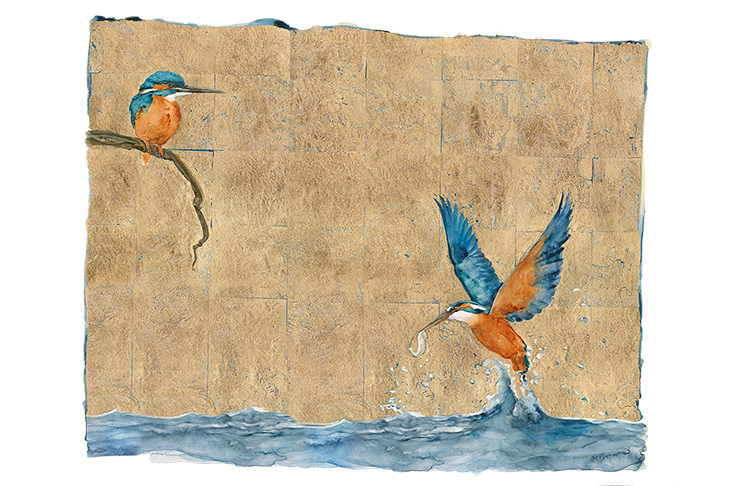
Its declared purpose is an intervention in our ongoing destruction of nature. ‘Knowledge may lead to wonder, wonder to care, care to action, action to change,’ Macfarlane writes. Wonder, for bird lovers, drives us to learn the ways and wiles of birds, but it begins in beauty, in seeing, in line and colour and motion. Fascination with their forms took me to bird art, and on to a love of art. The book is illustrated by one of our most distinctive and prolific painters, Jackie Morris. She sees the dinosaur in the bird. Her portraits have a savagery about them, as if she is captured by the creatures’ appetites, their thrust and strut and will to life. It is as though she is painting their souls as she conceives them.
In 1949, so many starlings landed on the hands of Big Ben that their weight slowed down national time
The book flaps and yells and squawks with life, its pages bursting with a ferocious, combative kind of beauty. There are moments when text and illustration work in sweet harmony: Morris’s gentle rendering of the knot is answered by Macfarlane’s prose:
…ten thousands knots at a time, at a turn, shimmering as if they might both catch the light and be it, and – watching this in the sun’s cold burn – you think those knots in flight and number are surely what faith must look like, if only you could see it.
Throughout the book there are moments of piercing beauty and emotion. A field, a hill, a world without birds is a lonely, barren place. This book is a laudable defence against that austerity and wonderful company in itself.
Got something to add? Join the discussion and comment below.
You might disagree with half of it, but you’ll enjoy reading all of it. Try your first month for free, then just $2 a week for the remainder of your first year.