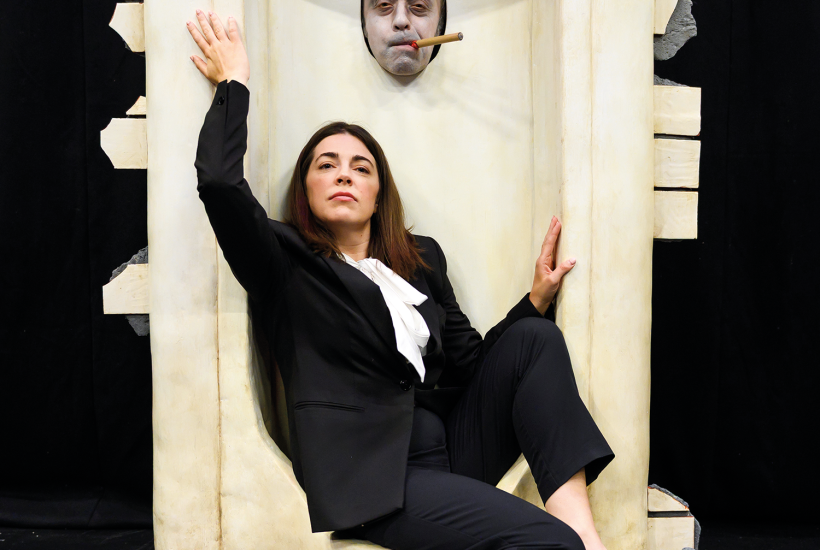
When Rachel Reeves became Chancellor she found a lavatory in her private suite which had been used by Churchill in the 1920s. She vowed to remove it. ‘Smashing glass ceilings and urinals’ was her policy. The actor, Rosie Holt, felt inspired by Reeves’s petulance and she wrote a satire about a female politician who sets out to refit the pipes at No. 11.
The Chancellor sits in her office taking phone calls from a secretary, a spin doctor and a divorce lawyer who wants her to finalise a settlement with her awkward ex-husband. Her campaign to replace the loo sparks national outrage and her office is besieged by throngs of far-right agitators. All are men. The urinal itself, played by a Churchill lookalike, becomes a personality in the play and offers advice: ‘Stand your ground. Don’t surrender.’
This is weird. Holt’s simple idea has morphed into a three-headed beast. It’s an emotional drama about a messy divorce. It’s a political satire about a feminist who defies the mob by barricading herself in Downing Street. And it’s a surreal fantasy about a politician whose office is haunted by her predecessor’s spirit. The awkward strands are never brought together and the result is a haphazard, bitty show.
Occasionally a decent joke emerges. Churchill’s statue in Parliament Square is likened to ‘Thérèse Coffey in a flasher mac’. But the rest of the gags are lazy. When the Chancellor claims that all Tommy Robinson supporters are ‘Nazis’ she assumes that her audience will concur. Her character is guilty of imperfect logic. She hates all men, naturally, including her dad, her ex-husband and the condescending spin doctors sent by No. 10 to monitor her protest. Yet she admits that ‘men with hammers’ are indispensable.
And she can’t decide if she hates Churchill or admires him. She calls him a ‘fat old cigar-chomping turd’ whose legacy is ‘obsolete’ but she’s happy to quote his speeches and to recycle his best jokes. She seeks to emulate his resolve when her courage falters. She has a strange relationship with the criminal weirdos who send her pervy messages online, and she seems to wallow in their depraved ramblings. She imagines how she might feel if the rape threats were to cease altogether. She admits that she would miss them. This is truly eccentric. Do female MPs believe that a few rape threats are preferable to none? Holt is a superb performer with strong comic instincts who can hold a live audience effortlessly. She needs better writing to propel her talent skywards.
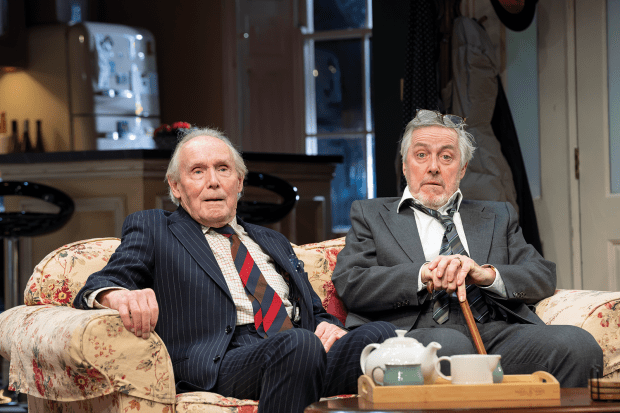
Stage Kiss is a dressing-room comedy about two old flames who meet when a director hires them to play lovers in a daft 1930s comedy. The Last Kiss has a hilariously awful storyline. In a swish New York apartment, a dying heiress invites her old boyfriend to pay her a final visit. His arrival reverses her condition and she rekindles their affair on her deathbed. Her husband indulges her infidelity but the old boyfriend tires of the heiress and runs off with her teenage daughter.
At the opening rehearsal of The Last Kiss, the leading actors (known as ‘She’ and ‘He’) are seized with an irresistible desire to revive their dead romance. Both are in existing relationships and their affair causes predictable problems. And blandness is part of the problem here. The show is easy to enjoy but hard to care about because ‘She’ and ‘He’ are playing two roles, on stage and off, so the viewer’s sympathies are divided.
This lack of focus is compounded in Act Two when the pair are hired to play lovers in an even sillier romcom set in the 1990s. ‘She’ is cast as a Brooklyn hooker who wants to become an ophthalmologist. ‘He’ plays an undercover IRA terrorist arranging a shipment of weapons to Belfast. The absurdity of the narrative will amuse anyone who has been forced to read a slush pile of scripts at a producing theatre or a literary agency.
The show, expertly directed by Blanche McIntyre, is full of theatrical in-jokes about bad lighting, faulty props, dangerous items of furniture and gunshot sounds that go off at the wrong moment. Thesps will recognise bugbears like the elusive director, played by Rolf Saxon, who refuses to give an opinion and encourages the actors to do whatever they feel like doing. Patrick Kennedy is acceptably handsome as ‘He’ while MyAnna Buring conveys the increasing desperation of ‘She’. But the time they spend capering around the set, brilliantly designed by Robert Innes Hopkins, doesn’t add up to much.
The play would be a surefire hit for two stars with lots of fans who are prepared to pay money to see them in absolutely anything. A pair of globally famous has-beens would do the trick. Are Meryl Streep and Danny DeVito available?
Got something to add? Join the discussion and comment below.
You might disagree with half of it, but you’ll enjoy reading all of it. Try your first month for free, then just $2 a week for the remainder of your first year.