John Bolton was born in the Year of the Rat. The Chinese, who have been thinking about human character rather longer than Washington has existed, associate the type with intelligence, calculation, and an entirely unsentimental view of the world. One need not believe any of it. The description fits anyway.
Bolton belongs to a class of men the American state once produced in abundance and has now largely stopped: hard, strategic, unembarrassed about power, and entirely at home in the machinery of government.
He served across Republican administrations, represented the United States at the United Nations, and occupied the office of National Security Adviser. These are not ornamental positions. They are the part of government where decisions are made under conditions that do not permit extended moral deliberation, and where the gap between intention and consequence is not academic.
The anecdote that has followed him longest concerns José Bustani, then Director-General of the Organisation for the Prohibition of Chemical Weapons. In 2002, Bolton flew to The Hague, gave Bustani 24 hours to resign, and – according to Bustani – added this: ‘We know where your children are.’ The line has followed him ever since. It should.
Bustani was being removed because his proposals for Iraqi accession to the Chemical Weapons Convention threatened to complicate the case for invasion. An international institution was obstructing a strategic objective. Bolton’s message was the signal that the obstruction would be treated as adversarial and that consequences were real. The international legal framework is, in this worldview, an instrument. When it assists American power, it is useful. When it impedes it, it is in the way. Bismarck, who never confused sentiment with statecraft, would have found the reasoning unremarkable.
Bolton has always rejected the ‘neoconservative’ label. He is, by his own description, a Goldwater conservative. Neoconservatism is a missionary project: American power deployed to reshape the world in America’s image. Bolton’s instinct runs harder and narrower. He is interested in freedom of action, which means removing whatever obstructs it.
There was a time when Bolton was a stock villain of liberal commentary: the embodiment of American overreach, filed under H for Hawk and largely left there. Then came the memoir, and with it one of the more cynical reversals in recent American political life. The moment Bolton turned on Trump, the same press that had spent 20 years denouncing his hawkishness discovered that he was a truth-teller. His views on Iran had not changed. What had changed was that he had become useful to a different team, and the liberal media signed him up without pausing to acknowledge the contradiction. As Operation Epic Fury – the very war Bolton’s worldview demanded – enters its second month, he appears on cable news several times a week, delivering lines like this: ‘Since Trump doesn’t have a philosophy, he doesn’t understand even the extreme form of philosophy which we call ideology – but the people in Iran do.’ The same outlets that once called him dangerous now nod along. They do not pause to note the irony.
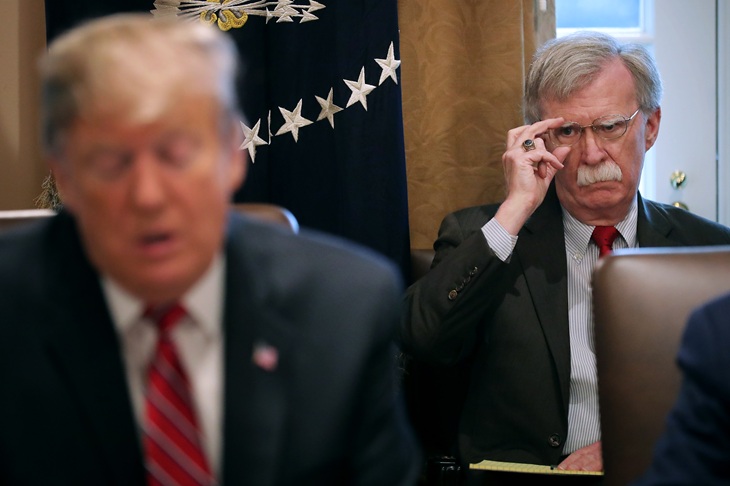
The first Trump Cabinet was not a governing structure in any traditional sense – a commander with a hollowed-out deputy in Pence, a Secretary of State in Pompeo who survived by accommodating instinct rather than directing it, and precious little between the president’s impulses and their execution. Bolton was expelled not because he was too dangerous but because the architecture was too thin to contain a man who treated foreign policy as consequential.
The second Cabinet is a different proposition. Vance brings a genuine foreign policy intellect. Rubio is a credentialled operator. Bessant, Lutnick, and Burgum provide institutional seriousness conspicuously absent the first time. The characterisation of this group as far-right ideologues is lazy and wrong – it is, by the standards of recent American government, a substantially more serious administration.
The Nato question sharpens this further. Bolton has always held that the President possesses the unilateral right to exit any treaty. Marco Rubio, now Secretary of State, once thought differently. In 2023, he co-sponsored legislation specifically designed to prevent any President from withdrawing from Nato without two-thirds Senate approval. He is now in Trump’s Cabinet as Trump, furious that Nato allies declined to participate in Operation Epic Fury, calls the alliance a paper tiger and tells reporters he doesn’t need Congress to leave it. Rubio has begun to reexamine his position. Bolton, characteristically, never needed to.
Which produces the most uncomfortable observation: the administration now serious enough to have absorbed Bolton is the one prosecuting him. What matters now is that the people carrying the prosecution belong to an administration serious enough to know better.
Bolton is, in the American sense, a meritocrat of the old school – a fireman’s son from Baltimore who made his way through Yale and into the governing heights by intelligence, discipline, and institutional cunning. In recent decades, the obvious comparisons are Zbigniew Brzezinski and Henry Kissinger. Beyond them, the company thins quickly.
It is this man who has been indicted on 18 counts under the Espionage Act, concerning the handling and transmission of classified material. Bolton served, clashed, departed, and then published a memoir describing his former employer as unfit for office. Trump stripped Bolton of his Secret Service protection while Iran was publicly plotting to kill him. The indictment followed. Pam Bondi, the Attorney General who announced it with the declaration that ‘no one is above the law’, was herself fired last week – ostensibly over other controversies, but amid broader White House frustration that the Justice Department had failed to secure enough successful prosecutions against the President’s enemies.
The more revealing question is what the indictment says about a system that chooses to handle a figure of this kind in this way. Bolton spent decades in the service of the American state at its most consequential levels. The state’s response is to make an object lesson of him.
Bolton’s type – men for whom power is a responsibility rather than a performance – has been disappearing for years, replaced by a political class more fluent in procedure than judgment, more comfortable with commentary than consequence, and more inclined to reach for process when it wants to punish than to reckon with what that desire says about its own moral condition. The successors are not hard to identify: a former judge who traded the courtroom for a camera and has now been handed a courtroom again as United States Attorney for the District of Columbia, a morning-show host running the Pentagon.
One can imagine Bondi asking whether to drop the case, and Trump replying: ‘That dirty rat? He almost cost me the election. Not a chance.’
The current administration is serious enough to recognise Bolton’s type. The indictment proceeds anyway. Only a fool prosecutes John Bolton.