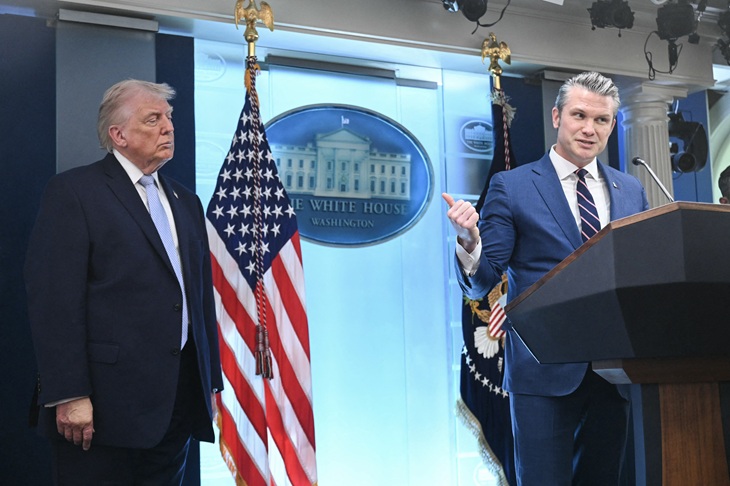
When an American F-15E Strike Eagle was brought down over Iran on April 3 by a shoulder-fired missile, the Pentagon executed what Defence Secretary Pete Hegseth has since compared, with characteristic restraint, to the resurrection of Christ.
Two crew members ejected. One was recovered within hours. The second, a wounded weapons systems officer, evaded capture for nearly two days in the mountains before Navy SEALs extracted him under heavy fire.
Donald Trump posted, ‘WE GOT HIM!’ on Truth Social. Benjamin Netanyahu invoked Entebbe. The story was wrapped in a flag and filed away as triumph.
Then the arithmetic started to misbehave.
The rescue package, by figures now circulating in both American and Iranian sources, involved more than 150 aircraft: four bombers,64 fighters, 48 refuelling tankers, 13 dedicated rescue platforms, and a constellation of helicopters, drones, and special-operations transports. A forward arming and refuelling point – a temporary desert airstrip improvised behind enemy lines to refuel and rearm helicopters mid-mission – was thrown together on a flat patch of desert near Isfahan. Two MC-130 Hercules became bogged in sand and were destroyed in place. Several helicopters were abandoned and torched. An A-10 Warthog was lost the same week near the Strait of Hormuz. By any honest accounting, this was the costliest American search-and-rescue operation in living memory – for one airman.
Planes, Missiles, and Coordinates: Where the Story Bends
That ratio alone would invite raised eyebrows. What turns eyebrows into open questions is the geography. The downed crew was reportedly located in Kohgiluyeh and Boyer-Ahmad province, in Iran’s rugged southwest. The improvised American airfield was set up several hundred kilometres to the northeast, near southern Isfahan – which happens to host the bulk of Iran’s stockpile of 60 per cent enriched uranium. Tehran’s foreign ministry was quick to draw the inference and quicker still to christen the episode ‘Tabas II’, a deliberate echo of the 1980 Eagle Claw debacle whose wreckage still smoulders in the American military memory.
Here is the part the official line cannot wave away. NBC News has confirmed, citing two former senior officers, that the Pentagon has drawn up contingency plans to seize or neutralise approximately 1,000 pounds of Iranian highly enriched uranium – an operation that would require American forces to hold a perimeter deep inside Iran for several days. Those plans exist.
They were not invented by Iranian propagandists. They are sitting in safes in Tampa and at the Pentagon, awaiting a presidential signature. Once that fact is on the table, the Isfahan FARP looks less like an improvisation and more like a rehearsal.
The honest question is not whether the rescue was secretly a uranium snatch – there is no public evidence that fissile material was the actual objective on the night – but whether the rescue and the uranium contingency were ever cleanly separable in the minds of the planners. A FARP is not a single-use asset. An airstrip improvised once can be reactivated. Hundreds of special-operations troops who have walked the ground around Isfahan, even briefly, are now hundreds of troops who know what the ground looks like, where the air defences sit, and how Iranian reaction forces move. Reconnaissance, in this trade, is rarely wasted.
There is a second, less comfortable possibility, which is that the operation was exactly what Washington says it was, and the cost is the story. Four to seven aircraft destroyed in a single weekend. Two Black Hawks damaged. Fifteen Reaper drones lost since hostilities began. Three F-15s downed by friendly fire over Kuwait last month. A KC-135 tanker crashed in Iraq, killing six.
This is not the silhouette of unchallenged air dominance the administration has been painting since February 28. It is the silhouette of a great power discovering, again, that a determined adversary armed with shoulder-fired missiles and patience can impose real costs on a precision-warfare doctrine that assumes the sky is a sanctuary.
From Washington’s motives to Canberra’s exposure, the line of accountability runs hot through the intelligence networks that link them. Australia is not a spectator to any American operation deep inside Iran, because the plumbing that enables such operations runs partly through Australian soil. Pine Gap, the joint US-Australian facility outside Alice Springs, is among the most important signals intelligence and satellite ground stations in the Western alliance. It contributes to missile early warning, the geolocation of emitters including air-defence radars and command nodes, and the targeting cycle for precision strikes. Any serious American mission of the Isfahan type – rescue, reconnaissance, or uranium seizure – is almost certainly drawing on data that passes through, or is processed with the help of, Pine Gap. That is not speculation. It is what the facility is built for.
From that single fact, both readings of Isfahan converge on the same uncomfortable conclusion for Canberra. If the operation was reconnaissance dressed as rescue, and the war is about to escalate vertically into the nuclear file, then Australia is materially contributing to the targeting and situational awareness of an operation that, under international law, would likely be characterised as an armed attack on a sovereign state’s nuclear facilities outside any United Nations authorisation? The legal term of art is co-belligerency: once a state provides operationally significant support to one side of an armed conflict, it becomes a party to that conflict, regardless of whether its own troops have crossed a border. Canberra would discover its status the way Berlin discovered its status over Ukraine – through a foreign minister’s press conference, not through a parliamentary vote.
If, on the other hand, Isfahan really was a rescue and the cost is the story, the implication for Australia is different but not smaller. The Aukus prospectus, and the wider case for hosting B-52s at Tindal, expanding HMAS Stirling for Virginia-class submarines, and integrating ever more deeply with American command structures, was sold to the Australian public on the implicit premise that American military dominance is a durable public good Australia is buying into. If American air superiority over a second-tier adversary is no longer a free good, then the next request from Washington – basing, refuelling, intelligence cueing, perhaps a Hobart-class frigate through Hormuz – arrives in a context where Canberra is being asked to pay a premium on a product whose quality has visibly degraded. The strategic class in Canberra has not psychologically priced that in. Neither scenario is the one the Aukus prospectus was sold on.
Hegseth has told the cameras the mission was unblinking. The harder question is what was being coordinated during those 46 hours. And for how many simultaneous contingencies. Wars in which the official story and the operational footprint diverge by several hundred kilometres tend to be remembered for the divergence. Not the story.
Tabas is still in the textbooks for a reason.
Isfahan may yet join it.