Walter Neurath, refugee from Nazism, public educator and the founder of Thames & Hudson, would have loved this book. In Lachlan Goudie the publisher has found a born guide, a painter himself and the son of a painter, perfectly equipped to explain how artists have created their masterpieces, from the cave paintings of Chauvet to the machine-learned extravaganzas of AI.
Some ten years ago Goudie’s television series The Story of Scottish Art introduced viewers to a similarly broad sweep of art history, and if this book doesn’t make it to the screen then it ought to. Here, too, Goudie uses his own practice to convey the dilemmas and difficulties that artists of every era have confronted in the mastery of their materials. Of his attempt at painting an Egyptian funerary portrait, he writes:
The wax dries so quickly. You have to move the brush without hesitation from the molten mixture straight onto the surface of the painting. You need to keep a separate brush for each colour, and after every stroke quickly wipe off the paint to prevent the brush fibres from congealing and implements from becoming sticky… Avoid letting the temperature of the melted wax exceed 90°, at which point the fumes become toxic.
His resulting image, blotchy and awkward next to the sophistication of the original, brings the point home. This is just one illustration among a handful of Goudie’s own works scattered through the text, and whether technical experiment or tribute they serve both as reminders of the challenges that faced some of our greatest artists and of the inimitable stamp of genius.
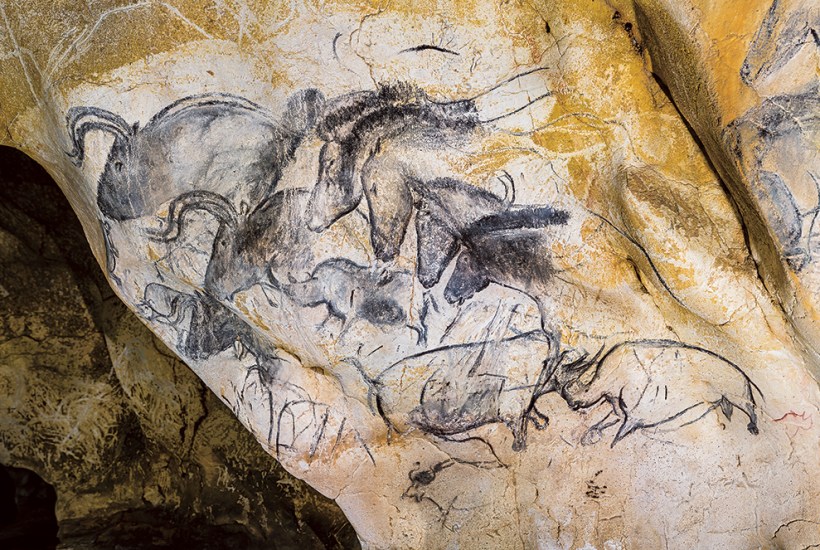
Rock, spit and a finger were all that the Neolithic artist needed to make an image, and nothing in essence has changed. Something to paint on, something to paint with and some means of applying it: support, pigment, binder, applicator. Until the electronic age, and even beyond, Goudie argues, these elements fundamentally underlie every painting and – throw in talent – drive the trajectory and development of art.
Rockface, plaster, wooden panel, stretched canvas, touchscreen; ground minerals, oil paint, colour blocks, synthetic colours, tin tubes, acrylic paint; squirrel hair, kitten whiskers, swan’s feather, metal ferrule, digital stylus – these, and the artists who pioneered their use, are the pegs on which Goudie hangs his 35,000-year trawl through mankind’s engagement with paint. Some of the usual suspects under the microscope are here – Van Eyck and oil paint, Titian and canvas, Turner and watercolour blocks – and some less familiar. Berthe Morisot’s use of the portable easel in a rowing boat in the Bois de Boulogne at daybreak is beautifully done.
Rock, spit and a finger were all that the Neolithic artist needed
Because he is an artist, Goudie is good on the feel of being one. It hurts your back when you bend over a work being made on the floor – this is as true of Ogata Korin painting his iris screen in 1701 as it is of Jackson Pollock 250 years later. He is also good on the studio as the nerve centre of creativity – hierarchical and organised in Song dynasty China or Mughal India; smelly and messy in 17th-century Amsterdam; or plain alarming in the case of Anselm Kiefer:
As he works in the studio, wearing flowing linen clothes and sandals, handling comically large ladles of magmatic lead, he appears to be tempting fate itself. The artist moves prophet-like around the building, unconcerned by toxic smoke, skirting molten obstacles and installations of artfully smashed glass while surrounded by assistants decked out in protective clothing.
There is something almost forensic in Goudie’s fascination with every detail of the way in which his 20 chosen works of art were actually made. Like Reynolds chopping through the layers of Rembrandt’s paint to see how he did it, Goudie examines each masterpiece from ground to finishing touch. Were the colours mixed or kept separate? Did each layer have to dry before being covered? Would the painting last or was it designed to decay? With the aid of infrared reflectography he notes decisions made in underpainting and alterations in composition. With the naked eye he catalogues the order of brushstrokes and the accumulation of paint. He’s not interested in the academic language of art historians; in fact he goes out of his way (too far sometimes) to reject it. Beautifully illustrated, wearing its learning lightly, this is a work that reveals the secrets of art in a book that anyone who loves painting will enjoy.
Got something to add? Join the discussion and comment below.
You might disagree with half of it, but you’ll enjoy reading all of it. Try your first month for free, then just $2 a week for the remainder of your first year.