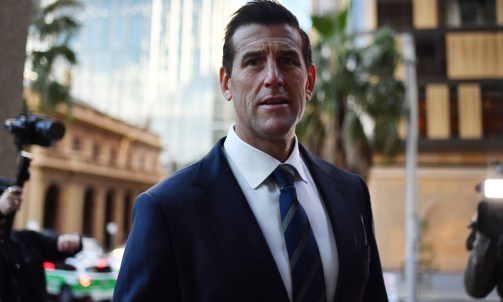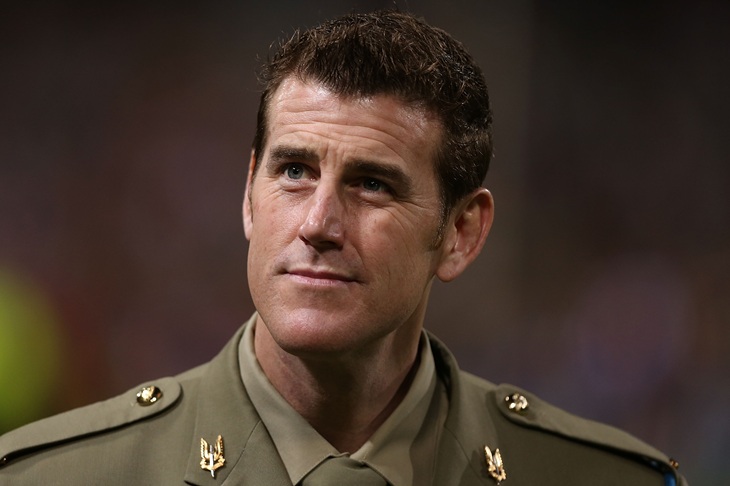
But for the Ben Roberts-Smith arrest this week, you would never know there were so many experts in criminal martial law in the general community.
As a practising lawyer of more than 35 years’ experience, including in Commonwealth criminal law, I always understood martial law, including war crimes, to be an arcane and highly specialised area of expertise, involving very few cases and only a handful of experienced practitioners. Clearly, I’m mistaken based on the authoritative and loudly expressed opinions on the Ben Roberts-Smith charges and arrests from the media, tradies, baristas, business leaders, billionaires, butchers, bakers, and candlestick makers, none of whom have been in active service in Afghanistan.
A few facts wouldn’t go astray in all the hubbub.
Ben Roberts-Smith has been charged under section 268.70(1) of the Commonwealth Criminal Code. This provision creates the offence of ‘War Crime-Murder’ where the alleged perpetrator has caused the death of one or more persons and the person or persons are not taking part in the hostilities nor are members of an organised armed group and the perpetrator knows or is reckless as to whether the person is a combatant. There are a various other technicalities and defences which will be tested by the court in the Ben Roberts-Smith case, including whether the alleged victims where ‘hors de combat’ or out of the fight because they were captured at the time of death.
The Australian Federal Police charges relate to the alleged murder of five persons, two in 2009 and three in 2012. It is alleged that Ben Roberts-Smith killed or caused others to kill persons during service in Afghanistan. The charges represent a subset of all the matters investigated and have been a long time in the making. The investigation has taken many years at eye-watering cost. The charges follow the civil defamation trial where the Federal Court held that the publishers of articles about Ben Roberts-Smith’s actions in Afghanistan proved the truth of their allegations against him to the civil standard of the balance of probabilities. In a lengthy and considered judgment, Justice Besanko essentially found that Ben Roberts-Smith engaged in war crimes. Evidence was heard from 40 witnesses. The judgment was appealed and three judges of the Full Federal Court unanimously upheld the trial judges’ findings. The Highest Court in the land, the High Court of Australia, then refused to hear Ben Roberts-Smith’s appeal on the basis that it ‘no question of legal principle was raised’ and the appeal had ‘insufficient prospects of success’. Uncommonly, all seven High Court judges heard Ben Roberts-Smith’s application for leave to appeal. In other words, a total of 11 judges have ruled on the underlying facts and effectively determined on a civil standard, that is on the balance of probabilities, that Ben Roberts-Smith engaged in war crimes.
Now of course the criminal standard is much higher i.e. ‘beyond reasonable doubt’ and the Crown bears the onus of proving Ben Roberts-Smith’s conduct meets the requirements of the Criminal Code. This is a qualitatively different inquiry. Ben Roberts-Smith is entitled to the presumption of innocence and deserves a fair trial. Having said this, the suggestion that the charges reflect some ill-conceived brain fade by the AFP or is a politically motivated publicity stunt is ridiculous. The allegations are very serious and there was a clear public interest in the AFP and special investigator investing significant resources in a thorough investigation. The AFP and others involved were duty-bound to act following the Federal Court’s findings, which were upheld on appeal. In this regard it must be remembered that BRS himself invoked the Court’s inquiry into his conduct when he filed the defamation case against the publishers, a decision he must surely regret.
Against this background, some of the public statements from politicians and media commentators about the charges are irresponsible or worse and show scant regard for the rule of law.
The charges are obviously very uncomfortable and don’t sit well with the war hero narrative of Ben Roberts-Smith as the Victoria Cross-awarded soldier who showed uncommon valour in the face of grave danger. Ben Roberts-Smith cuts an imposing figure and symbolises the public conception of a war hero. It’s also true that in war morality is regularly ambiguous and it’s impossible to judge the actions of soldiers from the safety of your living room rather than the craggy ranges of Darwan. But this point surely cuts both ways. If you weren’t in Afghanistan, you don’t and can’t know what happened. Many soldiers who were with Ben Roberts-Smith have given inculpatory evidence against him in the Federal Court and in so doing have been ostracised and put themselves in the frame for criminal prosecution. Eyewitness accounts are more probative than impressionistic views. These accounts will be stringently tested in the forthcoming case.
There’s a respectable argument that Ben Roberts-Smith’s public arrest at the airport was unnecessary and gratuitously conspicuous and that the general reputation of the ADF and the SAS shouldn’t be besmirched in the process. In fairness, the AFP have been quick to make this latter point in public comments.
The Ben Roberts-Smith issue has split the nation with many members of the public affronted or even disgusted that a decorated war hero has been charged. However, a sizeable portion of the public have the opposite view and fully support a process that will bring either accountability or vindication for Ben Roberts-Smith. Whilst opinions will always be split on matters like this, it pays to keep an open mind and reflect on the events, investigations and court hearings that preceded the charges. War crimes are crimes. The fact that they occur in other countries and in war zones is relevant but not determinative. There is a clear public interest in holding our military to the internationally recognised standard of behaviour. Ben Roberts-Smith will rightly be given a chance to defend his actions. Given the gravity of the charges and issues at stake, it would be preferable for his trial to occur in a calm atmosphere, rather than in a fever pitch of public sentiment.
Andrew Christopher is a lawyer and writer