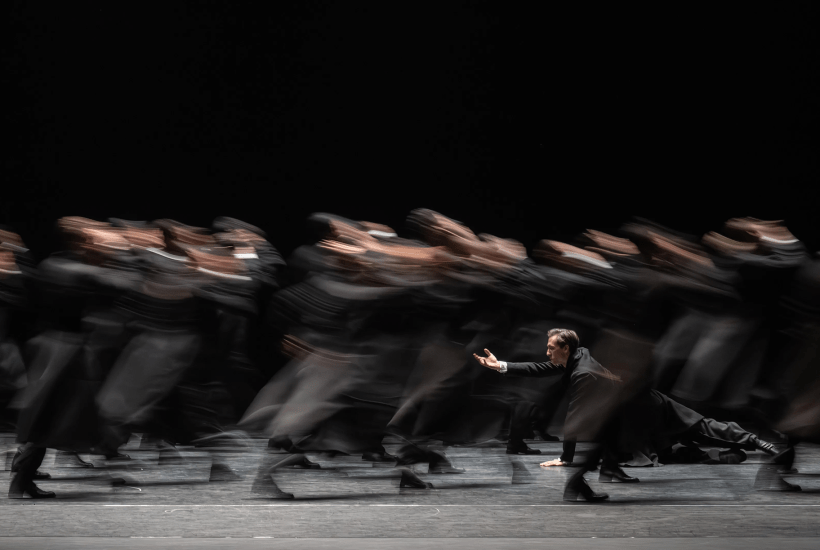
Crystal Pite is one of a handful of truly original choreographers today, extending the boundaries of her art form without going all doolally about trendy gender issues, AI or neuroscience. She is rooted in something more universal – the tension between conflict and connection, between what draws us together and what keeps us apart. ‘We want to individuate,’ she says. ‘Yet we want to belong.’
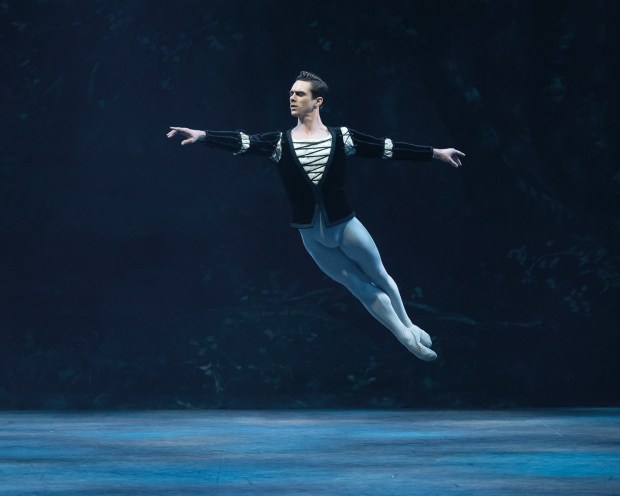
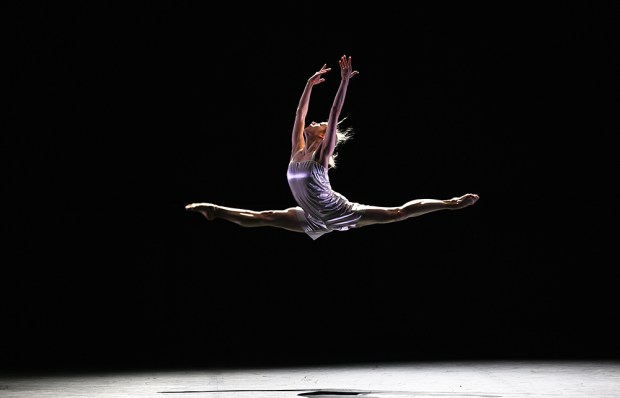
Out of this grows Body & Soul, in which individuals fight their way out of great swarms and cocoons, only to be sucked back into an inexorable flow that snakes and stiffens, multiplies and divides. Using only soberly clerical black and white costumes and lighting designed by the masterly Tom Visser, Pite can make starkly simple images – for instance, a man staring down at a prostrate figure that may or may not be a corpse – hauntingly resonant. Periodically an invisible French voice either records or commands each movement: head against chest, hands on the knees, left, right, left, right and so forth, in mesmerising Beckettian repetition. Some of Chopin’s more bittersweet Preludes add to the ambiguities.
Is Mayerling a great bad ballet, a bad great ballet, or even a plain bad one?
This is only the first section of a three-part conception, created in 2019 for the Paris Opéra: English National Ballet performs it here with blazing conviction. Can we now see the whole thing, please?
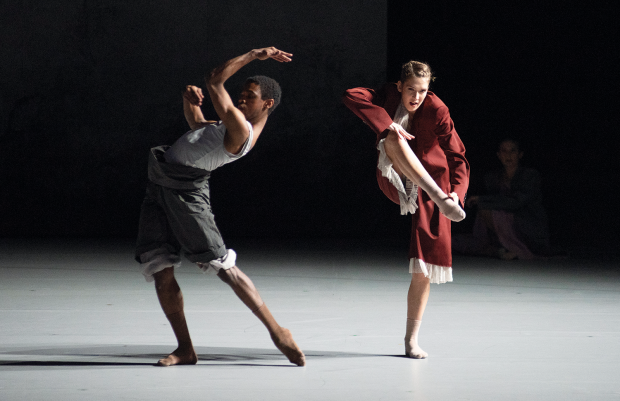
In the wake of the austere gravitas that underpins this compelling work, Kameron N. Saunders’s Proper Conduct seemed meretricious, though not short of superficial showbizzy flamboyance – Saunders has previously worked with Taylor Swift, and perhaps his talents would be better served in her world. Despite all the energy that ENB brings to it, Proper Conduct doesn’t cohere, and Saunders’s mish-mash of ideas – the rituals of undressing, faceless drones in hazmat suits – seem too derivative of Pite, Justin Peck, Trajal Harrell, William Forsythe and others. As another invisible narrator – embodied by the spry Jose Maria Lorca Menchon in Pierrot costume – fulminates doom-laden jeremiads, some deeper intention is hinted at. But I’m damned if I know what it is.
Although I’ve watched it closely at intervals over nearly half a century, I still feel uneasy about Kenneth MacMillan’s Mayerling. Is it a great bad ballet, a bad great ballet, or even a plain bad one? It has so many strengths, but painful flaws too – on the one hand, choreography of violent and extreme intensity, subtle characterisation, and the ambition to tell a richly layered story; on the other hand, it’s marred by an excess of plot, descents into crass cliché and something like misogyny. But even if Mayerling tries to do too much, it’s got terrific guts. Never prim or boring, it offers dancers wonderful opportunities to let rip.
Following a spate of revivals over the past decade alone, Mayerling would perhaps benefit from being given a lengthy rest. But here it is again, less than four years after its last outing, no different from what it was last time, except for the redundant appointment of an ‘intimacy consultant’ and
some debuts.
The cast I saw was led by Matthew Ball, who first danced the role of Rudolf in 2022, and Melissa Hamilton, a longer-serving Mary Vetsera. Both inhabit the complex choreography with thrilling clarity but neither wrings the deepest pathos out of two hopelessly weak characters and their addictive personalities. Mayara Magri was miscast – too amiable – as the pimping Ghislaine Maxwell figure of Countess Larisch, but I admired Mariko Sasaki’s glitter as the tart Mitzi Caspar and Meaghan Grace Hinkis’s pluck as Rudolf’s abused wife. The orchestra stormed its way through Liszt’s vulgarities with gusto: Nicolas Georgiadis’s designs remain masterly. It wasn’t the most heart-stopping Mayerling I’ve ever seen, but it was engrossing nonetheless: perhaps I’ll settle for bad great ballet.
Got something to add? Join the discussion and comment below.
You might disagree with half of it, but you’ll enjoy reading all of it. Try your first month for free, then just $2 a week for the remainder of your first year.