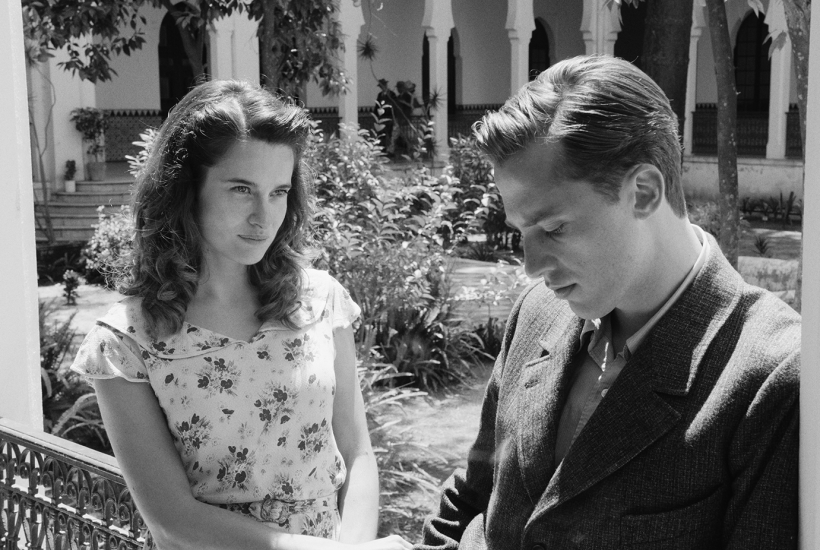
François Ozon’s The Stranger is an adaptation of Albert Camus’ 1942 novel about a clerk who – spoiler alert* – senselessly murders an Arab in broad daylight on a hot Algerian beach. Why did he do it? ‘It was because of the sun’ is all he can suggest. Existential ennui: that’s what’s at play here, which isn’t generally a great draw at the cinema. It would come way down on most people’s lists. But miraculously, Ozon has managed to make a film about boredom without making a boring film. If nothing else, the radiant black and white aesthetic will grab you from the off and then never let go. Visually, it’s divine.
The novel – which was published as The Outsider in this country – opens with the line: ‘Mother died today. Or maybe yesterday; I can’t be sure.’ The narrator is Meursault (Benjamin Voisin), a clerk in 1930s Algiers during French colonial rule. He attends his mother’s funeral where he shows no emotion. ‘There is no point,’ he tells the disapproving attendant. His beautiful girlfriend Marie (Rebecca Marder) is not dissuaded by his detachment. ‘Shall we get married?’ she asks. ‘If you want.’ ‘So you love me?’ ‘It means nothing.’
He never plays games. He is never dishonest. Though he is indifferent to other people, people are drawn to him. His neighbour (Pierre Lottin), who beats women and might be a pimp, is drawn to him, as is his other neighbour (Denis Lavant), an old man who both loves and hates his diseased elderly dog. You will be drawn to Meursault, too. He’s no doubt repellent but also fascinating. What would it be like to go through life not caring about anything?
Voisin is hypnotic. And the monochrome aesthetics are crisp and icy yet also sensuous and sunbaked. You can feel the intense heat as sweat pools at Meursault’s clavicle and prickles his skin. It’s a mood film, rather than a plot film, yet even when nothing is happening, it’s a compelling nothing. Every frame is meticulously composed; every little detail – a scuttling black beetle; a woman’s face looking up in the fields; a draw on a cigarette – feels full of purpose; even if a sense of purpose is just a means of avoiding the nihilistic dread in a universe that doesn’t know you exist. (Existential ennui can be catching.)
Miraculously, Ozon has managed to make a film about boredom without making a boring film
As in the book, the murder occurs at the midway mark. And then it’s the trial, where we are shown that the court couldn’t care less about a murdered Arab. Instead it’s Meursault’s lack of feeling that scandalises them. The prosecutor can scarce believe his luck. You didn’t cry when your mother died? You went to see a comedy film (Pagnol’s Le Schpountz) at the cinema after her funeral? He is threatened with the guillotine more for attending Le Schpountz than any crime that he might have committed.
The film is faithful to the text as far as I can tell – aside from one revisionist take. Camus does not name the murder victim in the novel. He is referred to only as ‘the Arab’, whereas here he is given a name, Moussa Hamdani (played by Abderrahmane Dehkani). This restores his identity. While his death may not have meaning for Meursault, it certainly does for his family.
Adapting Camus is a bold move, and Ozon has pulled it off – for what that’s worth. Which may, of course, be nothing.
(*Although there is no official statute of limitations for spoilers, can we agree that we’re maybe OK to spill the beans after 84 years?)
Got something to add? Join the discussion and comment below.
You might disagree with half of it, but you’ll enjoy reading all of it. Try your first month for free, then just $2 a week for the remainder of your first year.