What with the prospect of further resets with the European Union, and with British culture seemingly in a constant battle with those who would degrade and debase it, it’s easy to understand why some people are oversensitive to perceived threats to this country’s independence and integrity. Alas, sometimes this touchiness descends into out-and-out paranoia.
Eurovision has long since descended into a tacky, hyper-camp circus act
The flustered reaction to the news that this year’s UK Eurovision entry is partly sung in German is a case in point. Following the disclosure that the song, Eins, Zwei, Drei, by Look Mum No Computer, not only has a chorus in a foreign language, but has lyrics which appear to disparage British culture – ‘Counting in English doesn’t cut the mustard. So sick of munching roly-poly with custard. I’m so bored with it’ – many people seem have lost their heads.
In response to the news, broken on Friday by Scott Mills on Radio 2, one disgruntled listener took to X to write: ‘We now hate ourselves so much, our own UK Eurovision entry is singing our song in German rather than English.’ Another said: ‘Could we be any more Embarrassed of Britain???’ A third added: ‘The UKs Eurovision entry this year could be the worst yet. German lyrics, generic Europop trash.’ On GB News, speaking on a show hosted by Alex Armstrong, much of the panel and the host concurred that this represented a further insult to this country, yet another sop to the EU at the behest of a Rejoiner elite.
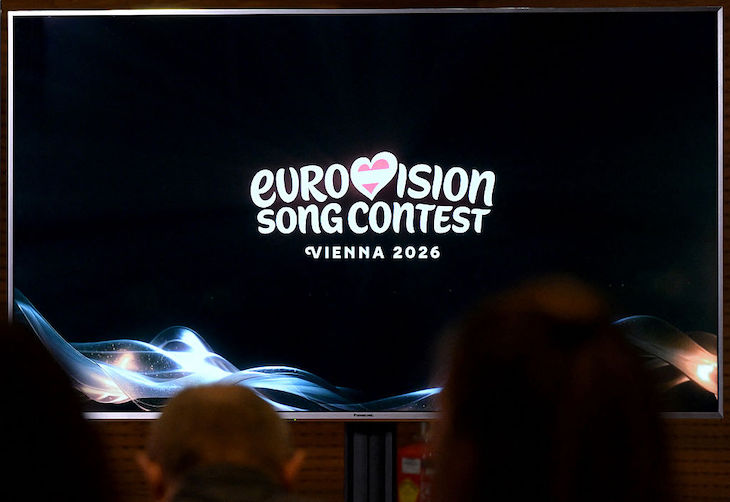
Yet those who see at play the dark forces of eurofederalism are making a category error, one made most grievously by Rejoiners themselves. This is to conflate European culture and civilisation with the EU, a technocratic, undemocratic anachronism that has rarely shown interest in the continent’s civilisation or culture. If anything, this gesture on behalf of Look Mum No Computer, i.e Sam Battle, should be seen a bilateral act of goodwill towards our German-speaking kin, and one entirely appropriate for a ceremony which this year is to be held in Vienna.
One of Radio 2’s incensed listeners was, however, quite right to denounce the song as ‘generic Europop trash.’ Reviewing it in the Times, Will Hodgkinson agrees that the ditty ‘is pure novelty nonsense’, before adding the proviso: ‘But since when was Eurovision about sophistication or consistency?’
Indeed. Eurovision has long since descended into a tacky, hyper-camp circus act. Long gone is the time when it was the launchpad or the platform for talented, authentic pop acts such as Cliff Richard, Abba or even Katrina and the Waves, who last won it for the UK in 1997. The event now has little to do with Europe, either. Vanished are the days when entrants would strive to showcase their country, heritage, customs and costumes by chanting, crooning or yodelling in their native tongues. Every year now it’s a familiar parade of talentless narcissists and exhibitions delivering the same indistinguishable pap, not in English as spoken on these islands, but in a kind of sloppy, cliché-infested, globish American-English.
Rather than perceive Eins, Zwei, Drei – ‘one, two, three’, in case you were wondering – as an act of capitulation, we should see it as a healthy riposte to the homogenising, deadening hand of American-English, that unlovely, ubiquitous hybrid which threatens the rich linguistic ecosystem of our world.
While we’re not to blame for the omnipresence of this variety of English, this being a result of America’s hegemony in the 20th century, the language was ultimately unleashed on to the world from these parts. With this in mind, Eins, Zwei, Drei ought to be seen by our European neighbours as a gesture of humility and courtesy, to make it known that we’re not a nation of complacent, lazy monoglots.
German is no bad place to start. Yes, those who have tried the language will tell you in exasperated tones how forbidding and bewildering it is, with its plethora of ways to spell ‘the’, no simple rule for forming plurals, and a mercurial word order system that seems to have a mind of its own.
Yet as well as being so different and difficult, German can also be so similar and simple. Most readers could probably intuit that ‘Mein brauner Schuh ist alt’ means ‘My brown shoe is old’, and most words in German relating to family members, the body, colours, numbers and nature, not to mention common verbs, are strikingly similar to English. This reminds us that in ancient, pre-literate times, and for the majority of the people on this island, our common ancestors spoke the same language.
A Eurovision entry which has a few words in German is not something that should worry us unduly. Rather than representing the dilution of our heritage, it should be seen as a homage to it.