Europe did not stumble into the Thirty Years’ War. It was dragged there by aristocrats who clothed ambition in sacred language and fed the furnace long after the original justifications had become indistinguishable from opportunism. Princes, dynasts, and foreign powers turned central Europe into a charnel house while insisting, each in his own register, that he was defending order, truth and necessity. Disease, famine, and displacement did far more damage than the fighting. The men who started it were mostly dead before it ended. The causes they had invoked had long since been transmuted into naked interest dressed in borrowed principle.
What makes the war permanently instructive is not its scale but its structure. It shows what happens when governing elites mistake the defence of everything for the defence of anything. Every concession looks like betrayal, every retreat like apostasy, every pragmatist like a coward – until the ruin is so extensive that even the fanatical begin to grasp that the world cannot be governed on absolutes alone. The tragedy was not that Europe contained evil men. It is that too many men of rank lacked the moral imagination to see the consequences of their own intransigence. They could describe legitimacy in exquisite detail. They could not recognise disintegration while helping to produce it.
Peter Wilson’s great history of the war catches the turn precisely. By the 1640s, a broad moderate coalition had formed – Catholic and Protestant alike – that isolated what Wilson calls ‘two small groups of uncompromising extremists on either flank’. Peace did not emerge because anyone had a change of heart. It emerged because enough men of consequence finally chose preservation over vindication.
Wilson gives that choice a name and a face. Johann Philipp von Schönborn, Archbishop-Elector of Mainz, was no liberal before his time. He was a serious Catholic prince of the Counter-Reformation world. What distinguished him was something rarer than principle: the capacity to place survival above belief. He ‘recognised the need’ Wilson writes, ‘to salvage the bulk of the imperial church by making wider concessions’ – not only over territory, but over freedom of conscience for recognised minorities. His representative spent more time talking to the Protestants in Osnabrück than to his fellow Catholics in Münster. With Austria, Bavaria, Mainz, and Cologne backing the moderate position, others fell into line rather than face isolation.
To salvage the bulk. The phrase already contains the presupposition of loss. It forecloses nostalgia before nostalgia can take hold. It forces the question every political tradition in genuine difficulty must eventually answer: what belongs to the core that must be saved, and what is merely accumulated habit, donor comfort, or shibboleth masquerading as conviction?
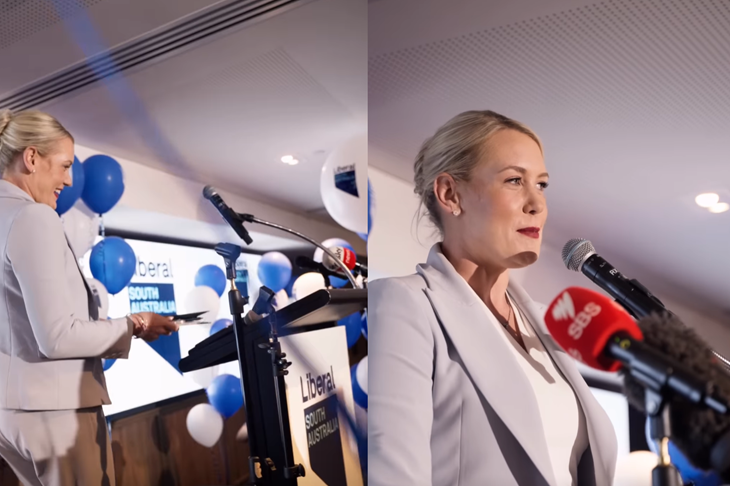
That is the question Australian conservatism has so far declined to answer. South Australia offered the latest and sharpest evidence of the cost.
The result was bad enough. The commentary was worse. Nicolle Flint praised Ashton Hurn for balancing political leadership with new motherhood. One hopes the bairn grows strong in the faith. But a political tradition had just suffered a historic humiliation, and the response was to reach for the language of personal achievement and life balance. This is what happens when a governing class has lost the sense that anything urgent is at stake: collapse gets processed as biography.
Then there was Alexander Downer – the provincial patrician, friend to kings and dukes – muttering about the sort of rabble attracted to One Nation. The tone was familiar: weary disgust, social recoil, the genteel grimace of a man whose political formation assumed that conservative voters would always, in the end, come home. They have not come home. They have gone elsewhere in sufficient numbers to make the Liberals a rump.
Of course, there is a knuckle-sandwich delivery crew among the populists. Where is politics staffed entirely by Mother Teresas, Gandhis, and Lions Club good fellas? It is a brutal vocation. The point is not the rough men. It is the moral laziness of an establishment that can always find energy for social differentiation but cannot summon urgency until socialism starts menacing its own position. National decline does not stir it. Institutional drift does not stir it. The top people remain comfortable, and so they drift on, half asleep and half punch-drunk from Labor, into another defeat.
For half a century, the Liberal Party has looked less like a national force than a closed circuit, repeatedly returning leadership to the same metropolitan world. Peacock never made it. Kennett never tried. Costello never pulled the trigger. Somewhere in that history, Melbourne ceased to function as a reliable nursery of federal conservative authority, and the city’s scepticism toward the party may owe something to that fact. But even that is only confirmatory evidence. The deeper problem is not geography. It is that the movement has become closed, self-referential, and morally tired. Too many of its people still seem to think politics is about preserving their place in the machine rather than preserving the country that machine was supposed to serve.
One Nation is not the answer to that question. But it is the symptom of a vacuum – and vacuums, in politics as in nature, do not stay empty.
Political traditions rarely die in a final climactic battle. They hollow out. The custodians go on performing the forms while the content drains away. South Australia was the result – catastrophic by their own account – and yet within hours the same people were back on television explaining, with evident composure, that everyone involved had managed it all rather well.
Schönborn’s lesson was not that concession is good. It was that knowing what to concede requires first knowing what you are actually trying to save – and that this recognition must come before any negotiation, any coalition, any tactical adjustment. It is the prior act. Without it, nothing follows.
Australian conservatism no longer appears blocked by strategy alone. It appears blocked by a ruling stratum that cannot distinguish between its own habits of command and the moral-political core it was meant to defend.
It is a Schönborn problem. And so far, there is no Schönborn in sight.