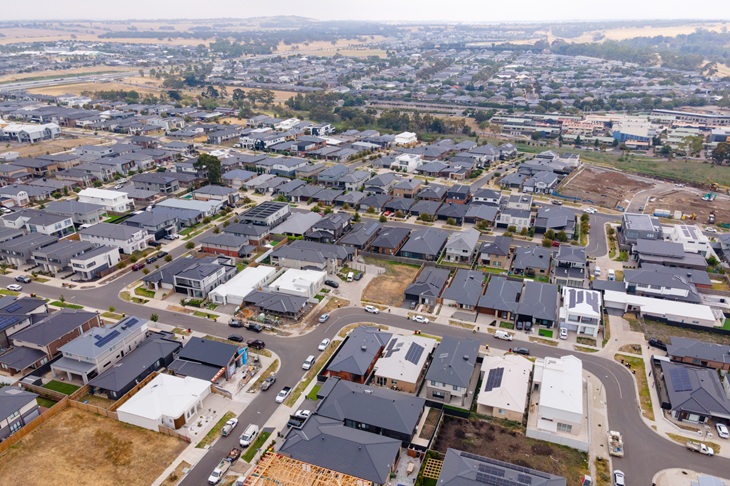
Labor’s ‘Big Australia’ mass migration project has created a catastrophic housing shortage.
Everyone knows it.
Even if the media and self-interested uniparty choose to deny the facts.
Young people across the country know it too. They are the ones standing in rental lines behind 50 people.
They feel upset. Betrayed. Left out. And ignored.
These Australians know they are competing against Labor’s migration agenda, not organic competition like their parents and grandparents faced. This is not, in any way, a ‘fair’ housing market.
When these young Australians decide to ditch the soul-crushing rental queue and take on the dream of home ownership that changed their parents’ lives – they discover an even worse situation.
The price of homes, including small city apartments in the areas they need to live to keep their jobs, are unattainable.
Some of this price increase is to do with greedy government fees and charges, while the rest is a consequence of too much demand from people who live outside the Australian economic cost-of-living crisis. Foreign buyers often have the means to push prices well above what they should be.
In Australia, house prices have advanced much faster than the average wage. Even those earning $100,000 per year – once considered a mark of success – feel that home ownership is financially impossible. These people are no longer considered to be ‘doing well’. They are struggling.
Not to mention that the average worker has a considerable amount of their wage taken as ‘super’ and given to union funds to play the stock market. This makes union super funds rich and pushes huge volumes of investment money into projects – usually in the green industry – that otherwise would never receive private funding. $4.5 trillion has been taken out of people’s pockets and locked away. This money remains untouchable until someone turns 65. 8-10 per cent of Australians will die before they access their super (or 56 per cent of Indigenous Australians if life expectancy rates remain the same).
That money used to be used for home investment and there is good reason to believe that compulsory super is one of the contributing factors to a major drop in home ownership amongst the middle and working classes.
There are ways to immediately improve the housing situation – the most obvious being the deportation of visa overstayers and a severe cut to migration. This would immediately free up hundreds of thousands of properties for domestic buyers and renters.
That would benefit Australians and massively hurt the political class and their major financial backers.
Instead of doing the right thing, Chalmers & Co have designed a system that leans into the hardship and desperation of young Australians.
In August of 2025, the Labor government introduced their 5 per cent deposit scheme for first home buyers. There is also another version of this for single parents to buy a home with a 2 per cent deposit.
Labor described this as ‘helping more Australians realise their dream of home ownership’ where the government (taxpayers) ‘guarantee a portion of a first home buyer’s home loan with a lower deposit and not pay Lenders Mortgage Insurance’.
Their argument is this:
‘All first home buyers will have access, with no caps on places or income limits. Property price caps will also be set higher in line with the average house prices, providing access to a greater variety of homes.’
Predictably, this did not unlock more desirable homes – it created an almost immediate increase in home prices. Labor said it would be 0.6 per cent over the medium term. Instead, it was 3.6 per cent in the first quarter. The developers win. Those with generous property portfolios win.
Finder says the average loan amount for first home buyers in December 2025 was $607,624. This is a huge sum of money. In 2015, you could expect a first homebuyer to take on $333,500. Westpac says first homebuyers are typically over 40. This shows you how much harder it is to get enough financial security to consider buying a home.
And while the ‘average wage’ is listed as $104,000, it’s suspected that this figure is skewed and the real average is probably closer to $88,000. After tax that’s around $69,000.
If you think this whole thing sounds like a bad idea, you’re right.
To translate it into economic reality, Labor is encouraging and actively changing the rules to allow young Australians to take on loans they cannot realistically afford (and would not be normally given) right when the RBA has warned it will continue to raise the cash rate – which it has done multiple times since the scheme began.
The Labor government is in danger of reviving Keating-era mortgage stress.
A person with a normal mortgage that they attained under strict rules is already suffering under the RBA rate rises. Individuals who took on a 95 per cent mortgage are at an increased risk of defaulting. It only takes a small rate rise on a sum of money this large to lead them into disaster.
An entire generation of vulnerable, trusting Australians have been led into imminent economic ruin by a government that thought 5 per cent deposits would attract young voters.
It isn’t a game.
It’s people’s lives.
People’s futures.
This isn’t about ‘votes for Labor’ from people who think the government is ‘gifting’ them a house, it’s about Australians watching their savings burn and homes taken off them in a time of economic uncertainty.
It’s rare to find a government that cares so little about young people – although we know exactly why they did it.
Mass migration has been a positive influence for the Labor Party. They cannot give it up, even though home ownership is the leading election topic among their rising young demographic that is in danger of being taken by the Greens. Labor has made a wager on a short-term popular policy with little regard for the coming disaster.
Even the Daily Mail warned of an impending catastrophe after the latest RBA cash rate rise highlighted a significant rise in risky mortgages (4 per cent of the total market!)
To quote:
‘While the banks are insulated by the government guarantee, which covers the first 15 per cent of any losses from these loans, households are exposed. The banks are fine. The main risk falls on individuals.’
It’s widely expected war in Iran, and the high petrol prices and fuel insecurity that flow on from this scenario, will increase inflation and lead to even more rate rises in the near future.
Government debt – also known as a spending spree – is the main driver of inflation and the interest repayments on this black hole are climbing every day.
When debt passes $1 trillion – which it is expected to do shortly – interest payments will cost $60 million per day or $41,667 every minute.
Every Australian – whether they are an infant or retired – owes $806.65 every year in just interest. And that’s if the Treasurer stops spending right now. And to pay off the $1 trillion debt tomorrow, it would require every person to cough up $36,850.01.
If fuel prices increase (or fuel rationing starts), we can expect a catastrophic loss of businesses and, therefore, jobs. How many young people will lose their jobs and be unable to service these mortgages?
The uniparty doesn’t care. The government never loses.
It raises taxes. It tightens your belt so it can eat more money.
Remember, if you think the LNP are any better, they have their own reasons for supporting ‘Big Australia’. The Howard government marked the start of mass migration. All Coalition governments since have done nothing of consequence to change it and they never will.
One Nation are desperately worried about the future young people face.
We have a comprehensive policy to cut immigration by over 570,000 and to deport 75,000 visa over-stayers, illegal workers, and unlawful non-residents who threaten our national security. We also have a housing policy to ensure unnecessary fees, charges, and taxes are cut to get homes built without destroying our green spaces or cultural heritage.
One Nation is here to make a genuine difference for you, not Canberra.
To read this, and more, follow Malcolm Roberts on Substack.