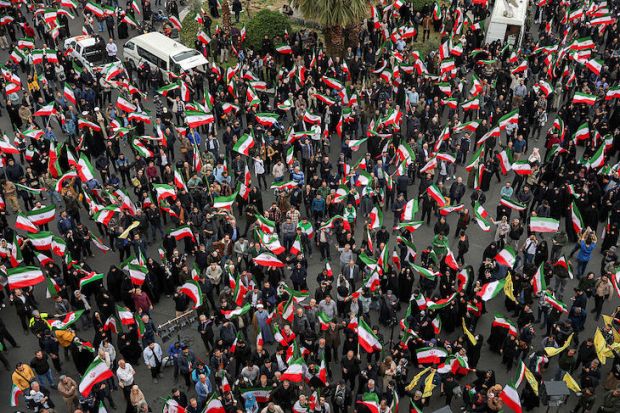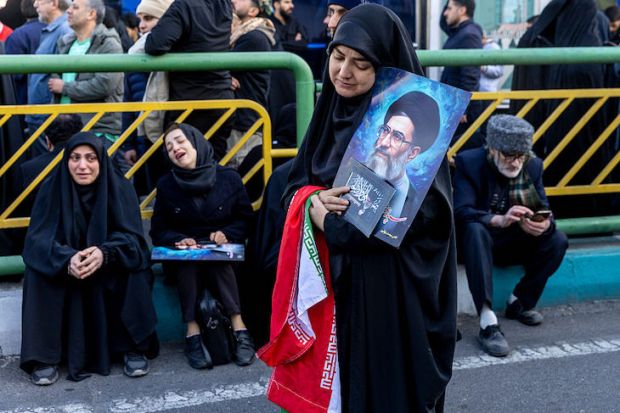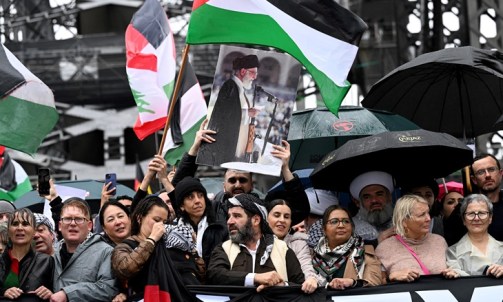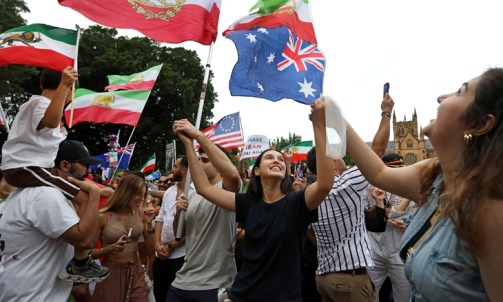
So farewell then, Ayatollah Khamenei. I’m put in mind of Private Eye’s cover on the death of Hendrik Verwoerd. “A Nation Mourns” read the headline, under a photograph of four black Africans in ceremonial dress leaping joyfully in the air in a traditional dance. Nobody’s going to be sorry he’s gone.
The received wisdom tends to skirt the possibility that some senior Nazis may have been quite cultured
But reading his obituary, I confess to surprise and dismay. What was to be found there was not, at least at first, an austere and viciously power-hungry religious monomaniac. Here, from what we know, was somebody who at least in his younger years was disciplined, modest, intellectually curious, and artistically inclined.
“He was said to live an austere, ascetic existence and enjoy gardening,” the Sunday Times reports. “As a young man he loved Persian poetry and music, played a traditional stringed instrument called a tar and read Western authors including Leo Tolstoy, Jean-Paul Sartre, John Steinbeck and Victor Hugo.” Yet, obviously, this did nothing to prevent his wielding power in a monstrous way.
He was a total drittsek, and the regime he presided over – as “part Pope, part Commander-in-Chief and part Supreme Court” – is as foul a theocracy as is to be found anywhere. When he read Tolstoy, Steinbeck and Victor Hugo – with their sympathy for the downtrodden and their strident denunciations of the cruelties of power – was he not paying attention? Did none of it go in at all?
We liberal humanist softies like to think that culture has an ethical angle. We hew to George Eliot’s line that “if art does not enlarge men’s sympathies, it does nothing morally”. It is an article of faith that fiction, inviting us as it does to imagine the lives of others, should help cultivate the capacity for empathy, and that deep learning and good taste will tend to mitigate against being the sort of malignant narcissist who sends his people to mass graves without a flicker of conscience.
In some cases, that seems to be true. There’s a longstanding fascination with the cultural and aesthetic lives of awful people. We eagerly consume photo anthologies of the tastelessly blingy decorations in dictators’ homes. We shake our heads at Stalin’s coarse humour and the kitschiness of Soviet art. We deride Hitler’s crappy watercolours just as we laugh at the AI slop aesthetic of the current wave of American neo-Nazis. There’s a mixture of moral superiority (and, no question, social sneering) in the collective liberal derogation of the tastes of the blood-soaked one per cent.
But the received wisdom tends to skirt the possibility that some senior Nazis may have been quite cultured – having a canny eye for what art to steal, and in the odd case an enthusiasm for Wagner that took in the music as well as the mythos. The Borgias, after all, were a nasty lot and you can’t accuse them of lacking culture. And it’s possible that disparaging dictators’ gold taps may say more about our snobbery than the intrinsic value of gold taps. It’s nice to feel superior to people you fear and detest. There’s a lovely description in Jane Rogoyska’s new book Hotel Exile, about wartime Paris, of how even as they had their jackboots on the necks of the French, the Germans were insecure enough to seek their approval.
We tend to imagine in a somewhat less extreme way that Donald Trump’s vulgarity, selfishness and moral grotesquerie go hand in hand with his philistinism – that he is exactly what we can expect of a man who shows no signs of ever having read a book, who worships power and money and is actuated by nothing but the gratification of his vanity and the discharging of his resentments. But perhaps he’d be like that even if he were a devotee of the poetry of W H Auden or the prose of Proust.
Here, on opposite sides of the ring in the latest geopolitical dust-up, appear to have been cultural opposites. One would-be dictator with no taste or culture whatever; and one full-fledged dictator with what in ordinary politicians would be described as a hinterland. Neither of them has ever shown much regard for the pieties of the international community, both had been ferociously interested in maintaining power by any means necessary, and both seemed to hold the lives of the little people pretty cheap.
Yet the supposedly cultured one was an even nastier piece of work than the philistine. Perhaps that’s down to him having had God in a big way; but, equally, perhaps not. (I don’t assert moral equivalence here. Heaven alone knows what The Donald would look like had some version of him come to power as a dictator in revolutionary Iran.) I’m tempted to conclude that Eliot was right in a way she didn’t mean to be: perhaps art really does do nothing morally.
As for the bigger picture, my twelve-year-old clocked yesterday morning – YouTube? – that the Iranian leader had died. He asked me: “Is that a good thing or a bad thing?” That’s the big question. At this stage I don’t think there’s anyone who can claim to know for sure. No doubt, hinterland or not, he was a very bad hat. But what follows is anyone’s guess.
I think back to the US invasion of Iraq in 2003, when my Dad advanced what seemed to me one of the few respectable positions in favour of it, aka the extreme nastiness of Saddam and the suffering of the Iraqi people: “If someone’s drowning, you throw them a life preserver, right?” Yes: but what if it turns out you’re throwing them a breezeblock? Or, for that matter, a sink with ridiculous gold taps…