The alleged sinking of an Iranian warship off the south Sri Lankan coast raises more questions than answers at present.
Details are still sketchy, but several news outlets began reporting the action on the evening of March 4 (Australian time), saying that the ‘Iris Dena’ had been attacked and sunk by a submarine, according to Reuters news agency.
Around 100 people from the ship were missing, with 32 rescued by the Sri Lankan navy, of whom around eight were hospitalised.
The Iris Dena of the Iranian Navy is described as 93 metres in length, and 1,500 tonnes displacement. Although labelled a destroyer by the Iranians, the ship is nothing like that oft-used label which nowadays refers to a ship of considerable size and power. A better description would be ‘missile corvette’, as the vessel is armed albeit lightly with Surface-to-Surface missiles and also Surface to Air weapons.
She is quite a new warship, commissioned in 2015, and built locally in Iran.
The ship would have had some anti-submarine warfare capability, although obviously not operating successfully.
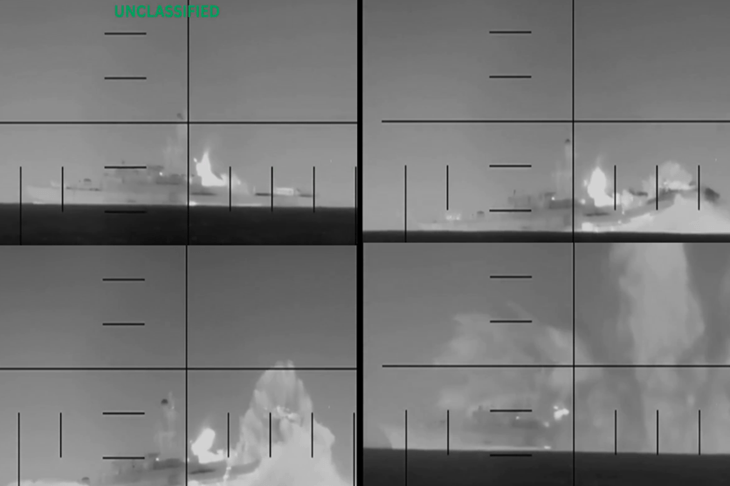
The strike against the Iranian warship was carried out with a torpedo, probably the trusty Mk 48 model, in a manner which would have brought approving nods from the ghosts of first and second world war submarine captains. This means the attacking submarine seeks an effective angle – usually from side-on to the enemy’s bow – although stern strikes are sometimes used. Vision released hours later by the USA shows a successful torpedo strike against the Iranian vessel.
As a nuclear submarine was involved – the USN operates no conventional boats – this would make it the first such successful sinking action since the loss of the Argentine cruiser General Belgrano to the British submarine HMS Conqueror in the Falklands War in 1982. Prior to that the Pakistani Daphné-class submarine Hangor sank the Indian Navy’s frigate Khukri in December 1971 in the third war with India.
Not that it makes much difference, but this is only the second time a surface warship has been sunk by a nuclear boat – the latter term used to describe subs since their early days. Conqueror was also nuclear-fuelled.
The sinking location is said to be off Galle, located about 115 kilometres south of Colombo, on the west of the south coast of the island nation. What an Iranian warship was doing, well away from the present war raging in Iran itself and other areas of the Middle East, remains unclear.
Iran is not a conventional naval power. It operates three conventional submarines of medium size – about half the size of Australia’s Collins-class; one smaller training boat, and around ten seven-man midget submarines. Its surface fleet consists of around seven of these missile corvettes; 15 fast attack craft, and six patrol boats. Analysis over the years suggests the fast attack would be used in swarm tactics; that is, attacking en masse at an enemy warship hoping to overwhelm its defences and close in to make an effective strike with short-range missiles. They would have minimal chance against a modern professional blue-water force such as the United States Navy.
Incidentally, successful submarines returning from action have flown the Jolly Roger, a black skull-and-crossbones flag, since the second world war. It was likely a reaction to comments from 1901 declaration by Admiral Sir Arthur Wilson, then the British head of their navy, who called the new weapon of submarines ‘underhanded, unfair, and damned un-English’ and argued that their crews should be ‘hung as pirates’.
In September 1914, in the first days of the first world war, after returning from a successful mission where his submarine HMS E9 sank the German cruiser Hela, Lieutenant-Commander Max Horton commanded his crew to raise a Jolly Roger.
The US submarine which carried out this action is yet to be identified, but it is likely that they are sewing their black flag now.
Dr Tom Lewis OAM is a retired naval officer and a military historian. His book The Secret Submarine, analysing the 1943 fight between the Japanese I-178 fleet submarine and RAAF bombers off the NSW coast, was released last year from Big Sky Publishing.