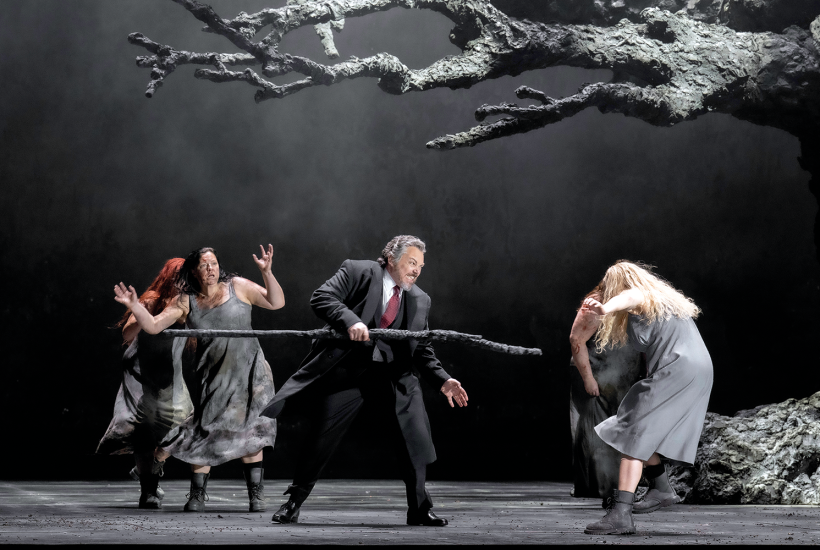
By the end of Siegfried, the third opera in Wagner’s Der Ring des Nibelungen, the king of the gods is in freefall. In the first opera, Das Rheingold, Wotan is a confident protagonist; a world-builder. In Die Walküre, we’ve seen him discover the limits of power, and felt his heart break. Now, in Siegfried, he’s a haunted figure; the solitary Wanderer, searching the world for answers that his all-powerful wisdom can no longer supply. He confronts the young hero Siegfried, and his law-giving spear shatters on the sword of a reckless, clueless boy.
‘All he can say is, “Go, then. I can’t hold you any more,’’’ says Christopher Maltman, who has sung the role of Wotan throughout the Royal Opera’s current Ring cycle, and brings it to completion when Siegfried opens later this month. ‘It says in the score, “He fades into darkness.”’ The final opera is called Götterdämmerung, ‘Twilight of the Gods’, but Wotan never appears. How does a performer handle the final, devastating fade to black of a character who has dominated three vast dramas – a role which Maltman has compared, in its scale and complexity, to Hamlet or Lear?
‘This bottomless pit of emotion that Wagner opens up in front of you really was a surprise for me’
‘Wanderer is a very different person from the Wotan of the earlier operas,’ Maltman says. ‘Well, I say he’s different, but he keeps all of the arrogance and pig-headedness that he displays in Rheingold, and especially in Walküre. But it’s tempered by this knowledge that everything is slipping away from him.
‘And so there’s a world-weariness – a sadness, I think, to the Wanderer. There’s a line in his scene with Alberich: “I’ve come to observe, not to do.” And that’s his arc for the whole of Siegfried.
‘He’s actually quite impotent. He’s always standing on the periphery, poking people and asking questions, but he never really accomplishes anything. At the end, it’s like all things that are catastrophic in our lives. We can anticipate the event, but as soon as it happens, the experience in reality is always an order of magnitude more devastating than we ever believed it could be.’
For Maltman himself the completion of his first Wotan/Wanderer marks a career landmark – the emergence of one of the most perceptive Wagnerian baritones of the 21st century: a thinking singer in repertoire that demands theatrical brains as well as vocal brawn. It was never a given. He made his name in the Noughties in Italian opera and Mozart, one of a generation of hot young baritones whom excitable fans dubbed ‘barihunks’. His mid-career transition to Wagner was a process that he never really anticipated.
‘I have been lucky enough to have had many careers,’ he says.‘I sang all of the Mozart roles, and eventually, I got to what I believed was the pinnacle of opera, which was Italian grand opera: Rigoletto, and things like that. And of course, it is incredibly wonderful, and I didn’t think anything could get better than that until I did Die Walküre for the first time. At which point, you enter into a world of harmony which is just so much more complex than Verdi and Puccini managed to achieve. They managed to achieve it in a localised way. But this bottomless pit of emotion that Wagner opens up in front of you, really, was a surprise for me. I didn’t expect to love it.’
But he did. So did critics and audiences, and so too have opera directors. Since his first Wotan (in Naples, in 2023), Maltman has been notching up the great Wagner baritone roles: the Flying Dutchman, Hans Sachs in Die Meistersinger von Nürnberg and a parallel Ring cycle at Paris’s Opéra Bastille, directed by the Catalan firebrand Calixto Bieito. ‘In my thirties I found myself being exhausted at the end of Don Giovanni,’ he says. He attributes the transformation to a regime of vocal de-stressing devised by his wife and singing teacher, the conductor and pianist Audrey Saint-Gil. ‘Now, in my fifties, I feel like I could sing Meistersinger again at the end of the night.’
So Maltman finds himself on the operatic A-list: in demand on every major stage. How easy is it to adapt to directors as dissimilar as – say – Barrie Kosky, the Australian livewire behind Covent Garden’s noir-ish, ecologically themed Ring, and Bieito, a provocateur whose recent staging of Prokofiev’s Tolstoy opera War and Peace featured soiled nappies and onstage pizza deliveries? How – to ask the question that every opera buff hankers to ask – does an intelligent singer tolerate some of the things that directors expect them to do?
‘I had my own ideas about Wotan when we started Rheingold,’ Maltman says. ‘But no plan survives first contact with the enemy! Barrie, for me, is the ideal balance of love and respect for the art form, and a sort of puckish approach – there has to be a needle in there somewhere; he has to poke things to make them live. But it’s born of a deep love and knowledge of opera. As for Calixto, I was completely disarmed by him, as a man – he’s a philosopher; a fantastic, passionate person to speak to about an opera. As a director, he wants to break things a little, but not completely. And through those wounds in the piece, you see things differently. He asks an awful lot from you as an actor.
‘There are a lot of singers who believe that they know better than the director and the conductor. For me, the director and the conductor are very much the generals. They are the strategists; I’m a tactician – a captain, perhaps. Honestly, if I believe in my general, I’ll follow them even if I don’t fully understand where they’re going. It’s my job.’
Speaking of opera as a job, how does the landscape look, anno 2026, from the top of the international profession? Opera in Britain feels beleaguered: undermined by funding bodies, struggling with rising costs, and still – despite decades of commitment to accessibility and inclusion – battling politicised myths about elitism. Maltman lives in Vienna but works regularly in Britain, and is still involved in local music-making in his native Lincolnshire (he’s a Cleethorpes lad, who started out in school shows). What, for example, does he make of Jonas Kaufmann’s much-derided recent declaration that he can no longer afford to sing opera in London?
‘The elite accusations I find really annoying. In sport, elitism is seen as something absolutely fantastic’
‘I think the thing with Jonas – who has been spectacularly successful, and rightly so – is that he is in the fortunate situation of being able to make money doing other things,’ replies Maltman, tactfully. ‘But here’s where I sympathise. When I come here for a production, I’ll be here for a little over nine weeks.
‘Imagine doing a short-term rental on a flat in London! Once you’ve taken off the tax that we pay, the commission, accommodation, flights, subsistence, the hundreds of hours of preparation, and break it down to an hourly rate that we take home, even a good fee is not as great as it looks.
‘But it’s still a fine living. I’m not complaining. The real problem in the UK at the moment, as I see it, is that I’m not sure I would’ve ended up being an opera singer, had I been coming through today. The school music departments are no longer there. The church choir that I sang in is not there in the same way that it was. The first opera I ever saw was from Opera North, in Manchester: Don Giovanni. My first professional jobs were at Welsh National Opera and Mid Wales Opera.’ Point taken – every one of these vital regional companies has been forced into retreat by the Arts Council’s recent assaults on opera funding.
‘Some incredible people are still keeping their heads above water. But the elitism accusations, I find really annoying. In sport, elitism is seen as something that’s absolutely fantastic. As a singer I am quite militant about how I feel opera should be approached, which is not to alter it, to shorten it, to chop and change it to somehow suit a perceived audience.
‘It’s our job simply to do it at the very highest possible level – to bring all of our passion and musical skill and build the best show possible. I believe that great art, performed in the greatest way, will always have a place. Don’t throw the baby out with the bathwater.’
Got something to add? Join the discussion and comment below.
You might disagree with half of it, but you’ll enjoy reading all of it. Try your first month for free, then just $2 a week for the remainder of your first year.