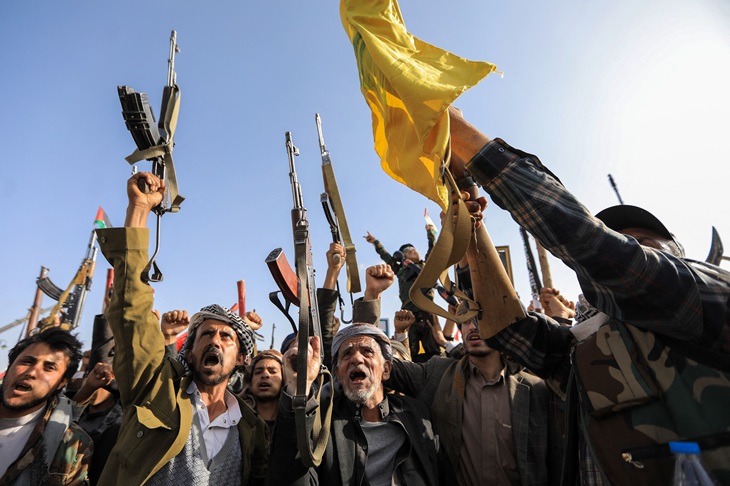
The Houthi pirates have gone awfully quiet.
For years, they have been holding the Red Sea shipping industry to ransom while claiming ‘solidarity’ with Palestine.
Like fresh-faced Western socialists, the Houthis wear ‘Palestine’ like a Temu-printed flag, justifying whatever disruptive activity they have in mind as ‘solidarity’. They are funded (or should we say, were funded) by Iran, whose terror-oriented regime used Houthi piracy as a way to create economic chaos.
Regional instability represents opportunity just as terror wedges open the cracks of democracy to allow anarchists, communists, and dangerous Islamic radicals to settle their roots.
There is no better way to screw around with European-Asian-Indian-American relations than by interfering with maritime highways.
To this end, the Houthis offer a magnifying glass to the powerful regimes that use them as a proxy.
Both China and Russia have complex dealings with the Houthis, sometimes via Iran and sometimes independently, which has evolved rapidly in recent years and now hangs as a giant question mark following the attacks on Iran.
In 2024, the Middle East Institute carried an article titled, Russia and China’s differing engagements with the Houthis:
On July 2 [2024], Russian Deputy Foreign Minister Mikhail Bogdanov hosted a Houthi delegation in Moscow. According to the Russian Ministry of Foreign Affairs’ read-out, Bogdanov discussed the “aggravation of the situation on the Red Sea” and the need for intra-Yemeni dialogue under the auspices of the United Nations. On July 8, China’s chargé d’affaires in Yemen, Shao Zheng, confirmed that his government was in contact with the Houthis about threats to maritime shipping in the Red Sea. The Chinese diplomat linked the Red Sea crisis to the ongoing Gaza war and called for “immediate peace in Gaza and humanitarian aid to prevent the crisis from spreading”.
From here it is made clear that the motivations for engagement differ wildly.
At the time, China was protecting its commercial vessels and assets which navigate the region. Russia found the narrative of solidarity politically useful when driving wedges between nations at UN meetings while continuing the same line it held during the Yemeni Civil War.
To this I might speculate that it serves Russia’s interest to have a semi-friendly, Iran-controlled group of terrorists and pirates that can be ‘Ubered’ into existence whenever strategically useful for Russia. This has been particularly true during the Ukraine conflict where diverting resources from European interests served Putin’s war efforts. They are also able to threaten Western-aligned Arab states into neutrality when used sparingly.
As Russia-West relations plunge to unprecedented lows over the Russo-Ukrainian war, Russian ultranationalists have lionised the Houthis as anti-Western resistance forces … a senior US official recently claimed that Putin considered supplying anti-ship cruise missiles to the Houthis … Saudi Crown Prince Mohammad bin Salman conveyed his opposition to Russia arming the Houthis.
Aside from the odd accident (pirates, what are you going to do?) China and Russia have kept their vessels safe.
Unlike Russia’s public hosting of Houthi officials, China has relied on clandestine bilateral outreach with the Houthis to secure its commercial vessels. Beijing has paired such overtures with engagement with Tehran on the need to protect Chinese ships.
Since then, China has taken a more direct approach to its Houthi friendship by providing them with satellite data and military equipment while pretending to talk about civilian ship protection for the cameras. Civilian ships that would not be in danger if it were not for the extra intel…
Increasingly it appears China has the same problem previous European empires had … it invested too much of its critical resources and military supply lines in Africa and the Middle East and thought it could accurately predict, placate, and control Islamic regimes that value global ideological conquest and martyrdom over stable empire building. (In Africa, their mining projects are facing extraordinary difficulty from government corruption and the local workforces.)
China clearly realised that it was easier to deal with the Houthis via Iran and began relationships with senior figures (who are probably dead). Whatever control Beijing brought over their shipping routes has been wiped out. The Houthis are free to re-assert themselves.
As Stimson wrote prior to the war:
By leveraging its ties with the Houthis, China has transformed the Red Sea crisis into an opportunity, gaining a competitive economic edge over global rivals … Beijing has used the Red Sea disruption to outmaneuver competitors and expand its influence in global trade without direct military involvement.
It has been alleged that during the Red Sea Crisis, China and Russia were feeding satellite imagery to Iran which the Houthis made use of in their shipping raids. The Houthis are also believed to have access to brand new Chinese technology. They use this to target Western ships in defiance of international law (not that you hear any complaints from the Oh, but what about international law! shills out in force online).
For all these entities, Palestine is not a humanitarian cause, it is a useful bit of anti-Western propaganda which China and Russia embrace to serve their cold commercial interests in the Middle East. Every time someone questions their involvement, they mutter something about Palestine.
China views the Middle East – particularly Yemen, Gaza, and the Red Sea – as a key arena in which to test and challenge the US-led global order. Beijing sees Yemen not only as a place to assert solidarity with the Palestinians, on whose behalf the Houthis say they are conducting their maritime attacks, but also as a strategic zone for advancing geopolitical competition with the United States. Its policy toward the US is guided by three “no’s”: no cooperation, no support, and no direct confrontation. This helps China maintain plausible neutrality while still undermining the Western rules-based system.
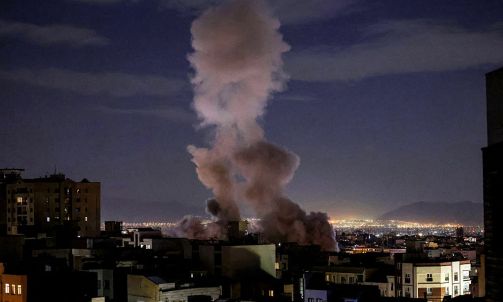
In addition to preventing a genuine, three-pronged, unwinnable global war at a later date, attacking Iran has severely disrupted China’s supply lines, regional power, and ability to launch any form of conflict in the Pacific (as it had threatened to do by the end of 2026).
China and Russia, via Iran and its proxy militant groups, have used Islamic terrorism to reshape the global order away from Western powers. And our duplicitous academics, commentators, activists, and politicians have cheered them on, most certainly out of ignorance.
Let’s not forget that 90 per cent of Iran’s oil is sold to China, the rest flows to Syria, the UAE, and Venezuela.
It has been long known that one of the biggest weaknesses of China is its reliance on imported crude.
Donald Trump tapped Beijing on the shoulder with the abduction and arrest of Venezuela’s Maduro, disrupting its imports. Now, with the Middle East descending into Chaos, it will have to lean heavily on its major supplier … Russia.
Of course, Saudi Arabia was the largest supplier of crude into China for 2025, but it will be disrupted, especially if there are any more drone strikes from Iran.
Beijing will also be frustrated by the war between Pakistan and Afghanistan, complicating regional hostilities awfully close to their Belt and Road network.
China is not as foolish as the Australian government, and has gone to the trouble of keeping reserves, however, if we are looking at prolonged Middle Eastern conflict or an Iranian regime change in favour of a Western alliance, it will spell big trouble for China. The nation that built itself on being the sweatshop of the world will no longer be able to rely on cheap energy.
It will be interesting to watch what the Houthis do next. They have said they ‘will’ resume attacks, but so far, the Houthis have not attempted to clamber up the sides of any US war ships.
Meanwhile, Hezbollah, in Lebanon, went crazy the minute missiles started flying over Iran. The Iran-backed terror group are ‘ready for open war’ despite Lebanon telling them to sit down, shut up, and hand over their weapons. Hezbollah has been officially banned by the President of Lebanon, who will likely assist Western allies in combating locations within his nation that have been firing on targets. It is also believed that Hezbollah’s leader was killed during an Israeli airstrike on Monday after they launched ‘largely symbolic’ attacks on Israel in ‘memory’ of Khamenei.
As for the rest of the Arab states, they have spent the last two days issuing strongly-worded warnings via X to Iran and its proxies that further stray missiles on their territory and embedded in the sides of their luxury hotels will result in the immediate and unrelenting return of fire. In a way, Iran’s emergency ‘burn it all’ backup plan is a gift to America’s regional strategy.
What we have learned is that wealthy Arab nations hate nothing more than Iran’s love affair with death and rubble.
Using drones to destroy the largest oil refinery in the region, of which 80 per cent of its customers are in Asia, was a huge faux pas. As were the rest of its attacks dedicated to the destruction of the energy network.
The entire region is turning on Iran.
This is already the natural direction of the war. The US is being assisted by frustrated Arab nations who want Iran to stop ruining everyone else’s progress. China and Russia would risk a great deal intervening on Iran’s behalf and, ever the opportunists, they are likely to withdraw what they can, remain quiet, and work out how to best profit when the dust has settled. There’s always a disgruntled rogue state or Islamic terror group to negotiate with. They just have to wait and see which ones survive before showing their hand.
At the moment, China and Russia are opposing military actions, calling for cessation of military operations, and demanding dialogue. Hypocritical? Absolutely. But the UN has never held them to any sort of standard.
It is difficult to predict what Russia will do, but we can be sure China’s primary goal will be securing oil and gas interests, perhaps even in two stages. One for immediate supply. A second for continued control. Their opening actions may not be representative of their long-term agenda.
To summarise, it seems very likely that despite the initial gnashing of teeth, the Islamic Republic in Iran is in big trouble.
Its proxy terrorists are being picked off. Its influence is being purged. Its neighbours are pissed. And its big ticket friends are re-assessing their options.
If you want insight into the relationship between Russia, China, and Iran … keep an eye on the pirates.
Flat White is written by Alexandra Marshall. If you would like to support her work, shout her a coffee over at donor-box.