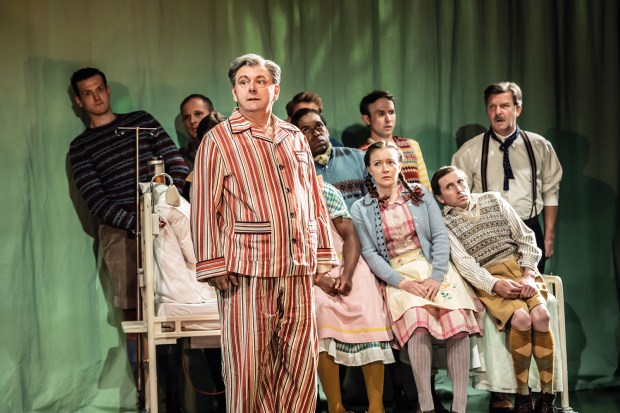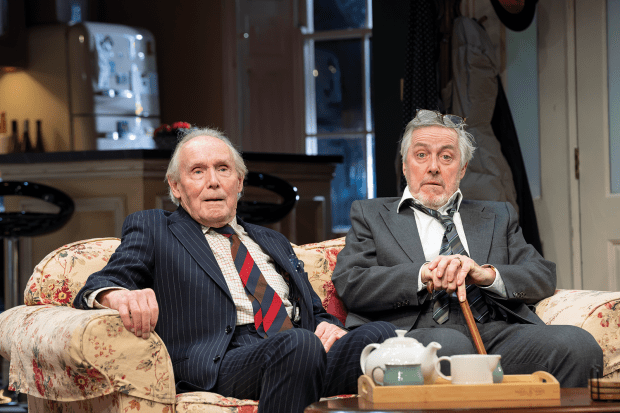
Dachniki meaning ‘dacha people’ is the Russian title of the National Theatre’s new production of Gorky’s sprawling 1905 drama. Nina and Moses Raine, who adapted the play, chose the flavourless title Summerfolk which doesn’t quite capture the play’s distinctive Russian atmosphere of ennui, intellectual rumination and despair. However, their perky, supple and idiomatic dialogue works very well.
Gorky appears to have written the script as a feverish homage to Chekhov, who died in 1904, and he pinched numerous characters and plot twists from his mentor. The beautiful, vain and sexually inert Varvara is a copy of Yelena in Uncle Vanya. Kaleria, the nervous actress who performs amateur verse for her friends, is inspired by Nina in The Seagull. And the cynical lawyer’s clerk, Vlass, is a version of Trofimov in The Cherry Orchard.
The setting and the personalities could become a Netflix series that never ends
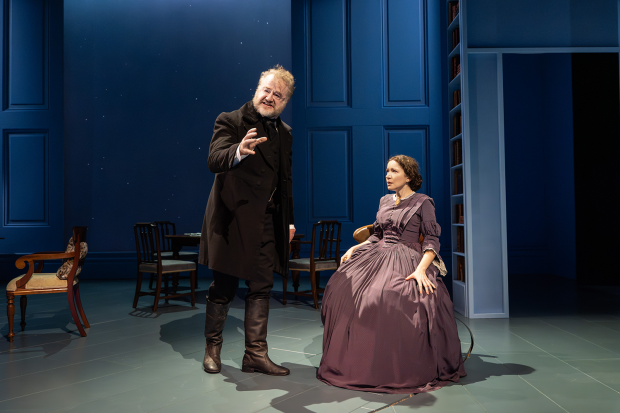
Gorky’s personalities chat about love, money and the meaning of life but they seem far more pompous and pretentious than Chekhov’s characters. Are we supposed to admire these people, to laugh at them or to despise them? Hard to say. And it’s unclear who the main character is until the beautiful widow Maria Lvovna (Justine Mitchell) receives a romantic proposition from the angry rebel Vlass. He seems sincere, if a little desperate, and his declaration turns Maria into a skittish, giggling novice as she considers his offer. She yearns for romance but she fears that her heart will break if Vlass becomes dissatisfied and moves on. Justine Mitchell and Alex Lawther (Vlass) make an adorably weird couple but their fling doesn’t receive as much narrative attention as it deserves.
As the play develops, the characters become sharper and nastier. Varvara (Sophie Rundle) makes it clear that she hates her hard-working husband, Sergei, who seeks emotional comfort in fishing and boozing instead. Paul Ready (Sergei) gives a masterclass in replicating the mannerisms and vocal cadences of Simon Russell Beale on stage. (Perhaps this impersonation is an in-joke among the cast.) An unhappy couple, Yulia and Pyotr, squabble bitterly when Yulia produces a pistol and takes aim at Pyotr’s head for fun. This lazy and ill-motivated spat would have dissatisfied Chekhov whose characters are always warm, humane and endowed with limitless charm.
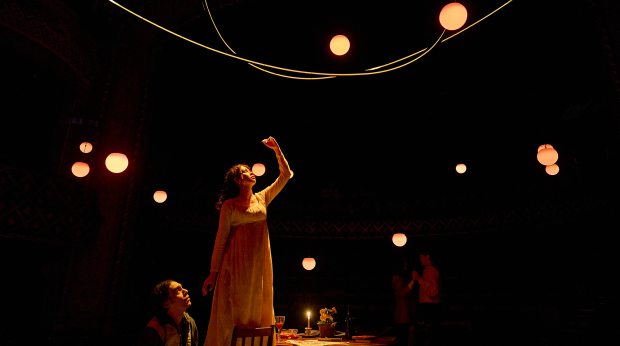
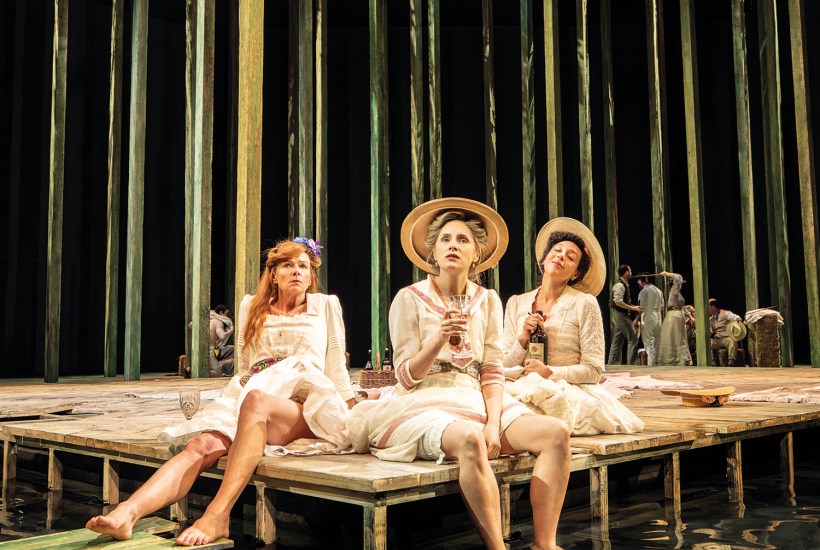
You may find yourself tiring of Gorky’s superficial and narcissistic personalities but you can still relish the play’s atmosphere of wasteful ease and its languidly beautiful aesthetic. Peter McKintosh’s luxurious wooden summerhouse is an ideal backdrop for the beautiful white costumes of linen and cotton. All are immaculately cut. At the edges of the stage lurk a few surly peasants dressed in ratty grey smocks who mutter angrily about vengeance and the coming revolution. These soiled bumpkins create a wonderful contrast that makes the wealthy characters seem all the more angelic and adorable.
In Act Two, the set opens up to reveal a shallow blue lake where the actors paddle and swim half-naked. It’s no criticism to say that this play might have continued until midnight or beyond, with the actors improvising more dialogue as they went along. The setting and the personalities could become a Netflix series that never ends. Don’t miss it, by the way. Everyone will be talking about this for months.
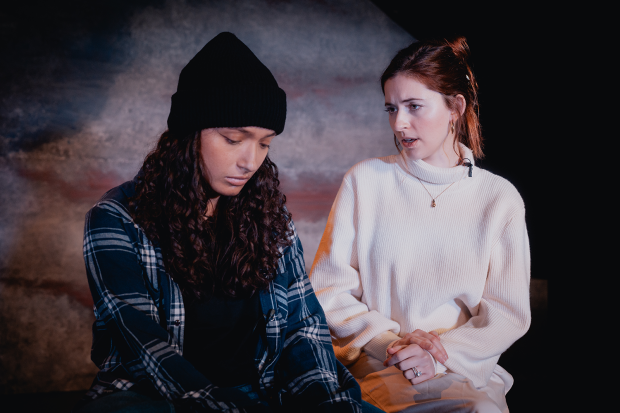
Welcome to Pemfort opens as a gentle sitcom set in a failing gift shop. Pemfort Castle is a neglected landmark near Warwick and the staff are determined to put the place on the map. A local geek, Glenn, is organising a family day out and he asks his boss, Uma, and his colleague, Ria, to create a timeline of the castle and to prepare a re-enactment of a duel between two bishops that took place in the grounds.
The nerdy atmosphere is brilliantly and subtly evoked in Ed Madden’s wonderful production, and the script by Sarah Power is full of deft, realistic touches.
It’s rare to find writing of this calibre on the fringe
The gift shop’s most loyal customer is a solitary villager, Pete, who owns a hound of prodigious size. Hence his nickname, ‘Big Dog Pete’. The characters are harmless, amiable types with low ambitions but the actors never stray into self-parody. Then the excitement begins. Uma hires a new assistant, Kurtis, without asking Glenn and Ria in advance. This feels like a violation of the informal rules of the gift shop. And Kurtis is hiding a secret which becomes the focus of the story as it develops into a fascinating drama about ethics and forgiveness. Is it a sign of strength or weakness to show mercy? Power’s script soars to unexpected levels. Kurtis and Ria bond over a distressed stag whose antlers have become entangled in a clump of fishing line and the fate of the animal becomes a symbol of their troubled romance. It’s rare to find writing of this calibre on the fringe. Could the show transfer? It doesn’t quite have enough oomph for a West End run. But the writer and the director are destined to hit the heights.
Got something to add? Join the discussion and comment below.
You might disagree with half of it, but you’ll enjoy reading all of it. Try your first month for free, then just $2 a week for the remainder of your first year.