How can you make ordinary people prosperous? Free trade and the market economy was George Reid’s controversial policy (Prime Minister 1904-05), which is still controversial and still the best bet for the country.
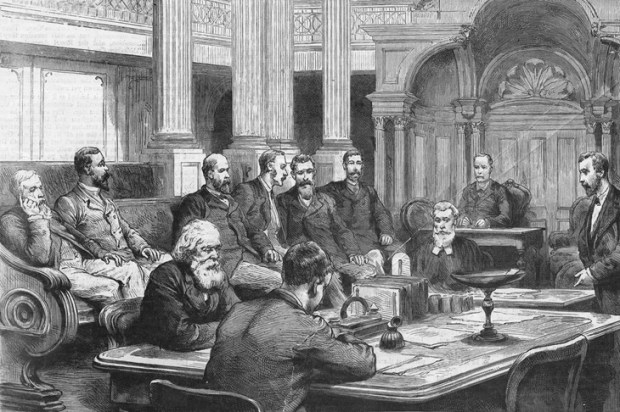
Alfred Deakin (Prime Minister 1903-04, 1905-08, 1909-10) protected private enterprise through tariffs and workers through labour laws. He warned against the ALP’s ‘sundry wild experiments, the results of which seem beyond calculation…’ This is arguably relevant now.
Reid described the ALP as ‘a hungry socialist tiger that would devour all’.
The ALP’s Andrew Fisher (Prime Minister 1908-09, 1910-13, 1914-15) said the market economy malfunctioned (e.g. monopolies) and supported larger government. In 1921, the ALP adopted ‘the socialisation of industry, production, distribution, and exchange’ as a party objective. It attempted but failed to nationalise private banks in 1947.
For the next one hundred years, these issues were fought out, election by election.
The market economy made us comparatively rich, subject to increasing regulation and taxation, which both hindered and helped.
British democracy was the means by which we made political decisions, Edmund Barton said: ‘The British Constitution on which the Federal Constitution was founded …’ (1909). Others call our democracy ‘Washminster’, a combination of the Westminster system and US federalism.
Autocracies however make poor decisions and never miss an opportunity to miss an opportunity.
As The Case for Democracy (VDEM Institute 2026) says, autocracies ‘frequently suffer from deep economic crisis’ while democracies ‘experience fewer economic crises’.
‘Democratisation leads to economic growth – on average 20 per cent higher GDP per capita after 25 years.’
The negative growth rate of Zimbabwe (topping 16 per cent) each year from 1999-2008 is ‘more representative of autocracies than present day China’.
Some ‘research’ resembles special pleading (e.g. the alleged link between diversity and economic growth). But this correlates.
Western Europe, North America, Australia, New Zealand, Japan, South Korea and Taiwan, all democracies, make ordinary people rich and safe and peaceful. No autocracy is represented in the rich club of nations, with perhaps one exception. China is the world’s second-largest economy, but the standard of living is upper-middle range on most measures (World Bank) and may have plateaued.
Nobel prize winners Acemoglu and Robinson explained the success of the rich club of nations as based on ‘inclusive institutions’ of free and fair elections, and strong property rights. Both these things are absent in the less fortunate autocracy club of rule by the gun and by theft.
Australians in the 1850s arguably had the highest standard of living in the world, as ‘one man one vote’ Constitutions were just starting. But it took the transformation of democracy and developing modernity before industry could afford to pay anything approaching modern wages.
Our early democratically elected colonial Premiers were dedicated to economic development. This was what the people demanded and supported with hard work.
The economic debate goes on, and we still miss important opportunities. Uranium will stay in the ground, although if Australia mined and sold it as the visiting International Energy Agency head suggested in March we would both help the world and make a lot of much-needed income. Land use is an unpredictable political football. All of this undermines prosperity.
More fundamental errors are made by autocracies:
‘Democracies do not wage wars against each other and see much lower risks of conflict and instability than autocracies. Autocratisation leads to more wars and conflicts.’ (The Case for Democracy.)
I can think of no democracy starting a war against another democracy.
People with the drive and hatred to introduce autocracy may not read polite Swedish reports. They also may not care at all that ‘climate change mitigation’ or ‘gender equity’ is the result of democracy. They live in rough neighbourhoods where priorities are drinking water and sewerage.
Or they are simply concerned with greed and power.
Whatever the reason the history of developing economies is littered with the ‘train that goes nowhere’ example of one African country. The train therefore earnt little revenue, but the government still had to service a massive loan.
Or expensive vanity projects which are then abandoned in the desert or jungle. Examples include a ghost town of Disney-like ‘mini-chateaus,’ and many massively expensive incomplete and disused new hotels.
Nor were the Founding Fathers completely new men, who suddenly emerged, blinking in the sunlight, in 1901. They were all men of colonial Australia and its liberties. If you hate colonial Australia, you reject our modern stable prosperity. Haters need to rethink.
George Reid was Premier of NSW and Alfred Deakin held office in the colonial Victorian governments.
The early Founding Fathers established a ‘policy of frugality’ for Commonwealth spending (Prime Minister Deakin, 1903). Now the ALP may be building a larger government sector.
The economic fundamentals are surely known to the government. But renewing the Australian project will require governing.
A qualified patriotism is a start but lessen or remove the equivocations. Most now seem very tired of the entirely negative campaigns which have dominated our intellectual life for 40 years or more. Surely that is now obvious from recent election returns.
We need less puerile posturing internally and in foreign relations, more understanding of the large gaps in what is called ‘international law’.
I do not support simple hatred of the previously all-powerful coalition of noes which rejected our country. That would be replication of something which damaged us for too long. What should replace it is a more realistic approach to the world and policy, not building vast and idealistic projects which prove to be unworkable and seriously unsustainable.
We have great assets. An educated and peaceful society, despite a flawed immigration system and the wars of troubled hotspots. A stable and workable democracy. A commitment to the market economy, with regulation to promote competition and social protection.
But now it is clear we need a better economic debate, more of an emphasis on the market. Budget restraint must be the start.
The Hon. Reg Hamilton, Adjunct Professor, School of Business and Law, Central Queensland University