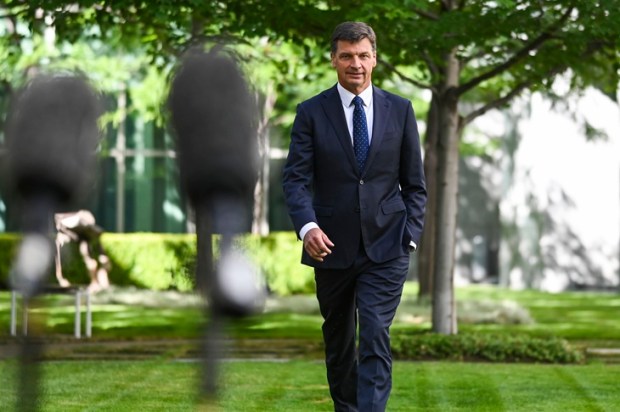
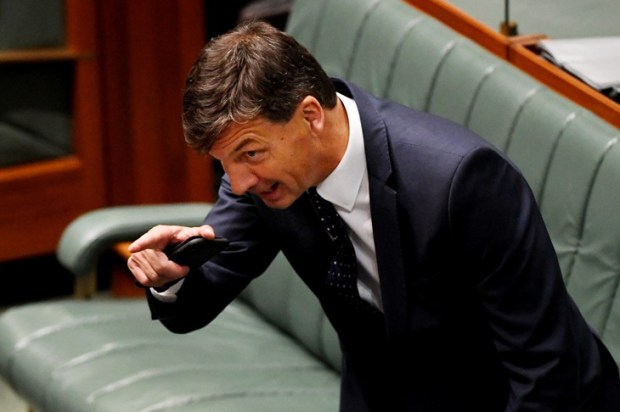
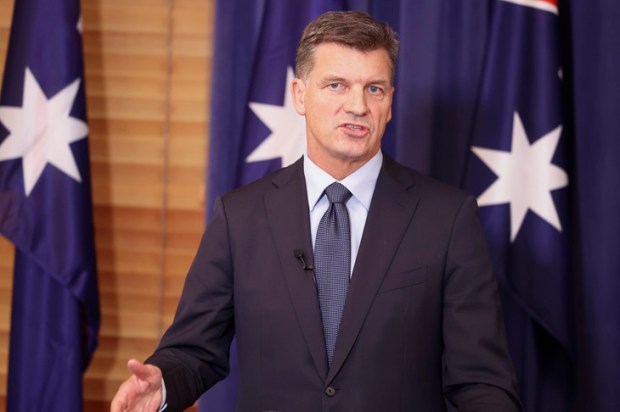
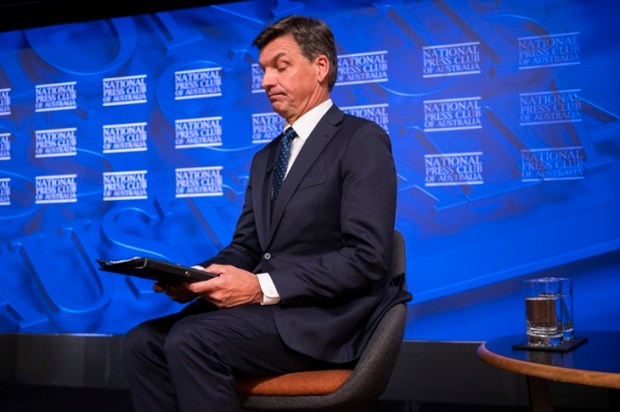
The Liberal Party are searching for good news in the polls on the back of Angus Taylor taking over from Sussan Ley as leader, but a bounce measured in single digits will be too modest for the comfort of the backroom boffins and professional tea-leaf readers at Liberal HQ.
As it is, the various polls show the Taylor-led party trailing One Nation by 7 per cent (Newspoll) 9 per cent (Redbridge) or more optimistically leading One Nation by 1.5 per cent (Roy Morgan), but still well behind Albanese’s Labor government.
Liberal Party heavyweights, including Tony Abbott, writing for this masthead have, if I may paraphrase, urged the public to give Angus Taylor time – a chance to establish himself and lay out his vision for the Liberal Party.
The argument is that we must give him time to prove that he is different.
I beg to differ, and the polls suggest that this kind of ‘give him some time’ argument, which has worked in the past, is no longer getting traction in our changing cultural landscape.
The Liberal Party are at risk of viewing through a political lens something that is far more significant. I believe we are witnessing the greatest social change since the sexual revolution of the 1960s. The reasons why and metrics by which this new revolution can be seen are a topic for another day.
Given that politics is downstream of culture, the political movement we are observing in the polls with the rapid rise of One Nation is nothing more or less than the inevitable day-follows-night consequence of this enormous social change that the Liberal Party show no signs of having noticed, much less understood.
Angus Taylor has 13 years of political history based upon which we can already assess the claim that he is ‘different’. He’s held senior ministerial roles in government such as the energy minister under both Turnbull and Morrison, and was a key architect of the compromised and doomed-to-fail-from-the-start Dutton Campaign.
We don’t need time to see if he’s different, we have history to tell us he is not. The Liberal Party are correct to recognise that ‘different’ is what is needed in today’s cultural climate, but they are wrong to think the electorate can be hoodwinked by little more than a new face on the old party.
If the Liberal Party pitch is that it’s ‘different this time’ then Angus Taylor is the wrong man for the leadership job and the onus is not on the public to patiently wait and see, the onus is squarely on him to sear in to the public consciousness a stark and undeniable contrast between himself and all that has gone before in the last 20 years.
Thus far, he has failed to warm a cup of tea, much less sear a brand into the psyche of the electorate.
I am sceptical of any claims that Taylor is anything more than a fresh coat of lipstick for three key reasons:
- Taylor’s personal political history.
- The timing of the ‘change’.
- Liberal Party policies going forward.
Let me discuss each in order.
Angus Taylor’s personal political history.
Political discourse and public opinion are currently dominated by cost-of-living pressures, and cost-of-living pressures are underpinned by energy prices in Australia. This means inevitably that Taylor’s time as the Energy Minister must be front and centre when considering his individual history.
Taylor and his supporters will point out, correctly, that as Energy Minister he argued for more affordable energy through mechanisms including a default market offer for energy of ‘less than $70 per Mwh by 2021’, argued for government underwriting of 4,000 Mw of new power generation projects, opposed stricter Co2 emissions targets, and argued for investment in gas extraction and strategic reserves during the market lows of 2020 caused by pandemic shutdowns, to name a few highlights.
I don’t dispute any of those claims and whilst these certainly set him apart from today’s Albanese government, they do not set him apart substantially from Turnbull, Morrison, Dutton, or Ley.
Worse, the fact remains that as Energy Minister he presided over continued commitment to the Paris agreement, continued ‘investment’ into the black hole that is the Snowy 2.0 project, and on his watch consumer power prices continued to climb when adjusted for the impacts of the pandemic shutdowns, and alongside the positives, such as interest in gas projects, sits negatives, such as investment in doomed pumped hydro projects and other efforts to comply, at least in appearance, with Australia’s obligations under the Paris Agreement.
This is, at best, a mixed record in the critical portfolio of Energy Minister which shows the same yes-but-no each-way-bet weakness that has been endemic to the Liberal Party on energy policy for some decades.
And this is in my opinion Taylor’s strongest argument in his favour. From here things go downhill considerably.
Voting records from theyvoteforyou.org.au show Taylor’s votes matched 100 per cent with Malcolm Turnbull during the five years they shared in Parliament, 99.9 per cent with both Morisson and Dutton, and 99.5 per cent with Sussan Ley.
Now, I’ll be the first to put my hand up and acknowledge that there will, of course, be considerable overlap between the voting records of members of the same parties! They are ideological bedfellows to begin with, and party discipline requires that they vote identically in most situations in any case.
So defenders will object: ‘of course’ their voting records are so similar!
Yes… ‘of course’ they are… but isn’t that the point? If Taylor’s argument was that we should support him because he is a continuation of the status quo then the ‘of course’ would be a strong argument, however he’s not making that case, quite the opposite.
We’re being asked to consider him precisely because he’s allegedly different, but his voting record says otherwise.
Compare this record to someone like Senator Alex Antic and the contrast comes into sharp focus. Now of course it’s difficult to make a direct comparison between Taylor and Antic because they sit in different Houses of Parliament and have different versions of bills and different votes at different times, but it can be seen from his record that Senator Antic has rebelled against the Liberal Party position on 22 separate occasions, and about half of those occasions he was alone, the only member to cross the floor, and in many more it was Antic and Gerard Rennick, who was effectively ousted from the party through preselection because he wouldn’t ‘play ball’.
Alex Antic could make the argument that he is different because his voting record say so. Such an argument from someone like him would be compelling because he has the voting record to prove it, either crossing the floor or choosing to abstain on numerous votes in defiance of party discipline.
If Angus Taylor could say the same for himself then his pitch would be more compelling. But here’s the rub; If Angus Taylor had crossed the floor as many times as Senator Antic then he would never have been given the position of leader. He would not even be a shadow minister. He would be an outsider in his own party…
Angus Taylor is the leader of today’s Liberal Party specifically because he served and supported all the past leaders, and his ascension is a natural continuation of the same leadership, not evidence of something different, and in the Liberal Party it cannot be any other way. Not only does Taylor not represent change, but in fact real and substantive chance has been made impossible.
The timing of the ‘change’.
Had Angus Taylor, or Sussan Ley for that matter, come off the back of their drubbing at the last federal election and said ‘we hear you and we’re going to change’ then pledges of a new direction might be credible as being values-based and substantive, a rediscovery of the Liberal Party’s venerable roots.
But coming off the back of nine months of abysmal polling and in the face of a surging One Nation, any claimed ‘change’ today comes off as a desperate ploy for survival, not a substantive return to principles.
I’d liken the Liberal Party’s ‘but this time we’ve changed’ strategy to a junkie ex-boyfriend begging you to take him back because, really truly, he’s different this time… But you both know that this is about the fact that you’ve found a new boyfriend.
You both know he hasn’t changed and if you take the old boyfriend back, he’ll go right back to his old self-destructive ways.
It should not have taken the metastasising of One Nation into an existential threat to trigger real and substantial soul-searching and an excavation of long-lost-values from the Liberal Party. The electorate is right to be sceptical of political promises that appear to be rooted more in survival than values, and the onus is certainly on Angus Taylor to prove our scepticism wrong, not on us to give him time.
Liberal Party Policies.
To this day the Liberal Party remain committed to the Paris Agreement, at least on paper. This might seem like smart politics if voters are deciding between the Liberals and Albanese’s Labor government and casting their vote in a two-horse race, however the polls are absolutely shouting the fact that this is no longer a two-horse race. Those days are gone.
Liberal Party election strategies are built entirely around bidding for a ‘middle’ voter, someone who might swing between Labor and Liberal based on specific policies aimed at specific issues.
That model hasn’t served them well for many years and given polling in the last 18 months it is well and truly obsolete today.
Political polarisation today is real and has certainly accelerated post Covid, and in coming elections the Liberal Party cannot simply obsess over a ‘swing’ voter and take their base for granted, because their base is now being stolen by a competitor who is closer to the ‘polar’ position of today’s electors.
Political wonks might argue that ‘bid for the middle’ model has worked in the past, that that’s how Scott Morrison got elected, but I would argue that the pursuit of the mythical middle over 20 years is what led the Liberal Party into the wilderness devoid of values or meaning where they find themselves today, and their very survival is now at stake.
Voters will not believe in a party unless that party first believes in something. The Greens believe in something. Labor believe in something. One Nation believe in something. The Liberals? They’ll morph into whatever it takes to appeal to a mythical middle and in the process they prove they believe in … what?
Australian culture is changing rapidly in ways which are historic, substantive, and lasting, but the Liberal Party today are still drawing their strategies from a playbook which barely worked previously, and certainly won’t work now.
Polling continues to be hard on Taylor, Yougov put Taylor 9 per cent above where they last put Sussan Ley, which looks great but it’s still 11 per cent behind Albanese, and as we’ve covered here that’s not the comparison that matters.
The latest Redbridge poll which crucially included Pauline Hanson as a ‘preferred’ option in a 3 way contest, puts Taylor’s net approval at 10 per cent, only the slightest improvement over Sussan Ley, and far behind the allegedly ‘hated’ Pauline Hanson on 23 per cent, and absolutely nowhere in comparison to Prime Minister Anthony Albanese on 34 per cent.
This is more reflective of the actual decision that will be made by voters… it’s no longer Red or Blue, Orange is in the mix and Taylor has yet to respond to that new reality.
‘We just need to give him more time.’
More time doesn’t help when you’re still going in the wrong direction, and time is something the Liberal Party do not have to play with.
The looming South Australian State election is almost a certain lock for the Malinauskas Labor government, with the Liberals reduced to battling with One Nation over who gets to call themselves the opposition in South Australia.
Right now, Roy Morgan says the Liberal Party will struggle to attract even 1 in 5 South Australian votes in a three-party-preferred runoff against One Nation and Labor, with Labor the crushing victor, One Nation in opposition, and the LNP barely more than the new Greens, irrelevant in the lower house and a mere nuisance in the upper.
Irrespective of the exact outcome, it will be difficult for the Liberal Party to extract a positive narrative from the South Australian election.
There’s also the Farrer by-election, a parting gift from Sussan Ley, and whilst there’s a realistic chance of a win for the National’s candidate there’s equally a very real chance of a win for One Nation.
But the biggest danger for the Liberal Party in Farrer is the temptation for them to thwart One Nation by ‘helping’ the independent Michelle Milthorpe. The Liberal Party, along with the Nationals, will be very tempted to put Milthorpe above One Nation on their How To Vote cards. I consider this so likely that I’ve devoted entire videos to this exact topic and how, in their desperation to quell the perception of a rising One Nation tide, the Liberal Party may be tempted to preference the independent candidate above One Nation in Farrer.
Whilst this might save them some face in the short term, avoiding a One Nation win, it would condemn Taylor’s Liberals as being no different to the Uniparty of old, it will confirm that the Liberal Party truly do not understand the historic social change that is happening in the Australian electorate right before our eyes, and such a tactical ‘win’ would be weaponised strategically by One Nation with tremendous effect in the next federal election.
The ‘Uniparty’ narrative would become iron-clad in the wake of such a compromise by the LNP, and in hindsight they will wish they had lost to One Nation rather than helped Milthorpe.
Then, of course, we have the Victorian state election in November. One Nation have recently hit the lead in a very tight contest with Labor, LNP, and One Nation all within 4 per cent of each other in the latest Roy Morgan poll.
It must be said that there’s a long way to go before the Victorian election and if a week is a long time in politics then there’s eons of time before November and I’m not game to make predictions now, however, One Nation don’t have to win in Victoria to cement the public perception of their inexorable rise.
Just as with South Australia and with Farrer, One Nation can win in Victoria without winning. They need only force either the Liberal or Labor parties into a minority government with them, or perhaps even better, with each other, highlighting their collusion to exclude One Nation and further cementing the ‘Uniparty’ narrative. That’s all it will take and the taste of blood will be enough to energise an Orange Army for the federal election the likes of which this country has never seen.
Our politics have been dominated by the fruits of the sexual revolution of the 60s for as long as any of us can remember and the Liberal Party are still playing by the rules that dominated the game 20 years ago. But the counter-revolution is now well underway and the rules are changing rapidly in ways that none of us have seen before in Australia.
One Nation are discovering after 30 years, most of them ‘in the wilderness’, that they are in the right place at the right time and the new cultural revolution is rallying to their flag.
Angus Taylor and the Liberal Party have figured out that a ‘change’ narrative is needed in these times, but they haven’t yet realised that today’s voters are actually paying attention to politics, and that electors today are too cynical to be fooled by new lipstick on the same pig.