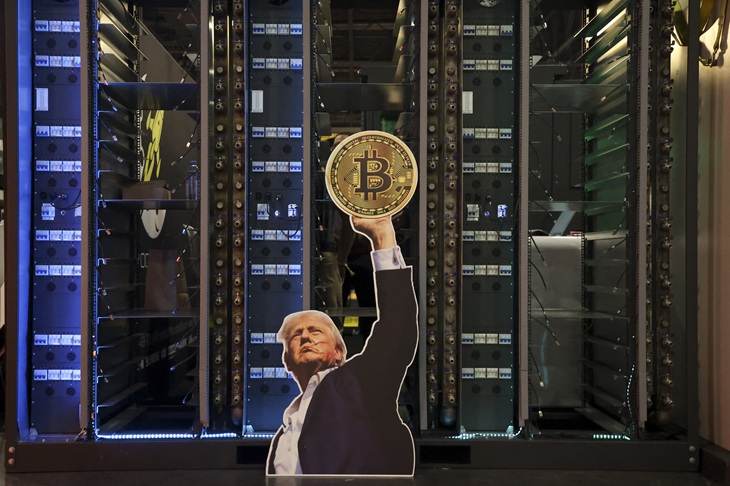
For years, the true believers have shouted from the rooftops of social media, preaching a bitcoin gospel of decentralisation and ‘digital gold’.
But last week’s turmoil in the markets, which was nothing short of historic, has been followed by a deafening silence.
At the time of writing, bitcoin has ‘stabilised’ around USD $70,000 after plunging a record $10,000 in a single day and is down more than 50 per cent in just four months.
The crypto Fear and Greed index is at its lowest point since its creation – lower than Covid’s Black Thursday or the FTX bankruptcy.
Crypto fear and greed just hit an all-time low.
Lowest since the index was created. pic.twitter.com/jJns0gY64D
— Miles Deutscher (@milesdeutscher) February 9, 2026
The promoters of these ‘magic beans’ have suddenly gone quiet. Untold numbers of people have watched their savings evaporate into the ether – literally.
Promoters, as always, say it’s a good tip to buy the dip, that bitcoin is ‘cyclical’.
But this time might be different for several reasons.
One by one, the grand theses behind crypto’s adoption have fallen like the severed limbs of Monty Python’s Black Knight.
As a medium of exchange, it failed. It’s slow, expensive during congestion, and too volatile to price real economic activity. No one uses it to buy anything anymore.
In practice, bitcoin has behaved like a risk asset – rising with liquidity and falling when the taps are turned off, not as a stable store of value.
It has sold off during precisely the macro conditions it was meant to protect against.
While the future of the US dollar and ‘dedollarisation’ are being seriously questioned, people aren’t flocking to the supposed ‘future of money’.
They are piling into the ‘analogue bitcoin: gold’.
Over the past year, gold is up 70 per cent, while Bitcoin is down 34 per cent.
Another reason this could be the end of bitcoin is that it is no longer novel. The creation of ETFs means there are zero barriers to entry, and you are no longer ‘getting in early before the normies’.
It is tragically mainstream.
There are also no more regulatory wins to be made, and therefore no catalysts to front-run, like there were when Trump came to office.
The only ‘halving’ event that matters is the halving in price we’ve seen since October.
And now a shiny new toy has arrived in the form of AI.
For a long time, miners exploited cheap electricity to hunt for digital coins, but now they are being crowded out by the massive power demands of data centres.
Why mine bitcoin when you could jump on the AI trade?
Capital that once chased speculative crypto returns is now being drawn toward data centres, chips and infrastructure with clearer cash flows.
The most spectacular casualty in this saga of ego was a CEO who claimed no one had lost money buying Bitcoin. Now their company is currently down $7.3 billion on its Bitcoin investments.
Imagine spinning a bitcoin scheme into a ‘Digital Asset Treasury’, getting it listed on the share market, only to become a ‘bag holder’ with an average cost basis of roughly USD $76,000 per coin.
These bitcoin treasury companies, once the steady buyers keeping a floor under the price, are now massive holders who may become forced sellers, placing further pressure on the market.
The reality is that bitcoin has always relied on the greater fool theory: the hope that there is always a marginal buyer willing to pay more than you did for your imaginary casino chip.
A real thesis requires answering harder questions: Who must buy next? Why must they buy? Under what conditions do they stop?
The only remaining intact argument for buying bitcoin now is, purely based on belief it must go up, no fundamentals, entirely propped up by fraud and fake narratives.
Let’s not kid ourselves about what this is.
Bitcoin is not a revolution; it’s a speculative punt. I’m fine with that, provided we call it by its real name.
Just remember: there is no crying allowed at the crypto casino.