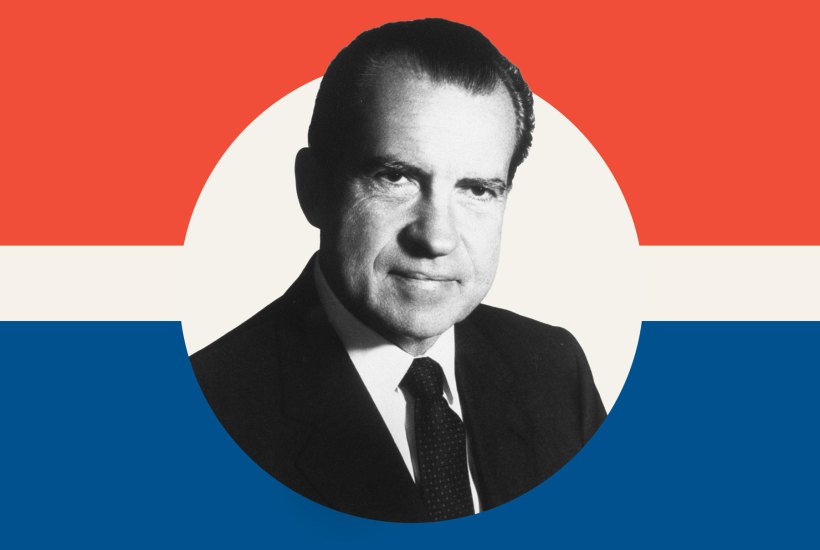
Americans took a break from their partisan vituperation in February to mull over newly revealed testimony that Richard Nixon gave to grand jury investigators in 1975, a year after the Watergate scandal drove him from power. James Rosen, a veteran Washington journalist and the biographer of Nixon’s attorney general John Mitchell, revealed the episode in the New York Times. Nixon had argued that his program of wiretaps had been made necessary by another spying operation that senior American military commanders were carrying out against him and his top aides.
The outline of this story has been known to historians since James Hougan laid it out in Secret Agenda (1984): a brilliant young sailor named Charles Radford memorized, photocopied, and purloined classified documents from Nixon’s National Security Council, sometimes even emptying Henry Kissinger’s briefcase, and delivered them to a hawkish group of high military officers led by Admiral Thomas Moorer, chairman of the Joint Chiefs of Staff. Alarmingly intimate accounts of arguments over military strategy began showing up in the syndicated columns of journalist Jack Anderson.
What Watergate did was to separate the Oval Office from the political choices of the American people
What is new in Rosen’s account is the context in which Nixon places the crisis. It came to a head in the last weeks of 1971, as his administration was planning the great strategic surprise that arguably won the Cold War – namely, America’s “opening to China,” the secretly negotiated rupture in the Sino-Soviet alliance. It happened at the height of the bloody war between India and Pakistan over Bangladeshi independence, and Pakistan, then a pariah state, had been the “bridge to China,” Nixon revealed. Kissinger, accompanied by Radford on a trip to Pakistan, had feigned illness to secretly visit China, and was offering extraordinary American support to Mao Zedong: “If India jumped Pakistan and China decided to take on the Indians,” Nixon explained in the secret testimony, “we would support them.”
Pentagon investigators didn’t know what to make of Radford’s thefts. Perhaps a coup was afoot. (“We walked out thinking this was Seven Days in May,” one officer recalled.) If so, how would the plotters react to Nixon’s rapprochement with the world’s most ruthless communist power at the height of the Cultural Revolution? The Vietnam War was going on, too, of course, drastically limiting Nixon’s options. To reveal a military spy ring would have destroyed support for the conflict. Hence Nixon’s resort to wiretapping and other “abuses of power.”
Nixon’s argument before history doesn’t really stand up. His men had broken into the offices of the war critic Daniel Ellsberg’s psychiatrist months before the Moorer-Radford business came to a head. But the revelations do fit a general pattern: every time we find out something new and factual about Nixon, it places him in a better light and strengthens the case that he got a raw deal – that he was, at least in part, taken down by what we now call the “deep state.”
That is important because Nixon is linked in the public mind to Donald Trump. There is a logic to this. Watergate became part of a constitutional project. The same Washington insiders who exposed it – lawyers, journalists, government employees and newly elected congressmen – also set up institutions to curtail future presidents’ freedom of action. In 1974 came laws against impoundment of funds. Starting in 1976, ethical watchdogs, known as inspectors general, were given a role in every government department. In 1978, the Justice Department got “independent” powers to investigate the president. As the historian Julian E. Zelizer recently described the post-Watergate reforms: “A fragile wall was constructed to separate the Department of Justice from the political interests of the Oval Office.”
That’s one way of looking at it. But there is another way: what Watergate did was to separate the Oval Office from the political choices of the American people. Decisions about whom to prosecute and what ethical system the government follows are not supposed to be independent. They are supposed to be determined by the American electorate, through the man they elect to run the executive branch. American progressives have come to deride this point of view as “the unitary executive theory.”
But this right-wing understanding of Watergate seemed to make more sense: didn’t Alexander Hamilton argue for a unitary executive in Federalist 70? And if the judiciary can call the president to account for “obstruction of justice,” aren’t unelected judges our real rulers? By the end of the 1970s, Americans were feeling remorseful enough about Watergate to elect Ronald Reagan in a landslide. By 1990, when Stanley Kutler wrote The Wars of Watergate, which is still the authoritative account of the scandal, Nixon had been almost rehabilitated. “Nixon,” the liberal Kutler wrote, “certainly ranks with the two Roosevelts, Woodrow Wilson, and Dwight Eisenhower as a dominant, influential and charismatic figure of the 20th century.” Nixon had a lot of progressive enemies, sure, but today’s cartoon-villain caricature is a recent invention. And it is “woke” that is responsible.
That is where Trump comes in. Nixon’s disgrace enabled the reform of the state to make it more deep state-friendly, with a permanent role in steering the executive given to judges and regulators. That role was unpopular, but whenever voters declared they wanted it changed, a judge or regulator would inform them that this was against the rules. The state thus became unreformable through ordinary democratic means. Uh-oh.
Nixon’s misdeeds, when soberly tallied up no longer appear commensurate with the dudgeon expended on them. He wanted to keep classified documents like the Pentagon Papers from being published? All presidents do that. He wiretapped people? Lyndon B. Johnson’s FBI wiretapped Martin Luther King. Nixon was not especially corrupt by the standards of his day. He was more corrupt than Eisenhower or Jimmy Carter. He was about as corrupt as JFK or LBJ, which is plenty corrupt. But he doesn’t bear comparison with the crypto-dealing, Qatari-plane-soliciting occupant of today’s White House.
Nixon had progressive enemies, sure, but today’s cartoon-villain caricature is a recent invention
Except in the sense that the assault on Nixon ultimately brought about Trump’s rise. Nixon, for all his overdeveloped distrust, was patriotic and constitutionally loyal. He eventually handed over his White House recordings to investigators. The aides who betrayed him didn’t fear him. John Dean, Nixon’s White House counsel, by his own account “told the President that I hoped that my going to the prosecutors and telling the truth would not result in the impeachment of the president. [Nixon] jokingly said, ‘I certainly hope so also,’ and he said it would be handled properly.”
Nixon’s presidency was destroyed not by his ruthlessness but by his lack thereof. The same can be said of Trump’s first term. Until May 2017, Trump lacked the resolve to fire then-FBI director James Comey, who had sought to ensnare him in an investigation and had sabotaged the nomination of his national security advisor. So began “Russiagate.” Trump lacked the resolve because he lacked the loyalty of the lawyers and prosecutors embedded in his own government – which, under any pre-Nixon constitutional understanding, he could have counted on as a matter of course.
Our current President is often criticized for putting loyalty above competence. His first term showed the contrary approach to be impracticable. The failing goes back to Watergate. It is not personal but constitutional. Blame lies not with Nixon, but with his vanquishers.