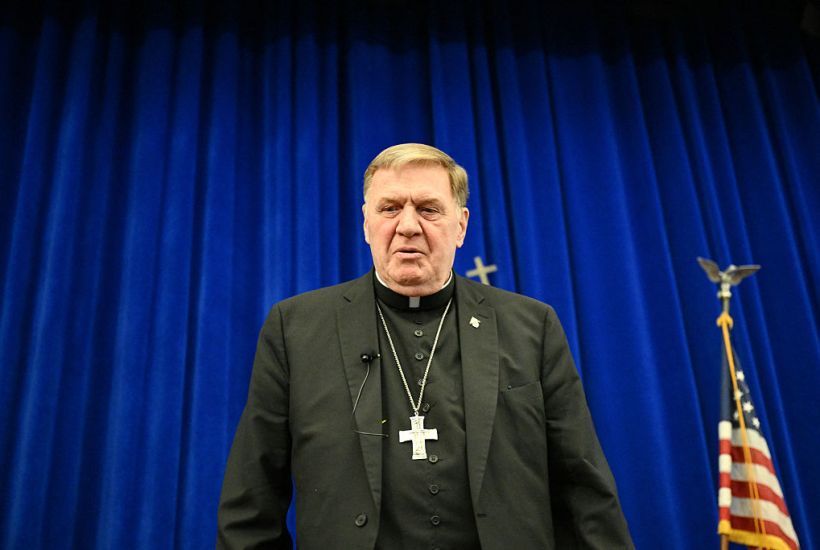
Cardinal Joseph Tobin, the archbishop of Newark and a close confidant of Pope Leo, called for the defunding of ICE during an interfaith prayer livestream. “If we are serious about putting our faith in action, we need to say ‘no,’” he said. As Congress debates ICE funding this week, Tobin urged Catholics to write to their lawmakers and encourage them to “vote against renewing funding for such a lawless organization.”
The scenes from Minneapolis are disturbing, and the dissonance between what I see and what I’ve been told – either by Trump administration officials calling Alex Pretti a “would-be assassin” seeking to “massacre” law enforcement, or by commentators depicting him as a martyr and saying that people are being “executed” on the street – has made me desperate to turn to some wise voice of moral and spiritual authority. Perhaps that’s what makes it so disappointing to hear Tobin fall in with such an obviously partisan and misguided call to defund ICE. It indicates that the Catholic Church lacks confidence in her own ability to address these complex issues with justice as well as mercy.
American bishops have so far struggled to offer much in the way of practical guidance on the immigration issue, or more specifically, what to do about ICE. Several wrote letters against President Trump’s immigration policy shortly after his inauguration in January 2025, with Archbishop Timothy Broglio, president of the US Conference of Catholic Bishops (USCCB), saying that many of the new executive orders were “deeply troubling and will have negative consequences.” Bishop Mark J. Seitz of El Paso, chairman of the USCCB’s Committee on Migration, stressed “that national self-interest does not justify policies with consequences that are contrary to the moral law.” Archbishop Jose H. Gomez of Los Angeles said that statements from the then-new administration “have caused fear in our parishes, schools, and communities,” and that any law enforcement actions “should be matched by immediate action in Congress to fix our immigration system, which has been broken for decades now.”
One has to wonder if many politicians would not consider the “broken” immigration system to have been functioning as intended in those decades. It was not action in Congress that halted the flow of illegal immigrants over the southern border, but an executive order. Vice President J.D. Vance has criticized the USCCB for its lack of a “commonsense” stance on immigration. “I think the US Conference of Catholic Bishops has, frankly, not been a good partner in commonsense immigration enforcement that the American people voted for,” Vance said, “and I hope – again, as a devout Catholic – that they’ll do better.”
In November, the USCCB issued a joint message on immigration in the light of President Trump’s ramped-up deployment of ICE. “We are disturbed when we see among our people a climate of fear and anxiety around questions of profiling and immigration enforcement,” they wrote (and read out in a short Instagram video with four million views). “We oppose the indiscriminate mass deportation of people. We pray for an end to dehumanizing rhetoric and violence, whether directed at immigrants or at law enforcement.”
Pope Leo called it an “important statement,” and invited Catholics to listen closely to what the bishops said. “No one has said that the United States should have open borders,” Leo said. “I think every country has a right to determine who and how and when people enter.” But “if people are in the United States illegally, there are ways to treat that,” he offered vaguely, such as seeking removal through the justice system. (Notably, the USCCB’s statement did not make any differentiation between legal and illegal immigrants.)
The Immigration and Customs Enforcement agency is, of course, a way of treating the issue. It has arguably overstepped its popular mandate: most Americans are in favor of deporting criminal aliens, less so an indiscriminate approach where immigrants are sent to detention centers even if they have no criminal background. Much of the criticism from Catholic bishops regarding the dehumanizing, deeply Twitter-brained rhetoric coming from the DHS is warranted. But the unrest in Minneapolis is not about how many illegal immigrants are being removed, or which ones, or how. For many of the protestors, it is not a question of how ICE operates, but that it operates at all. They grant themselves the authority to resist federal deportations, no matter how humanely they’re carried out. That is, after all, the point of sanctuary cities.
Minneapolis is a sanctuary city, which means it permits its officials to operate in opposition to federal agents under what is essentially a very ambitious re-interpretation of religious philosophy. Until around the early modern period, sanctuary was provided by churches for criminals who sought refuge and were fleeing arrest. The condition of sanctuary being granted was that the criminal must confess his sins to a priest and repent. After 40 days, the criminal could either stand trial or publicly confess to his crimes and submit to exile.
Sanctuary, in its original sense, requires a particular way of seeing the world: namely, that there is such a thing as the sacred. The “Operation Pullup” protestors who occupied Cities Church during Sunday worship clearly have no sense of the sacred. If there is anything these people hold to be inviolable, it is a set of progressive ideals which might tolerate a lukewarm, tractable version of Christianity, but ultimately holds it in contempt.
“How will you say ‘no’ to violence?” Tobin asked, saying that people of many faiths go to immigration detention centers “and they say ‘no’ by standing at the gates, by talking with the ICE personnel, by insisting on the rights of the detainees within.” Many Americans said “no” to violence by voting for a president who promised to make cities safer by deporting criminals who should not have been there in the first place. Detainees deserve to receive pastoral care and to be treated humanely, but Tobin should be wary of encouraging the kind of confrontation and harassment of agents that we’ve seen in Minneapolis.
The Catholic Church has a long history of peaceful resistance, and a whole litany of saints who stood up to injustice and even gave their lives doing so, but it is naive to think that supporting the Minnesota protests or interfering with ICE arrests is simply and indisputably “the Christian thing to do.” The organised anti-ICE movement is, at its core, anarchic. It is at odds with institutional power, whether that be the Catholic Church or the federal government. Many of these protestors – and the “rapid response” groups that have engineered unrest by harassing and provoking immigration officers – have granted themselves the right to resist law enforcement and to help others do so simply by decreeing the government “fascist.” In Cities Church, worshippers were condemned as “Nazis” in front of their children.
The US bishops have a serious spiritual malaise to minister to in this country, and their emphasis on having respect for other human beings is, however basic it seems, needed. But it does not go far enough. The tensions over ICE’s actions and presence in US cities raise many other questions that require more thoughtful answers from bishops, such as how to face the tensions between solidarity with migrants and America’s right to sovereignty and control of its borders, or what a humane but fair approach to illegal immigration looks like, or what to do about the Catholics who work in border enforcement, immigration courts or ICE and see themselves as civil servants trying to balance compassion and the law. The USCCB should counsel the people of Minneapolis and respond to their outrage, but that is a different thing than being swayed and swept away by it.