If you lived anywhere near Kilburn half a decade ago, you might have noticed the messages one of our neighbours kept spray-painting over our walls and bridges. They’d appear overnight across a fairly wide swathe of north-west London, always in an immediately recognisable loopy handwriting, and the content was always recognisably loopy too. This person was trying to communicate something, but it was hard to tell exactly what. The messages said things like ‘STAND UP TO BLACK MASSES’ and ‘MERCY FROM DR HACK’ and ‘TAKE MERCY UNTO ME TAKE IT OUT OF IT’.
Every few days for about a year, I would come across another one of these messages, and try to piece together exactly what the author was trying to tell me. There was something going on in the world, something bad. It had to do with hospitals and doctors, in particular the sinister Dr Hack, but also with Satanic rituals, and sometimes other bits and pieces from the news would be strewn in there, all mushed together into the general frantic senselessness. I found it strangely compelling. I wanted to know more about this reality. But the author was keeping their cards close to their chest, and I couldn’t exactly ask. All I had to work with was this cryptic novel being released sentence by sentence in underpasses at night.
Even the most devoted cultist is, in some sense, having fun
Some conspiracy theories are more interesting than others. The most boring kind is also the most popular. Somewhere, there’s a sinister cabal of elites, some shadowy ‘They’, who keep themselves alive by eating babies’ adrenal glands, and are secretly plotting to wipe out the rest of the world’s population. What’s strange about this theory – aside from the baby-eating – is that these elites keep mysteriously failing to follow through on their plans. Despite the pandemic and the vaccine and 5G and everything else, the world’s population is still stubbornly here.
On a day-to-day level, what ‘They’ actually seem to be doing is putting on a highly elaborate play for you. Fake political divisions, fake mass shootings, fake terrorist attacks, sometimes fake wars. The most basic form of conspiracism is to insist that everything you see through the media and its system of images, from the Moon landings to 9/11, is in some sense not real. The point of all this fakery is to distract you, so you don’t notice what ‘They’ are planning. In practice, believing in this kind of theory tends to involve obsessively following the news every second of the day, but constantly announcing that you don’t think any of it means anything. This is a generally sad and pointless way to spend your life, but a lot of people seem to like it.
Luckily, there are better kinds of deranged paranoia out there. It might be boring to claim that everything we know about the world is a lie, but sooner or later the conspiracy theorist has to give an account of what’s real.
Last month, a terrifying image circulated on TikTok: a Google satellite view of the eastern seaboard of the United States, including some kind of enormous undersea geological formation in the shape of a snake’s head just off the coast of Virginia. It isn’t actually there, but that hardly mattered. The story was that Leviathan – the biblical sea monster, the one God taunts Job with, the one you will not be able to hook – had awakened from his 1,000-year slumber, and was now rising from the depths to devour the Earth. This was, apparently, the reason for the cold weather in the region. Credulous people might reach for explanations like ‘It’s January’ and ‘That’s winter’, but those with eyes to see knew that the US government was controlling the weather, creating artificial snowstorms to send Leviathan back into hibernation. Not for good reasons, obviously. It was just trying to protect the naval bases in the area from the creature that ‘esteemeth iron as straw, and brass as rotten wood’.
A lot of people were talking about Leviathan awakening off the Virginia coast. Did any of them truly believe it? Harder to say. There are plenty of credulous types out there, but most of them were probably having fun. It’s fun to imagine that the miserable cold weather outside your window is part of a convoluted narrative involving a secret war between some shady government agency and an Old Testament kaiju. It’s fun to invent stories about things.
Some conspiracy theories are beautiful. There are people who have spent years, even decades, making up miniature worlds in their heads, perfect jewelled creations that work according to a brilliant logic that doesn’t exist in the real one. Among my favourites is the ‘new chronology’ proposed by the Russian mathematician Anatoly Fomenko, who compared the regnal periods of Roman Emperors, Egyptian Pharaohs and Israelite kings, and found a pattern; he concluded that these were all the same people. We only think otherwise because historians have taken different accounts and assumed they referred to different time periods. In fact, Jesus Christ was the same person as Pope Gregory VII and the Byzantine emperor Andronikos I Komnenos; he was born around 1150 in Crimea. (In Fomenko’s version of history, almost everything that ever happened took place in Russia.)
Others are genuinely haunting. Flat Earthers believe the world is a flat disc with the North Pole at its centre; the Sun is about 32 miles wide and spins along the Equator, and Antarctica is a wall of ice surrounding us on all sides. But they have different ideas about what’s beyond that ice wall. Some think it rises into the firmament, the crystal dome surrounding our little universe. Others believe in something called ‘Infinite Plane Theory’, in which there are other undiscovered continents out there beyond the ice. Unlike the firmament model, Infinite Plane Theory can explain the 24-hour sunlight during the Antarctic summer. Antarctica is lit by more than one star: there’s a place where you can see an alien sun, floating over an entirely unknown world.
One of the most elaborate recent conspiracy theories is QAnon, which held that everything that happened in Donald Trump’s first presidential term was cover for a clandestine operation against an international cabal of child-trafficking Satanists. What looked like politics – tax cuts, cabinet reshuffles, that sort of thing – was actually something else. But Trump was constantly giving secret signals to his true followers, letting them know what was really going on through a series of codes hidden in ordinary statements, catty tweets or hand gestures. For instance, the act of drinking a bottle of water with two hands was interpreted as a signal that mass arrests would be coming imminently. Nothing is random; everything in the world is delivering a secret meaning. Soon, believers were assembling this tissue of coded messages into an entirely parallel universe, in which World War Three was secretly being fought in deep underground tunnels across the world, and practically every Hollywood celebrity had been arrested, flown to Guantanamo Bay, executed for treason and then replaced with a body double or a lifelike robot, which would then continue to act in films as if nothing had happened.
At QAnon’s peak, it might have had millions of adherents. Many really did believe in this stuff; it could take over their lives. There are forums for their grieving family members, who’ve had to accept that someone they love is now incapable of thinking or talking about anything other than the mole children and the secret bases on Mars and the coming storm. But I think even the most devoted cultist is still, in some sense, having fun. Their mad narrative makes the world a more beautiful place, charged with meaning, rich with secrets; it lets them work creatively with the world instead of just passively accepting it.
In a way, conspiracy theory is exactly the same as art. The conspiracist and the artist both take a world in which things simply happen and replace it with a world in which everything is deliberate. The only difference is that the artist is confined to their own work. The conspiracist gets to attribute their own inventions to an all-powerful cabal, which means they can work on a much larger scale. They can rewrite all of history; they can dream our boring ordinary spherical reality into entirely new shapes.
This is the problem with artistic responses to conspiracy theory, like the ones currently being shown at the Warburg Institute’s Conspiracies exhibition: most of the time, the best art about conspiracy theory will be made by the conspiracists themselves. Next to them, artists – who have reputations to protect, after all – are too tepid and cautious. The introduction to the exhibition feels the need to sternly note that conspiracy theories ‘drive political campaigns, cultivate moral panic, and promote racism and hatred of difference’. Which might be why most of the artists exhibited have chosen not to really deal with the substance or even the aesthetics of conspiracy theory in any meaningful sense.
Most of the time, the best art about conspiracy theory will be made by the conspiracists themselves
Caspar Heinemann contributes two dashed-off pen drawings of Unabomber Ted Kaczynski as a woman, which supposedly prompt questions about ‘how we understand the role of nature and technology in relation to subjecthood and society’. These are displayed alongside some cardboard boxes covered in gaffer tape, with which Heinemann ‘conjures an aesthetics of secrecy’. Instead of conspiracy, Hannah Black takes on the randomness of the world that conspiracy theory annuls, through an elaborate but unimpressive A-level project based on Fortuna’s wheel. A big plastic wheel spins; when it stops a light shines through it on to one of a collection of basically tedious objects.
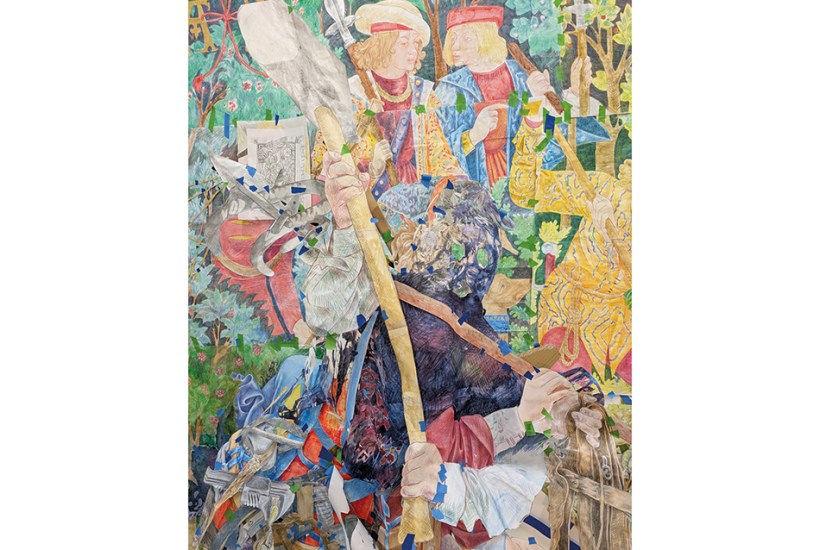
The work that comes closest to the lurid intensity of actual conspiracism is Sam Keogh’s ‘The Unicorn Crosses a Stream Cartoon’, in which a 16th-century tapestry is interrupted with fragments of modern life, CCTV cameras, smartphones, plus a mysterious sign that Friedrich Engels described as the ‘secret identity stamp of the peasants’. It’s a fun melange; you could spend a few minutes working out the connections between the images, as with Aby Warburg’s own brilliant clusters of portentous forms. But it’s a shame that none of what our professional artists can come up with is as creative or as arresting as the alien worlds strange and nameless people create on walls at night.
Got something to add? Join the discussion and comment below.
You might disagree with half of it, but you’ll enjoy reading all of it. Try your first month for free, then just $2 a week for the remainder of your first year.