‘Socialism is a philosophy of failure, the creed of ignorance, and the gospel of envy; its inherent virtue is the equal sharing of misery.’ – Winston Churchill
When I came to Australia from the USSR in 1978, people expected me to be shocked. I was. Not because of gum trees smelling like a sauna, kangaroos with joeys in their pouches, or the fantastic, almost empty beaches. Not because of the easy‑going locals whose jumble of supposedly English words I could barely understand, combined with their remarkable respect and kindness toward an immigrant who did not have a cent to his name.
For all of this, I was deeply grateful, sometimes to the point of tears.
What shocked me was something else entirely: Australians were remarkably relaxed about their home‑grown communists, socialists, and assorted radicals of many labels, every one of them eager to ‘liberate’ this wonderful country from … what, exactly?
Even they did not seem sure, muttering vaguely about ‘the system’ while radiating enthusiasm and youthful sincerity.
No one took them seriously.
The pubs were full, the beer was cold, the footy was exciting, and the Aussie dollar was as strong as a 20‑year‑old’s morning erection. Nobody cared about my political views, religion, colour, or gender – they only wanted to know what kind of person I was.
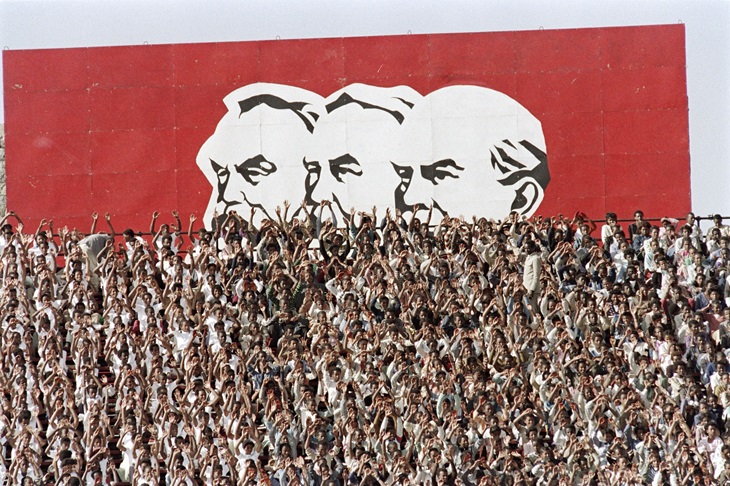
The weekend edition of The Age looked and weighed like a mid‑sized suitcase and cost 14 cents – the same price as a litre of premium petrol. The entire Communist Party of Australia’s float in the Moomba parade was a huge red sign with a hammer and sickle painted on it, mounted on five bicycles, each pushed by an octogenarian. That was essentially the whole Communist Party of Australia (Marxist‑Leninist – meaning they took their instructions and funding from Moscow rather than Beijing). The crowd neither jeered nor laughed at this feeble display. Sports‑mad Australians did not kick a man when he was down. It simply was not cricket.
My attempts to ‘enlighten’ my new countrymen, in my best broken English, were met with polite nods, raised eyebrows, and equally polite expressions of interest. I naively believed that my eloquent descriptions of the evils of Marxism were having an impact. Later I realised this was the classic Aussie way: let a man have his say while quietly keeping your own opinion. It was also one of the most cherished Australian habits – live and let live.
Still, I was not as naïve as I thought. When I found myself working in the middle of nowhere with outback Aboriginal patients and discovered that there was no personal ownership of land, only communal ownership, I immediately recognised that Indigenous Australians had been herded into a Soviet‑style kolkhoz. It was a sobering discovery. Yet what amazed me even more was the eagerness with which well‑to‑do Australians donated money to obviously extremist, radical left‑wing causes. Many of these donors were passionate believers in the vague ideas of ‘social justice’, wealth redistribution, and Australia’s future as a socialist country. They voted Labor and were unaware that the ALP’s national platform spoke of building ‘democratic socialism’.
Whenever I discussed Marxism (I no longer do), I would ask two questions of the person denouncing the failures of capitalism:
Have you read The Communist Manifesto?
Do you realise what communists will do to you, your family and your property if they gain political power?
Without exception, the answers were ‘no’. Not one supporter of socialism had read The Communist Manifesto. Not one understood the consequences for themselves, their families, or their property. They imagined a kindly, soft‑focus socialism without the slightest understanding of its nature. For example, they did not grasp that Marxism recognises no concept of private property; it treats it as stolen and illegitimate. Under such a system, anything you own can be taken from you. Nor is there such a thing as habeas corpus; your very existence can depend on the whim of a party official.
I had to study Marxist theory and pass examinations on it in a Soviet medical school in order to graduate. More importantly, I have lived under both socialist and capitalist systems.
There are many varieties of socialism – Russian, Chinese, Danish, German, European Union – almost as many as there are revolutionaries burning to bring universal happiness to mankind and, not incidentally, to win political power. The desire for power burns 24/7, regardless of the wishes of those they claim they want to ‘liberate’. These varieties differ in detail, but they all share three common elements and one universal principle.
First, they need a victim group or groups on whose behalf the socialists must seize political power, in order to ‘protect’ them from exploiters.
Second, they need a common enemy against whom the whole society should direct its hatred.
Third, they need a monopoly on power, which they will never willingly share.
The victim group can change. Early socialists chose the proletariat, the working class, as their preferred victim in need of advocacy and protection. (The Latin word ‘proletarius’ describes a person who has nothing to offer the state but his children – in essence, the contents of his testicles and ovaries.)
When the proletariat became prosperous and evolved into a middle class, socialists had to invent new victims: the environment, members of the LGBT community, global warming, solar energy, the Palestinian cause, Indigenous causes, open‑border immigration and so on – anything that undermines liberal democracy and smooths their path to power.
The common enemy can also change. One reason socialists are so angry with Israel is their fury at what they see as the ‘betrayal’ by Israel’s founding socialists when they chose the capitalist road and rejected the socialist one. Germany’s National Socialists chose the Jews as enemies; the Soviets chose ‘class enemies’; the Khmer Rouge selected the educated; the Chinese communists targeted ‘capitalist roaders and running dogs of capitalism’. Every socialist regime needs its own enemy. One look at the hate‑contorted faces of weekend ‘protesters’ in our CBD streets shows how prophetic George Orwell was when he described the Two Minutes Hate in his novel 1984.
Monopoly on power is self‑explanatory. The clearest example is the sham Soviet election with a single approved name on the ballot. Modern socialists move toward monopoly more subtly, for example by importing large numbers of third‑world migrants who then reliably vote for them.
And now, drum roll.
The main principle of socialism is as simple as a cow’s moo: ‘We will work less and less and be paid more and more.’ Margaret Thatcher summed it up: ‘The problem with socialism is that eventually you run out of other people’s money.’
The beauty of this principle, for its advocates, is that they regard themselves as altruistic fighters for freedom, justice, and the common good. They insist, ‘We are not fighting for ourselves but for the oppressed, depressed and dispossessed.’ This wins applause and votes. That is when the so‑called Tytler cycle begins:
A democracy cannot exist as a permanent form of government. It can only exist until the voters discover that they can vote themselves largesse from the public treasury. From that moment on, the majority always votes for the candidates promising the most benefits from the public treasury, with the result that a democracy always collapses over loose fiscal policy, always followed by a dictatorship. The average age of the world’s greatest civilisations has been 200 years.
These nations have progressed through this sequence:
From bondage to spiritual faith;
From spiritual faith to great courage;
From courage to liberty;
From liberty to abundance;
From abundance to selfishness;
From selfishness to apathy;
From apathy to dependence;
From dependence back into bondage.
Where are we on this scale? I fear we are on the second step from the bottom. Using the main principle of socialism, any economy – even the strongest – will eventually collapse. Those who gain political power by promising ‘social justice’ must either ditch their promises or plunge the country into massive debt, because it is impossible to work less and less and receive more and more. Sooner or later, the economy fails.
This raises a simple question: do the people telling us these beautiful fairy tales understand what they are doing? Do they understand where they are leading us, our children and our grandchildren? Do they grasp the consequences of their generosity with ‘public money’ for voters who naively believe that the state’s coffers are bottomless? Do our fearless leaders, the pursuers of ‘social justice’, understand that they must either abandon their promises or borrow staggering sums that our children and grandchildren will have to repay?
If they do not understand this, they are fools. If they do understand it and still persist in dragging us into poverty with these policies, they are criminals, scammers and tricksters. Of course there will always be ‘useful idiots’ who sincerely believe that free cheese is theirs by right. I have news for them: free cheese exists only in a mousetrap, and only for the second mouse. A system built by fools or criminals on this basis cannot end well.
It gets worse, because the next stage of socialism is communism. There, according to the classic formula, you do not need to work at all – or only a little, if you feel like it. The main principle of communism is, ‘From each according to his ability, to each according to his needs.’ It is not supposed to arrive overnight; it is promised in 20 or 30 years. In other words, ‘Let us string you along for half a century and then it will no longer be our problem.’
To illustrate this mentality: at the 22nd Congress of the Communist Party of the Soviet Union in 1961, Nikita Khrushchev declared that the current generation of Soviet people would live under communism and promised that a basically communist society would be built by 1980.
You already know how that promise ended.