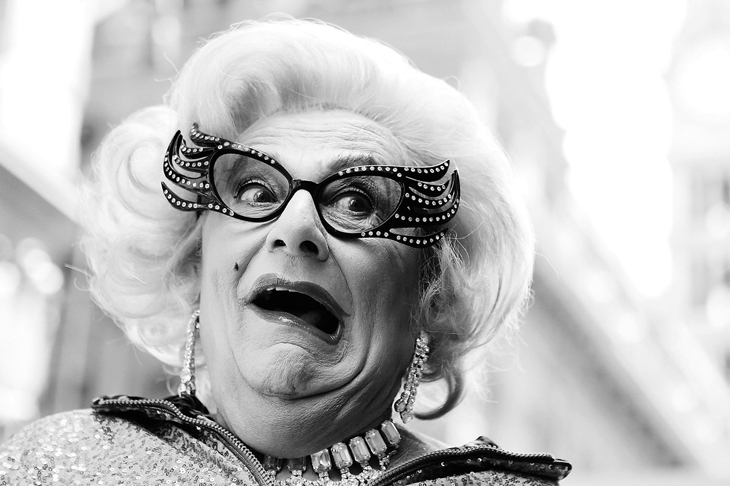
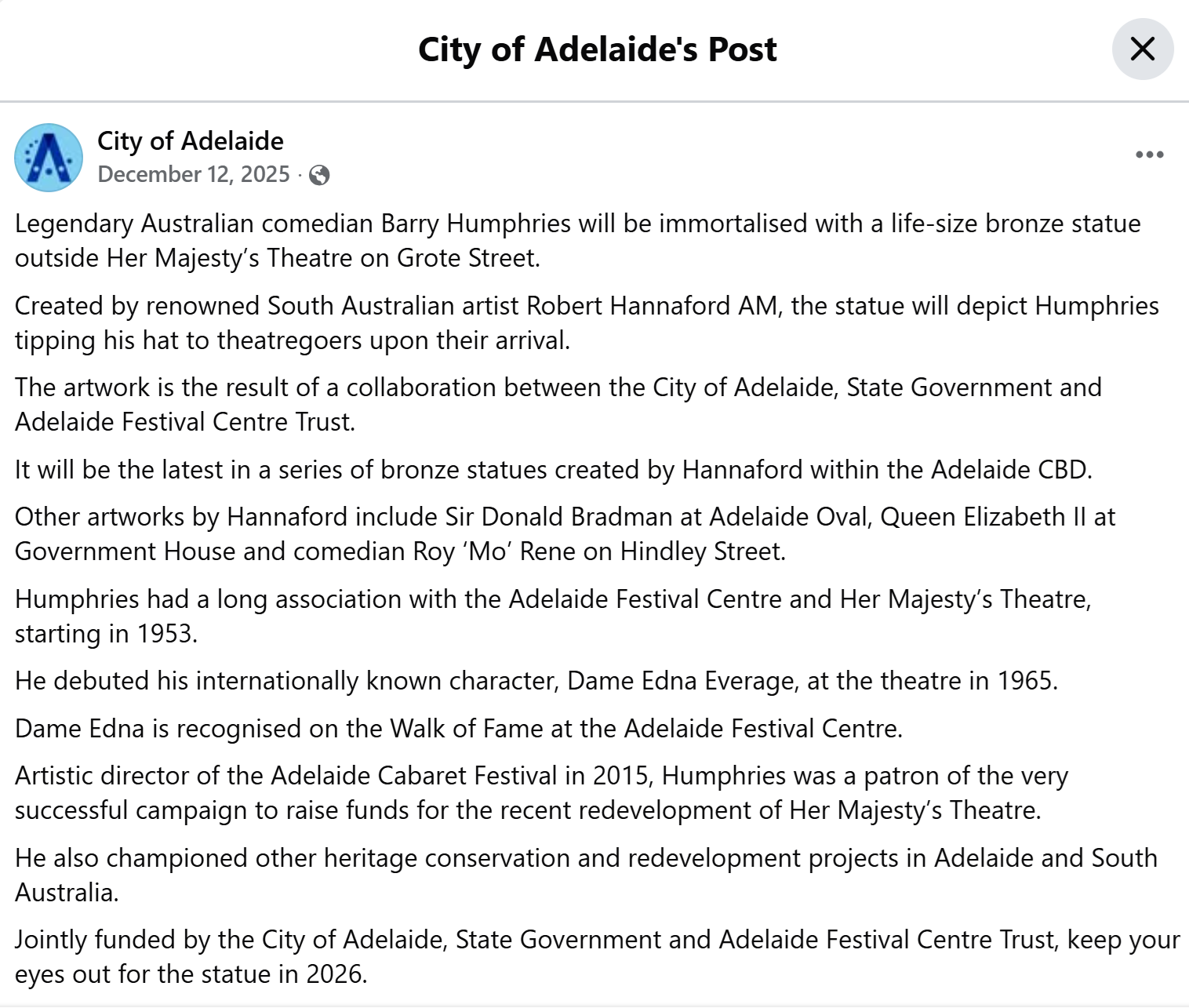
Soon, theatre-goers strolling past Her Majesty’s Theatre in Adelaide – the very stage where Barry Humphries made his theatrical debut as a 19-year-old in 1953, and later called his favourite theatre in the world – will encounter a new bronze statue in his honour.
In December 2025, Adelaide City Council approved the $313,083 sculpture, to be crafted by celebrated South Australian artist Robert Hannaford AM. The price tag has sparked debate across council chambers, headlines, and social media threads.
For some, it is a frivolous extravagance; for others, a fitting tribute to a cultural provocateur whose legacy is both hilarious and uncomfortable.
One can almost hear Sir Les Patterson himself bellowing beneath it: ‘Finally! A bloody statue with enough room to park my ego!’
For the uninitiated, Patterson was Humphries’ most outrageous creation: a slobbering, tactless, endlessly self-assured cultural attaché whose qualifications seemed to include sexism, unfiltered appetite, and an uncanny ability to offend diplomats and the public alike. In today’s ‘Woke’ climate – where hashtags regulate morals and algorithms dispense outrage – he would be cancelled before finishing the first cork-soaked sentence.
Yet it is precisely this unpublishable audacity that made Patterson enduringly brilliant. Humour, particularly the uncomfortable kind, is a societal mirror. Through Sir Les, Humphries lampooned national ego, bureaucratic puffery, and moral posturing. He never asked us to admire the offensive behaviour; he demanded reflection through laughter. He took what was local – Australian manners, politics, and cultural cringe – and made it universal, exposing the absurdities all societies share.
Even internationally, Patterson’s grotesque diplomacy resonates. Every culture has its version of the blundering, blithering, self-important, spectacularly oblivious public figure, and every society benefits from laughter at their expense. Dame Edna Everage, Humphries’ other iconic creation, navigated progressive culture with charm and wit, proving that he understood both sides of human absurdity. Patterson, in contrast, forced us to confront the untidy, unsanitised, ungovernable aspects of our own societies – and to laugh at them.
Imagine Patterson addressing a gender-sensitivity seminar today: ‘Love, I identify as whatever gets me through customs without a fuss.’ Outrage would erupt, hashtags would flare, and social media tribunals would convene. Yet the brilliance lies not in the chaos, but in what it illuminates: comedy functions as cultural lubrication. Sterilise it into politeness, and you sacrifice perspective for prudence.
The Adelaide statue itself becomes a metaphor: societies often undervalue culture and humour because they are uncomfortable or ‘unsafe’. Spending a few hundred thousand dollars on bronze may spark debate, but it costs far less than the cultural sterility created when we attempt to sanitise every joke, gag, or grotesque caricature. Money well spent!
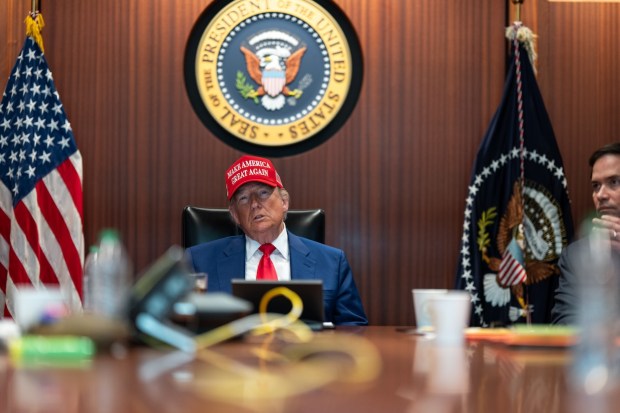
And then there is the fantasy scenario that Patterson, somehow alive, confronts the modern political circus – say, Donald Trump. The news that he might be appointed US Ambassador would, in Les’s eyes, be both validation and absurdity:
‘Ambassador?’ he’d bellow. ‘Love, I’m already ambassador to the Court of St. James’s, and possibly your mother-in-law’s dining room! Do you think I have time to negotiate trade deals between the golden toilets and my tie collection?’
Patterson would recognise a kindred spirit in Trump – the ego, the spectacle, the brand-as-politics – yet have no patience for careful phrasing, performative virtue, or social media outrage. ‘Look, love, diplomacy is about knowing how to offend politely,’ Patterson would snarl. ‘Not just tweeting insults at the other bloke while wearing a red cap!’
Were he somehow installed as Ambassador, Washington might never recover. He’d hold press briefings in hotel ballrooms, address Congress while waving cocktail napkins, and issue treaties in the form of limericks. Yet beneath the chaos lies the sharpest lesson: Patterson instinctively exposed theatricality, ego, and self-interest in politics. Just as he lampooned Australian public life, he would hold a mirror to global pomp, ambition, and spectacle – leaving a trail of scandal and laughter in his wake.
Even today, Patterson’s irreverence offers a prescription for cultural health. Humour is not frivolity; it is a democratic tool, a mirror, a pressure valve. It allows societies to interrogate themselves, to confront pretension, and to survive their own absurdities. In a world dominated by curated outrage and performative virtue, we forget how essential laughter is to perspective, resilience, and civic intelligence.
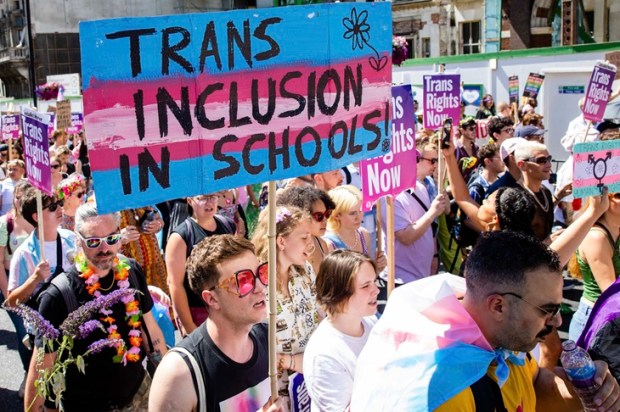
We should also reflect on Patterson’s later-life controversies. Humphries attracted criticism for remarks about transgender people – including describing gender-affirmation surgery as ‘self-mutilation’ in 2016 – a reminder that even genius can misstep. The Melbourne International Comedy Festival removed his name from its top award in 2019 in response. Yet a thoughtful reading of his work reminds us that satire is never about comfort; it is about friction, reflection, and truth told through exaggeration. Patterson’s genius was not in seeking admiration, but in forcing discomfort, self-recognition, and laughter simultaneously.
If Sir Les could not survive the Woke, perhaps that says less about him – and more about how brittle our collective sense of humour has become. The Adelaide statue, the budget debate, the imagined ambassadorial chaos – these are reminders that satire, irreverence, and the occasional moral discomfort are essential to cultural life.
We need Les Patterson now more than ever. We may not deserve him. But when Robert Hannaford’s statue takes its place outside Her Majesty’s Theatre, it will provoke outrage, laughter, and reflection for generations – and perhaps remind us to take our culture a little less seriously, and our laughter a little more seriously.
Rest in Peace Barry Humphries. Legend!