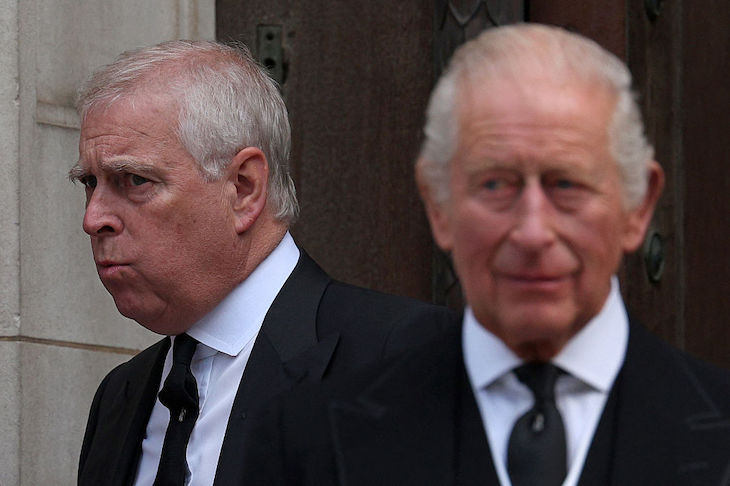
There was considerable interest from local and even international media concerning the arrest of Andrew Mountbatten-Windsor on suspicion of misconduct in public office, which was allegedly revealed in his links with Jeffrey Epstein.
Having been stripped of his royal titles in October last year, he had also been asked by King Charles to move out of Royal Lodge at Windsor to be relocated to the King’s Sandringham estate in Norfolk.
The media was particularly focused on the impact of this arrest, and any subsequent prosecution, on the future of the monarchy in Australia and, therefore, in the Commonwealth realms up to the United Kingdom.
Opinion polls are rarely amusing. So I referred the media, all of whom were aware of the ACM’s role in the republic referendum, to the YouGov poll from October 2024, which shows that members of the Royal Family are far more popular than Australian politicians.
The Princess of Wales and Prince William recorded approval ratings of 74 per cent and 73 per cent, respectively, with Princess Anne at 65 per cent and the King at 58 per cent. By contrast, Prime Minister Albanese stood alone at 43 per cent, the highest of the four politicians chosen for the comparison and probably far higher than now.
What I particularly wanted to emphasise was that this poll showed that any impact of Andrew’s activities was already reflected in his personal polling. His level of approval was a low 19 per cent, whereas his negativity polling was the highest in the group at 67 per cent. It seems obvious from this that Australians have already made a judgment about Andrew, and it has not affected their high assessment of the leading members of the Royal Family.
I noted that the official republicans linked to Labor will clearly try to argue that the arrest of Andrew indicates that Australia should become a republic. While I agreed with the media that the official republicans are likely to make use of these allegations to argue for major constitutional change, I do not believe Australians will shift their view that his conduct is not relevant to the institution. Indeed, they may well agree that the arrest indicates that even the King’s brother is not above the law.
I told the media that the republicans could be expected to make as much as they could out of this; it is consistent with their long-term hope that some ‘silver bullet’ will eventually drop a politicians’ republic in their laps. In recent years, that silver bullet was supposed to be the Queen leaving this world. In fact, her passing away coincided with a gradual lift in support for the monarchy, which, according to Roy Morgan polling, reached as high as 60:40.
I made the obvious point that a constitutional change of this magnitude requires time and reflection. The founders of the Australian Commonwealth wisely ensured that constitutional change must have the approval of the people in a referendum. That approval has to be both national and federal; that is, in a majority of states. If a referendum is put, the concern will obviously not be about the activities of a former prince: the concern would be whether the change would improve the governance of Australia.
Any proposal for change must be set out in detail in the bill authorising the referendum. This must normally be passed by both Houses. Under current law, where there is a division in Parliament over the referendum, the cases for both sides must be put to the people to ensure a proper debate. In relation to a republican referendum, a division is assured by the presence of two parties proudly supporting the founders’ concept of Australia being a Federal Commonwealth under the Crown and under the Constitution: the Nationals and One Nation.
And as Richard E. McGarvie – a real republican and former Supreme Court Judge and Governor of Victoria, whose republican model featured at the 1998 Constitutional Convention – used to observe: ‘Australians are a wise constitutional people.’ Despite the fact that in the 1999 referendum, most politicians and almost all of the mainstream media supported the ‘Yes’ case, and unlike the republicans, ACM was not well funded, the ‘No’ case still prevailed nationally (55:45 per cent) and in all states. As the ‘No’ vote was spread across the Commonwealth, it should be noted that it also prevailed in a high 72 per cent of electorates.
Despite threatening a second referendum for the last quarter-century, no Labor government has ever introduced a bill for this. The reason is simple: they obviously believe a second referendum would be lost, probably by a greater margin than the first. Research into repeat referendums suggests that whenever a rejected subject has been put to the people again, even as many as five times, Australians have not so far approved it.
I believe there is an appreciation of, and support for, the Crown as an institution that has been with us since the settlement in 1788 by what has proved to be the best colonial power in the world. I told the media that I believe this support extends to immigrants. This was obvious in the 1999 campaign, as I believe it is now.
This was demonstrated when the King was last in Sydney. The viewing area was confined to a small section in front of the Opera House. People queued to get into that area in an orderly fashion from the Opera House, all the way around Circular Quay, to the overseas passenger terminal and beyond. Those crowds consisted mainly of non-Anglo, often Asian families, waiting patiently to see their King.
I therefore affirmed my strong view that while opinion polls fluctuate, I do not expect to see any significant change in the current distaste for a politicians’ republic, especially when all models put by the official Australian Republican Movement have been designed to give even greater power to the political class. This is to be done by removing a significant check and balance in the vesting of the Crown’s reserve powers in the Governor-General and the Governors.
There can be no doubt that another referendum for a politicians’ republic would be clearly defeated, as it was in 1999, by a well-run ‘No’ case. It is not the ‘silver bullet’ that will land a politicians’ republic into the powerbrokers’ laps. Indeed, Australians can look forward to a century of remarkable stability; in the remainder of the 21st century, the nation is likely to live under the successive reigns of three Kings: Charles III, William V, and George VII. This is a heritage of continuity that no model of a politicians’ republic can ever hope to provide.